
CI/CD pipelines are supposed to make software delivery faster — but for most teams, they become a second job. That’s exactly where AI for CI/CD pipelines comes in. Failed builds at 2 AM, flaky tests nobody has time to fix, rollbacks that take longer than the deployment itself. Sound familiar?
Quick definition: what a CI/CD pipeline is
Continuous Integration (CI) automatically builds and tests every change. Continuous Delivery or Deployment (CD) takes a passing build and gets it ready — or live — without a manual copy-paste ritual. If you already know that, skip ahead to the AI tools comparison below. If you are choosing AI to sit on top of GitHub Actions, GitLab, or Harness, the rest of this page is the decision guide.
The good news is that AI for CI/CD pipelines has actually gotten useful. Not “useful” in a marketing-brochure sense — useful in a “this thing caught a production issue before I noticed” sense. In 2026–2027, a handful of tools have matured enough to genuinely change how pipelines are managed, not just assist with them.
So which one is actually best? Honest answer: it depends on your stack. But this post breaks down the real contenders, what they’re each good at, and how to pick one that fits your setup.
What Does AI in CI/CD Actually Mean?
Before comparing tools, worth being clear on what we’re even talking about. “AI in CI/CD” gets used to mean wildly different things depending on who’s pitching it.
At the basic end, it’s stuff like autocomplete for YAML pipeline files, or a chatbot that explains what a build error means. Helpful, sure. But that’s more AI-assisted editing than AI pipeline management.
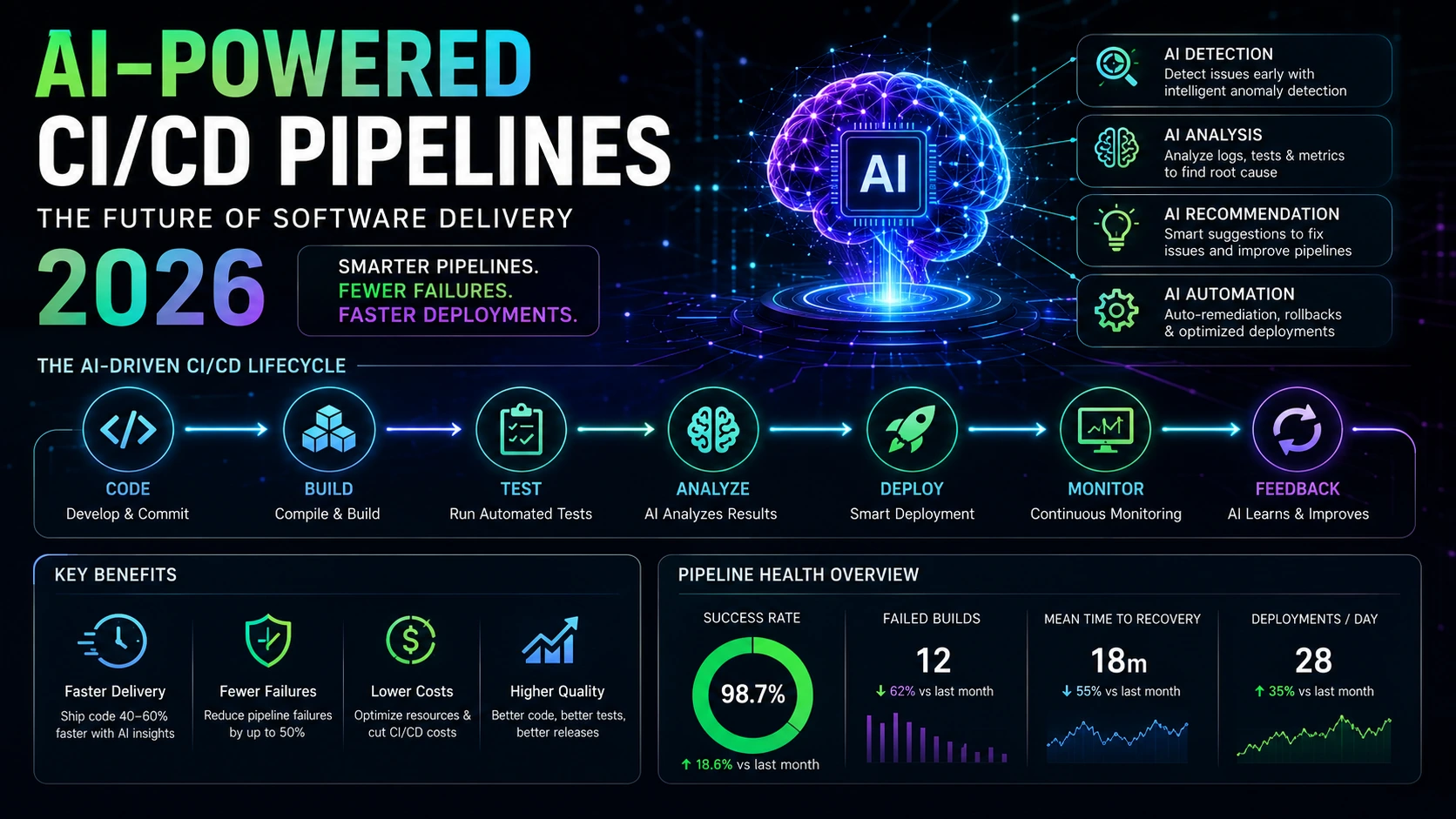
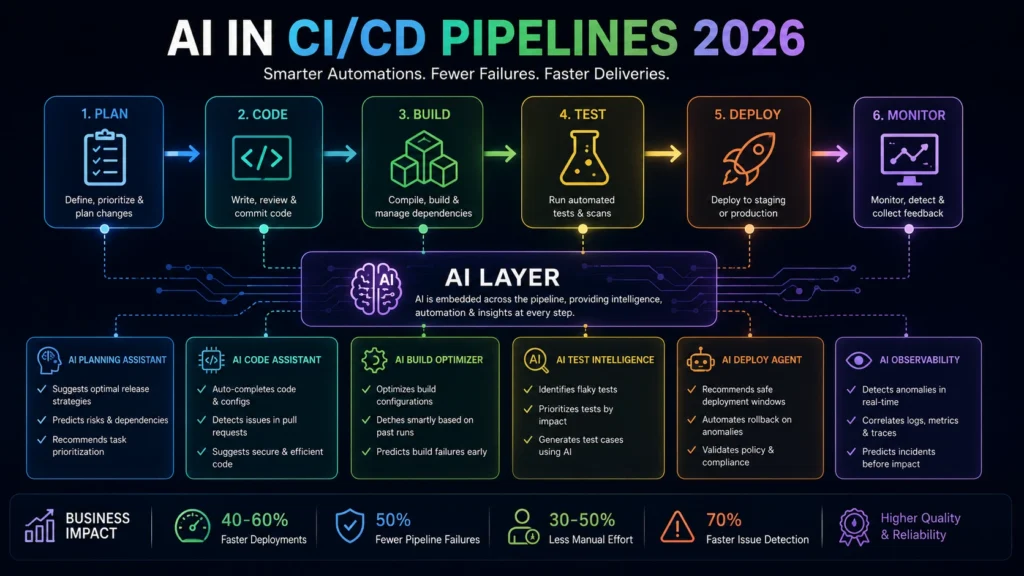
The more interesting stuff is when AI is actually integrated into the pipeline execution layer. Think: detecting that a test has been flaky for three sprints and automatically quarantining it, or predicting that a deployment is likely to fail based on historical patterns and prompting a rollback before it happens. That’s the category worth paying attention to.
In 2026–2027, the line between “AI assistant” and “AI agent in the pipeline” has gotten much blurrier. Some tools are now making autonomous decisions, not just suggestions.
Why This Matters More in 2026 Than It Did Two Years Ago
Two things shifted. First, pipelines got more complex. Microservices, multi-cloud deployments, and parallel test suites have made CI/CD chains long enough that a human watching a dashboard can realistically miss things. The cognitive load is genuinely high.
Second, the AI tooling caught up. Early attempts at “AI-powered DevOps” were mostly dashboards with ML models slapped on. What’s available now has better context awareness, tighter integration with the actual pipeline events, and in some cases the ability to take corrective action without a human in the loop.
Teams that figure this out in 2026 are going to ship faster and break less. The annoying part is that the tool landscape is fragmented, and not every AI feature actually works as advertised.
The Real Contenders: AI Tools for CI/CD in 2026–2027
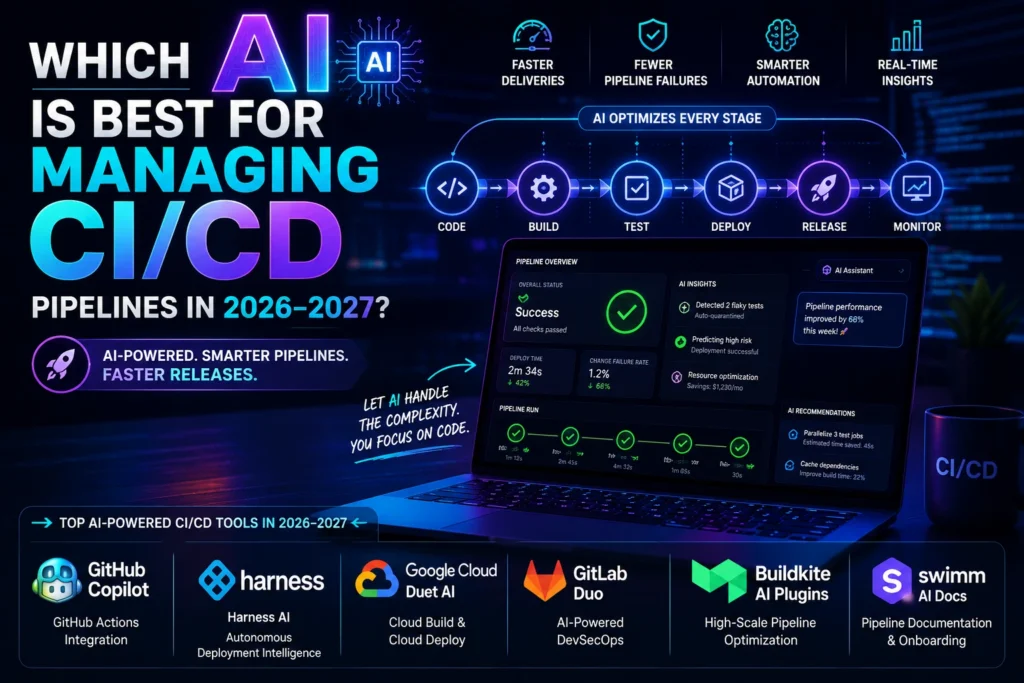
1. GitHub Copilot for CI/CD (GitHub Actions Integration)
If your team already lives on GitHub, Copilot’s pipeline integration is probably the lowest-friction starting point. It can generate GitHub Actions workflows from plain-language descriptions, suggest fixes when a job fails, and explain what a cryptic error actually means.
What’s gotten better in 2026 is the context window. Copilot now pulls in your repo history and recent pipeline runs when making suggestions, so it’s not just giving generic YAML fixes — it’s responding to what your specific pipeline does. Still not perfect, but noticeably more accurate than a year ago.
Best for: Teams already using GitHub Actions who want AI assistance without changing their stack.
2. Harness AI (Autonomous Deployment Intelligence)
Harness has leaned hard into the “AI does the work” direction. Their ML-driven failure analysis and rollback prediction have been around for a while, but the 2026 version is more aggressive about autonomous action. It can automatically roll back a deployment if it detects anomalies in post-deploy metrics, without waiting for a human to confirm.
That’s powerful and slightly terrifying, which is why the configurability of the guardrails matters a lot. For enterprise teams that have bought into Harness fully, the AI layer is genuinely impressive. For smaller teams, the setup overhead might not be worth it.
Best for: Mid-to-large teams with complex deployment pipelines where rollback speed is critical.
3. Google Cloud Duet AI (Cloud Build + Cloud Deploy)
Google’s answer is tightly scoped to GCP infrastructure. If you’re on Cloud Build, Duet AI can generate pipelines from a description, explain cost anomalies in your deployment, and flag security issues in your config. The prompt-to-pipeline feature is genuinely useful for teams that are setting up new services often.
The limitation is that it doesn’t travel well outside Google’s ecosystem. If you’re multi-cloud or heavily on AWS, Duet AI isn’t the right call. Within GCP though, it’s well-integrated.
Best for: Teams running primarily on Google Cloud who want AI that understands their infrastructure.
4. GitLab Duo
GitLab’s advantage has always been the all-in-one platform, and Duo extends that. The AI covers the entire DevSecOps lifecycle — not just pipeline execution but security scanning, code review, and vulnerability triaging. If you want AI for CI/CD pipelines without stitching together multiple tools, GitLab Duo is the most complete single-platform solution.
The 2026 version added better anomaly detection in pipeline performance and more accurate suggestions for test optimization. Worth noting: the quality of Duo’s suggestions has improved substantially in the last year as they’ve trained on GitLab’s own massive pipeline dataset.
Best for: Teams who want end-to-end DevSecOps with AI, without vendor sprawl.
5. Buildkite with AI Plugins
Buildkite doesn’t have a single “AI product” the way others do, but it has a plugin ecosystem that’s been picking up serious AI integrations. Flaky test detection, intelligent parallelization, and AI-generated test scripts are all available through the plugin architecture.
This is the best option for teams that run very high-scale pipelines and need performance intelligence, not just failure detection. Say you’re running thousands of builds a day — Buildkite’s AI layer is built for that volume in a way that GitHub Actions or GitLab aren’t.
Best for: High-scale engineering teams where pipeline performance optimization matters as much as failure recovery.
Quick Comparison: AI for CI/CD Tools in 2026–2027
| Tool | Best For | AI Feature Highlight | 2026–2027 Strength |
| GitHub Copilot for CI/CD | Teams on GitHub Actions | Inline pipeline fix suggestions, workflow generation | Deep GitHub ecosystem integration |
| Harness AI | Enterprise pipelines | Failure analysis, rollback prediction, anomaly alerts | Autonomous deployment decisions |
| Google Cloud Duet AI | GCP/Cloud Build users | Pipeline generation from prompts, cost insights | Multi-cloud and BigQuery integration |
| GitLab Duo | GitLab-native teams | Auto DevSecOps suggestions, vulnerability triaging | End-to-end platform with built-in AI |
| Buildkite Pipelines + AI | High-scale orgs | Flaky test detection, AI-written test scripts | Performance and reliability at scale |
| Swimm + LLM integrations | Documentation-heavy pipelines | Automated pipeline docs, onboarding flows | Knowledge base generation from CI context |
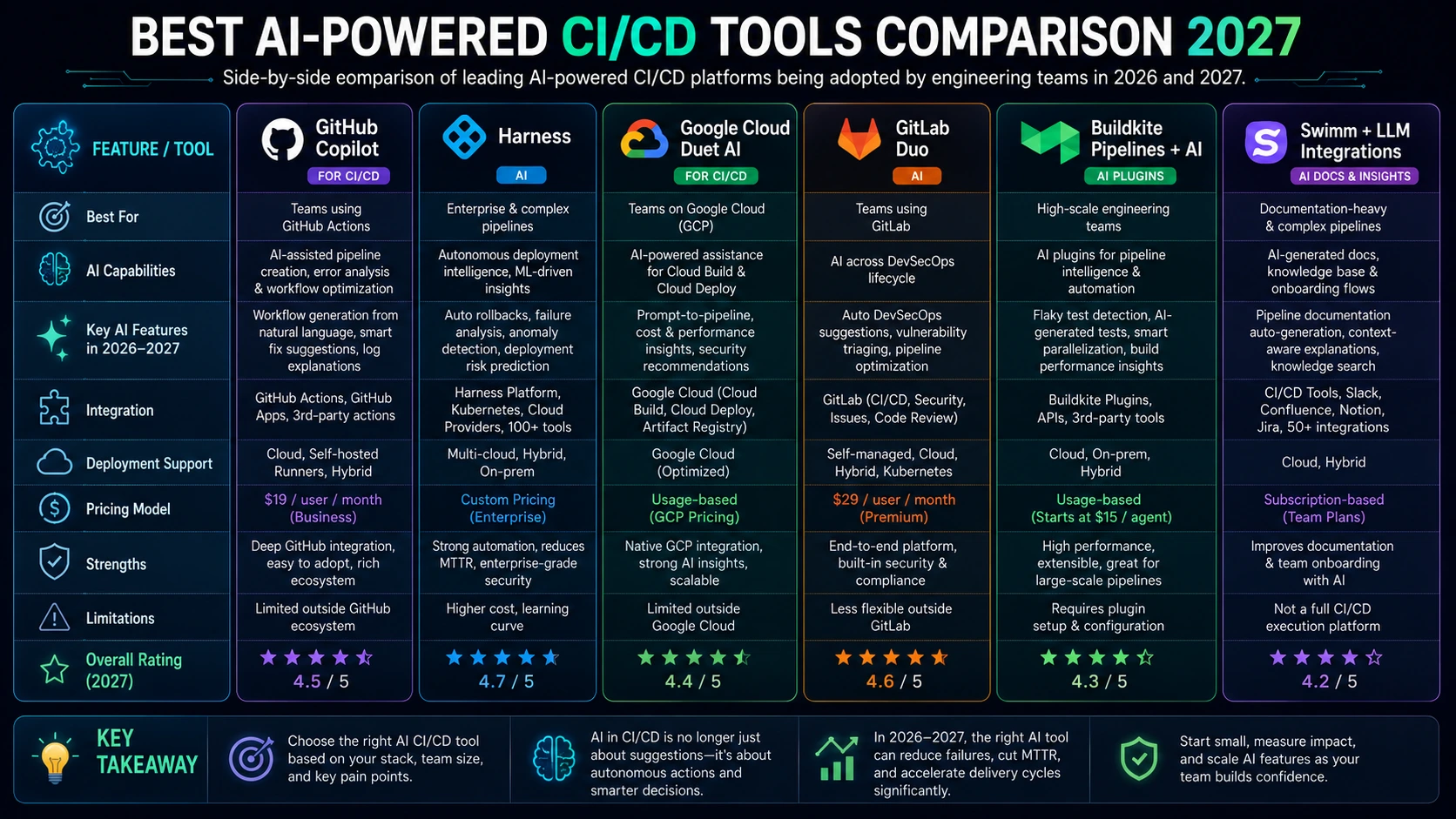
How to Actually Choose One
The comparison table is useful, but the real decision usually comes down to three questions.
First: where does your code live? If you’re on GitHub, start with Copilot. GitLab team? Duo is the obvious starting point. Jumping ecosystems to get better AI features usually isn’t worth the disruption unless you have a compelling reason.
Second: what problem hurts most? Flaky tests killing your team’s confidence? Buildkite or GitLab Duo. Rollback speed in production deployments? Harness. Pipeline setup for new services? Duet AI on GCP. The best tool is the one that fixes your actual bottleneck.
Third: how much autonomy do you want the AI to have? There’s a real spectrum here, from “suggest a fix” to “automatically roll back without asking.” Harness is at one end of that spectrum. Copilot is at the other. Most teams should start with more human-in-the-loop and loosen the guardrails as trust builds.
Common Mistakes When Adopting AI for CI/CD Pipelines
- Treating AI suggestions as ground truth. These models get things wrong. Review what they suggest, especially for rollback triggers.
- Enabling too many features at once. Pick one high-value use case — flaky test detection, failure analysis, pipeline generation — and get value from that before expanding.
- Ignoring the cost. AI-powered features often have pricing attached to them beyond the base platform tier. Know what you’re signing up for before you enable everything.
- Not measuring impact. If you can’t tell whether the AI actually reduced mean time to recovery or build failure rate, you have no idea if it’s working. Track the baseline metrics first.
- Assuming the AI understands your context. These tools are good but not magic. Unusual pipeline setups, custom scripts, and org-specific conventions often need explicit configuration before the AI is useful.
FAQ
Is there a single best AI for CI/CD pipelines in 2026?
Not universally. GitHub Copilot is the most accessible starting point for most teams. Harness wins for enterprise-grade autonomous deployment. GitLab Duo is best for all-in-one DevSecOps. It depends on your stack and the problem you need solved.
Can AI manage CI/CD pipelines without human oversight?
Some tools — Harness especially — are capable of taking autonomous actions like rollbacks. Whether you should let them depends on your team’s risk tolerance and how well-tuned the AI is to your specific deployment patterns. Start with oversight on, expand autonomy carefully.
How much do these AI CI/CD tools cost in 2026?
It varies a lot. GitHub Copilot Business starts around $19/user/month and covers most of the CI/CD features. Harness and GitLab Duo have tiered pricing that scales with usage. Google Cloud Duet AI is usage-based and tied to your GCP billing. Always check the current pricing page — this space moves fast.
Do I need to rewrite my pipelines to use AI features?
Usually not. Most tools are designed to layer on top of existing pipeline configurations. Harness is the biggest exception since it works best when you’re using its full deployment orchestration layer. The others mostly work with whatever CI/CD config you already have.
Will AI for CI/CD pipelines keep improving into 2027?
Almost certainly. The direction is toward more agentic behavior — AI that doesn’t just suggest fixes but actively monitors, adjusts, and optimizes pipelines in real time. By 2027, the gap between “AI-assisted” and “AI-managed” pipelines will probably be even smaller than it is now.
Final Thought
The honest reality is that no AI tool will fix a poorly architected pipeline. If your builds fail because of bad design decisions or untestable code, no amount of ML-powered failure analysis is going to change that.
But if your pipelines are fundamentally sound and you’re losing time to things like flaky tests, slow rollback decisions, and repetitive YAML wrangling, AI for CI/CD pipelines is worth taking seriously in 2026. The tools have gotten good enough to actually help. Pick the one that matches your stack, solve one real problem first, and go from there.