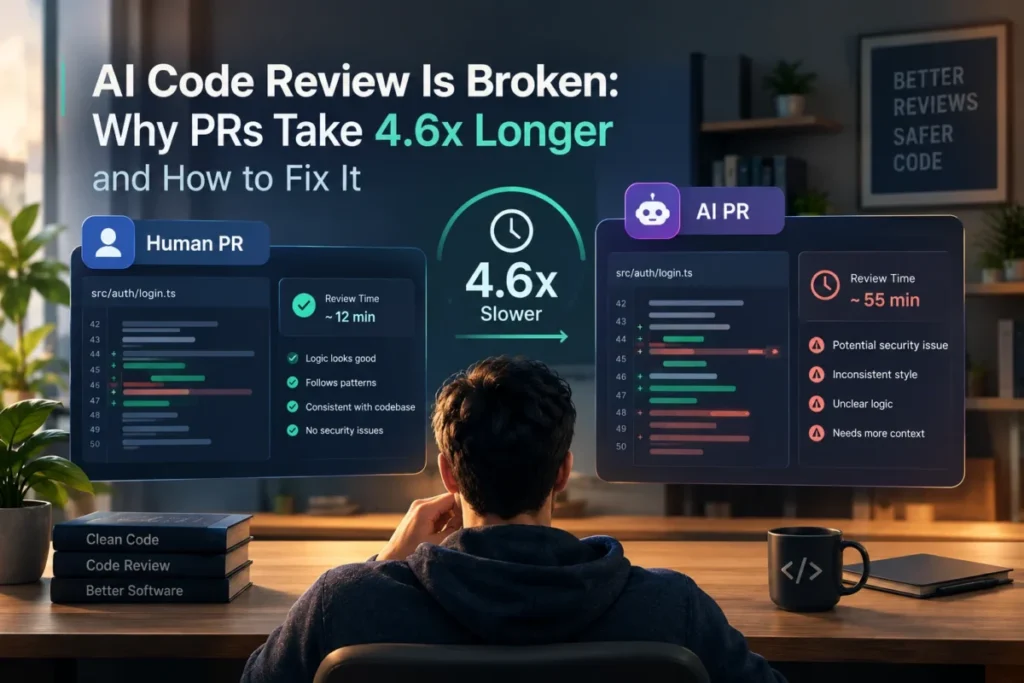

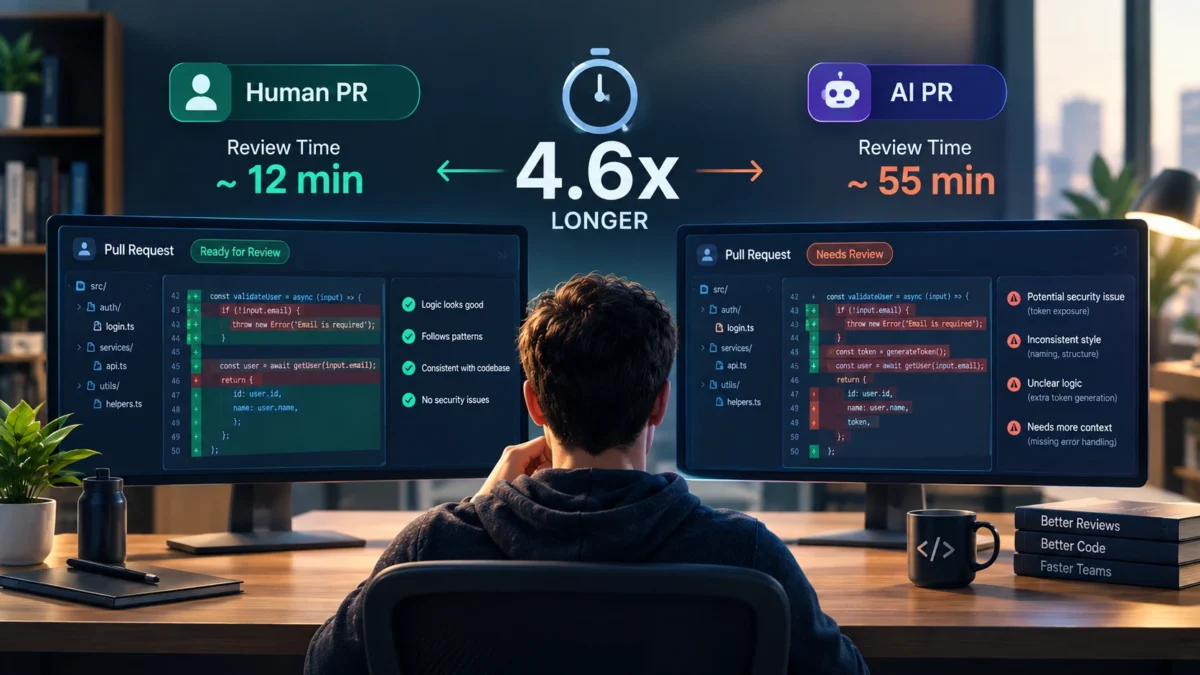
AI code review has become one of the biggest hidden costs of AI-assisted development in 2026. A benchmark study by software delivery firm Opsera found that AI-generated pull requests take 4.6 times longer to review than human-written code — and contain 15 to 18 percent more security vulnerabilities. The time saved writing the code quietly reappears in the review queue. Developers ship faster. Reviewers get slower.
This post explains exactly why AI code review breaks down, which types of AI-generated code create the most review overhead, and the specific process changes that bring review time back under control.
Why Pull Request Reviews Take So Much Longer
The core problem is not that AI code is bad. It is that AI code is unfamiliar in a specific way. Human-written code carries the author’s fingerprints — their naming patterns, their error handling style, their understanding of the codebase’s conventions. Reviewers recognize these patterns and can quickly identify what changed and why. AI-generated code optimizes for correctness against the prompt, not for consistency with the rest of the system.
A reviewer looking at a human PR can usually answer ‘does this match how we do things?’ in seconds. A reviewer looking at an AI PR has to answer that same question by reading the code more carefully — because the AI had no way of knowing ‘how you do things’ unless someone told it explicitly. That extra reading is where the 4.6x overhead lives.
GitClear’s analysis of 211 million changed lines of code found code churn nearly doubled between 2020 and 2024 while refactoring dropped from 25 percent to under 10 percent. AI tools generate new code faster than teams can maintain consistency. Each new AI PR adds slightly more divergence from established patterns, which makes the next AI PR slightly harder to review. The overhead compounds over time.
The AI Code Review Security Gap Nobody Talks About
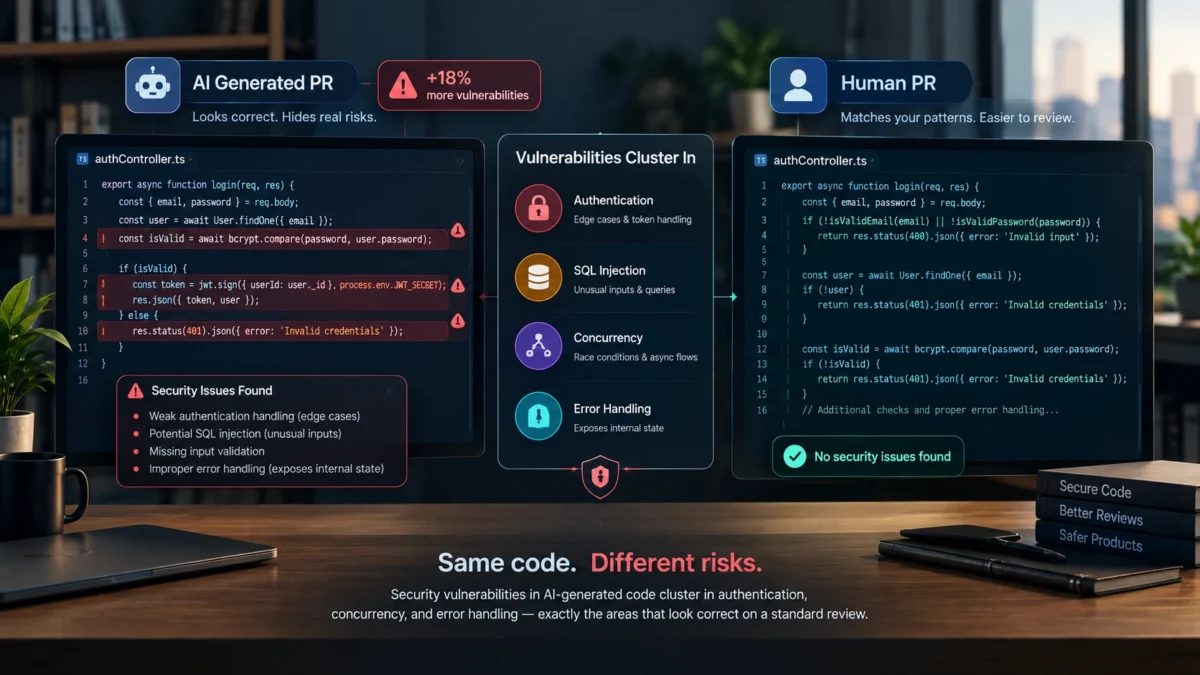
The 15 to 18 percent higher vulnerability rate in AI-generated PRs is not random. The vulnerabilities cluster in specific categories: authentication edge cases, SQL injection in unusual inputs, race conditions in concurrent code, and improper error handling that exposes internal state. These are exactly the categories where AI generates code that looks correct and handles the standard case, while missing the specific failure mode that only surfaces under unusual conditions.
Veracode’s 2025 research tested more than 100 large language models across 80 coding tasks and found that AI-generated code introduced security vulnerabilities in 45 percent of cases. Failure rates exceeded 70 percent for Java specifically. The vulnerabilities passed functional testing because they were not functional failures — they were logic failures that only triggered on inputs the test suite did not cover.
This is the same pattern covered in the guide on AI generated code that is almost right on this site — where the bug is not in the happy path, it is in the edge case the AI did not know to consider. For security-critical code, that distinction matters enormously. A bug that only triggers on an unusual input is exactly the kind that an attacker will find while a reviewer will miss.
Why Your Existing Review Process Is Not Enough
Traditional code review was designed for human-authored code. The mental model is: the author understood the context, made a decision, and you are checking whether the decision was right. You can ask the author why they chose one approach over another. You can read the PR description and understand the intent. You can flag something as ‘this doesn’t match how we usually do X’ and have a conversation about it.
None of that applies cleanly to AI code review. The author did not make most of the decisions — the model did. The PR description may have been AI-generated too. There is no one to ask why the model chose one error-handling approach over the established pattern, because the model made a statistical choice, not an architectural one. Reviewers trying to apply the standard human-code review process to AI PRs are asking questions that have no good answers.
The result is that reviewers either spend significantly more time trying to understand AI code before they can evaluate it, or they give it a faster-than-appropriate review because the code looks clean and the tests pass. Both paths lead to problems — the first through overhead, the second through missed issues that surface later in production.
AI Code Review Risk by Code Area
Not all AI-generated code creates the same review burden. Here is where to spend your review time and what to look for:
| Code Area | AI PR Risk | What Reviewers Must Check |
| Business logic | 🔴 High — context missing | Does this match the actual requirement, not just the prompt? |
| Auth / security | 🔴 Critical — 45% have flaws | Edge cases, role checks, token expiry — manually test all paths |
| Async / concurrent | 🔴 High — race conditions | Concurrent load test before merge — never trust sequential tests |
| Error handling | 🟡 Medium — too generic | Does it match our existing pattern or invent a new one? |
| Tests | 🔴 High — tests match code | Write edge cases before reading AI output — not after |
| Boilerplate / CRUD | 🟢 Low — mostly safe | Quick scan for hardcoded values — delegate review confidently |
How to Fix Your AI Code Review Process
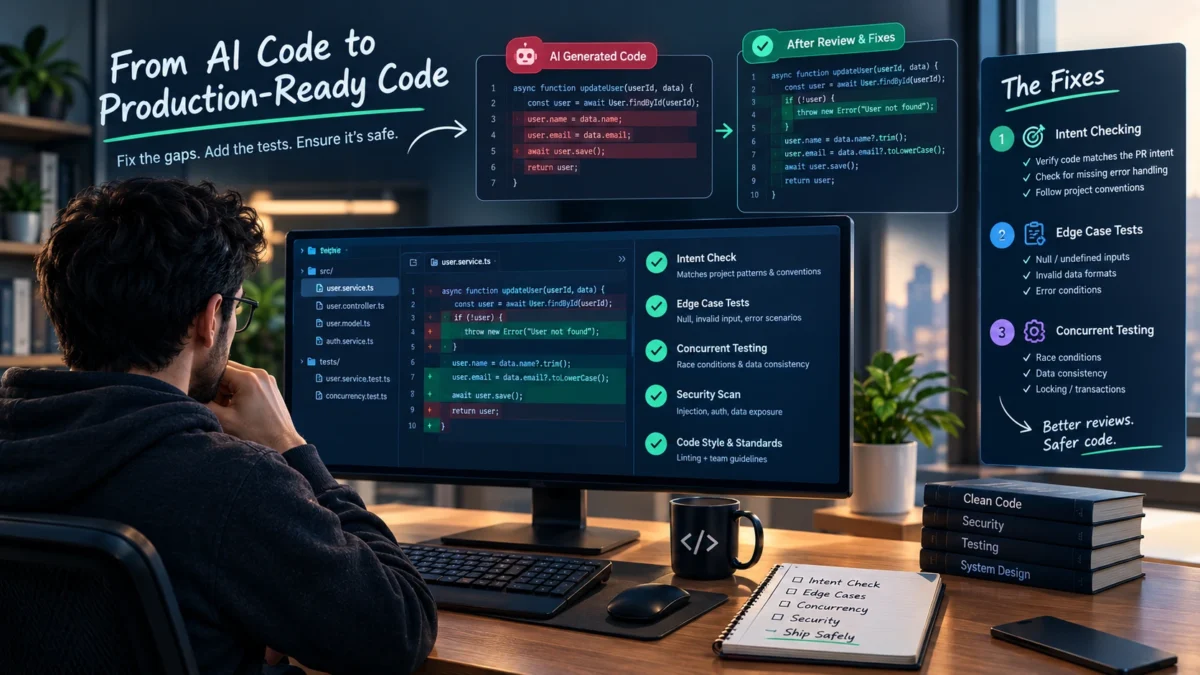
1. Add an Intent Check Before the Syntax Check
Start every AI code review with one question: does this code do what the ticket actually requires, or does it do what the prompt said? Those are different things. A developer prompted for ‘a discount function’ may have gotten a function that correctly applies discounts — but does not handle stacking, does not handle loyalty points, and does not cap at zero for negative results. All of those gaps are in the requirement, not the syntax. Reading the code carefully does not catch them if you are reading for correctness instead of completeness.
The intent check takes two minutes and catches the most common AI code review failures before they reach production. Treat the ticket as the specification and the AI code as an implementation to verify against it, rather than reading the code and working backwards to infer what it was supposed to do.
2. Run Edge Case Tests Before Reading the AI Output
Write the edge case tests yourself before you look at the AI-generated implementation. Null input, empty collections, concurrent requests, boundary values, failure paths. Then run the AI code against those tests. This approach — covered in detail in the AI prompt mistakes guide on this site — prevents the most common AI review failure: tests that match the implementation rather than the requirement.
When AI writes both the code and the tests, the tests are internally consistent with the implementation. They will pass even when the implementation is wrong, because the AI wrote them to match what it built rather than what was required. Your edge case tests, written before seeing the implementation, catch the gaps the AI’s own tests were designed to ignore.
3. Require Architecture Consistency Review for Every AI PR
Add one explicit question to your PR review checklist: does this match our existing patterns, or has it introduced a new approach? This is the question traditional review rarely asks because human authors generally follow established patterns automatically. AI does not — it generates architecturally valid code that may be inconsistent with your specific system.
Teams that have dramatically reduced their AI code review overhead typically report the same fix: a project rules file (CLAUDE.md, .cursorrules, or equivalent) that describes the team’s conventions, and an explicit architecture review step that checks whether the AI output respected those conventions. The rules file reduces drift at generation time. The review step catches what gets through. Both layers are necessary.
4. Never Trust Sequential Tests for Concurrent Code
AI-generated async code almost always passes sequential tests. Race conditions, shared state problems, and timing dependencies only surface under concurrent load. If any AI-generated PR touches async logic, database transactions, caching, or shared state, add a concurrent load test before it merges — not as an optional check, but as a gate. This single process change prevents the category of AI-generated bugs that most reliably slip through standard review: the code that works perfectly in testing and fails in production under real traffic.
Common Mistakes Teams Keep Making
Reviewing AI code the same way as human code. Human code review checks whether a decision was right. AI code review must also check whether the AI understood the requirement correctly. Those are different questions requiring different review habits.
Approving because the tests pass. AI-generated tests match AI-generated code. A test suite that passes proves internal consistency, not correctness. The edge cases that matter are the ones neither the AI nor its tests considered.
Skipping security review on ‘simple’ AI PRs. The Opsera data shows vulnerabilities are distributed across PRs, not concentrated in obviously complex ones. A simple CRUD endpoint with an unusual input path can carry a SQL injection vulnerability that looks like clean code. The AI technical debt guide on this site documents exactly how this compounds over time.
No rules file in the repository. If your AI coding tool has no project rules file telling it your conventions, every PR it generates is a coin flip on architectural consistency. The review overhead of cleaning up architectural drift is avoidable — but only if you invested in the rules file before the drift started.
Frequently Asked Questions About AI Code Review
Why does AI-generated code take longer to review?
Because it is optimized for correctness against the prompt, not for consistency with your codebase. Reviewers spend extra time verifying that the AI understood the requirement correctly, that it followed your team’s established patterns, and that it handled edge cases that were not in the prompt. Human-authored code carries context that reviewers can lean on. AI code carries none.
Is AI code review more or less secure than human code review?
Less, by a measurable margin. Opsera’s 2026 benchmark found 15 to 18 percent more security vulnerabilities in AI-generated PRs. Veracode’s testing found vulnerabilities in 45 percent of AI-generated code samples. The vulnerabilities are not random — they cluster in authentication, concurrency, and error handling, exactly the areas where AI generates plausible-looking code that fails on edge cases.
Should senior engineers review all AI-generated code?
For security-critical components, authentication, payment logic, and anything touching concurrent state — yes. For boilerplate, CRUD operations, and standard utilities, a well-calibrated junior reviewer with a good checklist can handle it. The issue is not seniority for its own sake; it is whether the reviewer has enough context to catch architectural drift and edge case gaps. Senior engineers have that context by default. Junior engineers can develop it with the right checklist and explicit mentorship on what ‘fits this codebase’ means.
How do we speed up AI code review without missing issues?
Three changes with the most impact: add a project rules file to constrain AI output to your conventions before generation, write edge case tests before reviewing the AI output, and add concurrent load testing as a merge gate for any async code. These reduce the review burden on the front end by improving what comes in, and catch on the back end what still gets through.
The Bottom Line on AI Code Review
The 4.6x review overhead is not a fixed cost of AI-assisted development. It is the cost of applying a human-code review process to AI-generated code without adjusting for how AI code fails differently. The failures are predictable — wrong edge cases, architectural drift, security gaps in unusual inputs — and the review process that catches them is buildable.
Intent check first. Edge cases before reading the implementation. Architecture consistency as an explicit step. Concurrent load testing for async code. These four changes do not slow development down. They redirect the review time that was already being spent — just more effectively, and on the issues that actually matter.
AI code ships fast. Fast and unreviewed breaks production. Fast with the right review process ships reliably.