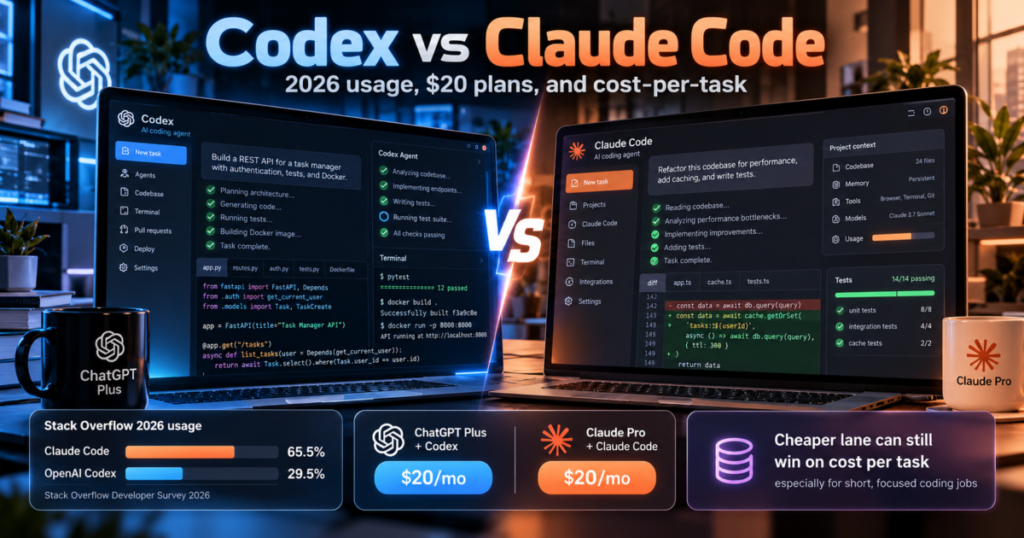

Codex vs Claude Code is the agent choice sitting under a lot of “Claude vs Cursor” tabs in 2026. Cursor is still an editor decision. This one is different: both products want to take a task, touch the repo, run commands, and come back with a diff. Stack Overflow’s 2026 coding-agent question put Claude Code first and OpenAI Codex third among 12,255 respondents. The pay question is not “which logo is winning Twitter.” It is whether you already buy Claude, already buy ChatGPT, and whether you care more about ceiling quality or cost per finished task.
Codex vs Claude Code: the short answer
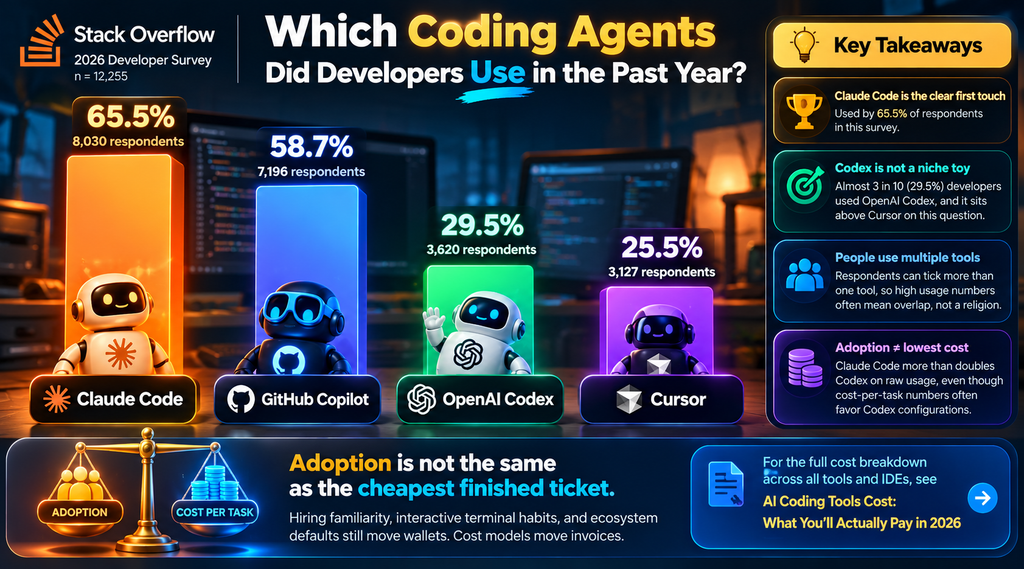
Pay for Claude Code if the hard part of your week is a long, interactive refactor in a repo you already live in, you want the deepest hooks / skills / MCP-style customization, and you are fine sharing one usage pool between chat and the terminal. Claude Code ships on Claude’s paid plans. Pro is $20 a month, or $17 a month when you pay $200 up front for the year. Max starts at $100 a month for 5× Pro’s per-session usage, or $200 for 20×.
Pay for OpenAI Codex if you want an agent that is cheap to try, already sits inside a ChatGPT plan, is strong on Windows-friendly / sandboxed / parallel cloud-shaped work, or you care about measured cost and speed per task more than the top composite benchmark score. Codex is included across ChatGPT Free, Go, Plus, Pro, Business, and Enterprise, with limits that scale by plan. ChatGPT Plus is $20 a month for expanded Codex. Heavier Pro tiers sit at $100 / $200 / $500 a month (OpenAI’s Pro-tier help docs). OpenAI’s Codex pricing FAQ also notes limited GPT-6 Astra on Plus / $20 Business, with fuller Astra inclusion on the $100 / $200 Pro lanes and $100 Business, plus credits when you burn through the included pool.
Do not buy Max and Pro 20× / Pro 500 “to be safe.” Start on the $20 lane you already half-own (Claude Pro or ChatGPT Plus), burn a real week of tickets, then upgrade only after the same limit stops you twice.
If your question is really Claude Code vs Cursor vs Copilot, that three-way money decision is already on Bytereviewer: Claude Code vs Cursor vs GitHub Copilot.
What 12,255 developers said they used:
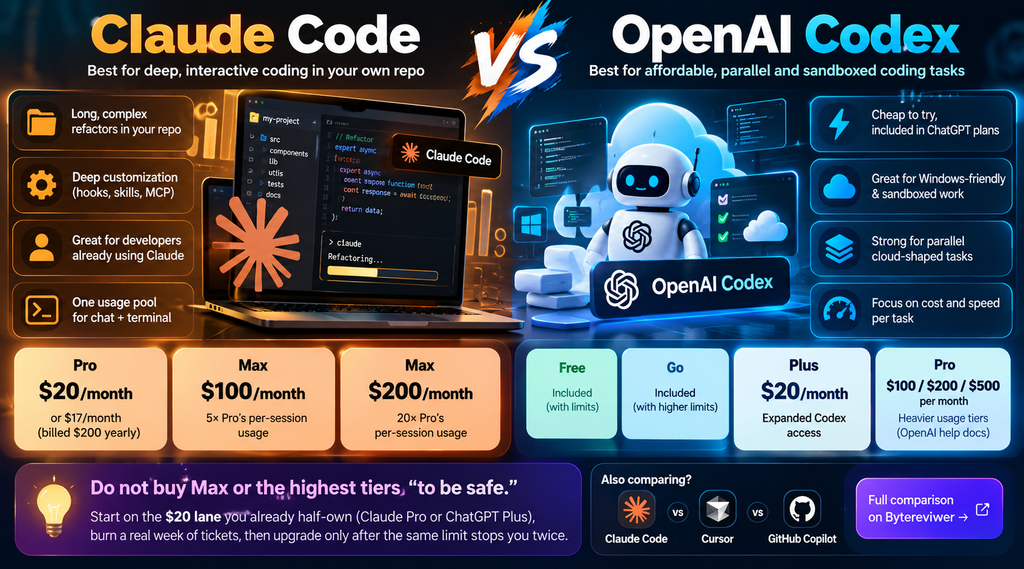
Stack Overflow asked which coding agents or assistants people had used in the past year. Published “used” numbers on the 2026 coding-agent page (n = 12,255):
| Tool | Respondents | Percent |
| Claude Code | 8,030 | 65.5% |
| GitHub Copilot | 7,196 | 58.7% |
| OpenAI Codex | 3,620 | 29.5% |
| Cursor | 3,127 | 25.5% |
Read that table carefully. Claude Code is not “slightly ahead.” It is the clear first touch in this sample. Codex is not a niche toy either almost three in ten respondents used it and it sits above Cursor on this particular question.
People can tick more than one tool. A high Claude Code number and a solid Codex number together usually mean overlap, not a religion. Treat the survey as “have used,” not “this is my only agent.”
Here is the gap most comparison posts miss. Claude Code more than doubles Codex on raw “used” share in this survey, even while independent cost-per-task numbers often favor Codex configurations. Adoption is not the same thing as cheapest finished ticket. Hiring familiarity, interactive terminal habits, and ecosystem defaults still move wallets. Cost models move invoices.
Google’s comparison SERP for Codex vs Claude Code is crowded with benchmark posts. The survey is the second correction: developers are already sampling both ecosystems, and Copilot still sits between them on raw usage. For the wider bill across assistants and IDEs, see AI Coding Tools Cost: What You’ll Actually Pay in 2026.
These are two different shapes of agent:
Claude Code:
is Anthropic’s coding agent. It maps a codebase, edits files, runs terminal tools, and works from the terminal, IDE plugins, desktop, and web. On Anthropic’s pricing FAQ, Claude Code is included on all paid Claude plans and shares the same usage pool as Claude chat on web, desktop, and mobile. Limits reset on a rolling five-hour session window, with weekly limits on paid plans. Anthropic does not publish a fixed message count long Opus/Fable sessions simply burn the pool faster. When you hit a wall, you wait, upgrade, or turn on usage credits at API rates. Practical rate-limit tactics are in Fix the Claude Code Rate Limit.
Claude Code is built for live, local work: full filesystem access in the terminal, a deep hooks system for guardrails, and MCP-style tool wiring. On native Windows, Anthropic’s sandbox story is weaker without WSL2 treat that as a real ops detail, not a footnote.
OpenAI Codex:
is OpenAI’s coding agent surface across CLI, IDE, cloud, and ChatGPT plans. OpenAI’s Codex pricing page states Codex is included in Free, Go, Plus, Pro, Business, and Enterprise, with local messages and cloud chats sharing the plan allowance and possible weekly limits. Credits can extend work past included usage. GPT-6 Astra has limited inclusion on Plus / $20 Business, and fuller inclusion on the $100 / $200 Pro lanes and $100 Business, per OpenAI’s Codex FAQ on that same page. If you are comparing Astra-era coding specifically, the sibling piece is GPT-6 Astra vs Claude Code.
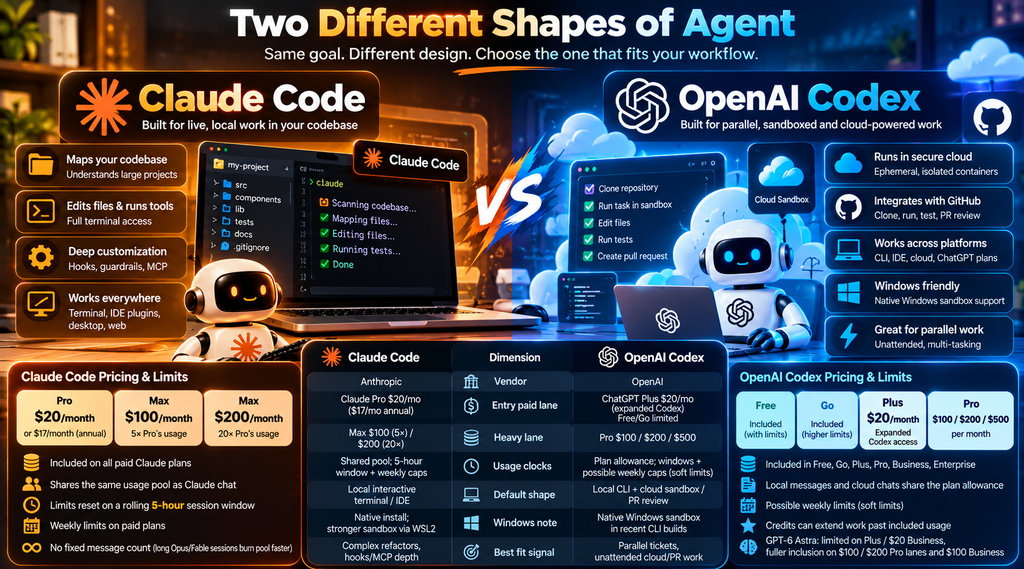
Codex’s cloud mode is the other design bet: tasks can run in an ephemeral, network-isolated container cloned from GitHub instead of living on your laptop. Native Windows sandbox support in recent Codex CLI builds is one reason Windows shops often trial Codex first.If you need the vocabulary straight agent vs autocomplete assistant start with What AI Coding Agents Actually Do.
| Dimension | Claude Code | OpenAI Codex |
| Vendor | Anthropic | OpenAI |
| Entry paid lane | Claude Pro $20/mo ($17/mo annual) | ChatGPT Plus $20/mo (expanded Codex); Free/Go limited |
| Heavy lane | Max $100 (5×) / $200 (20×) | Pro $100 / $200 / $500 |
| Usage clocks | | Shared pool; 5-hour window + weekly caps | Plan allowance; windows + possible weekly caps (soft limits) |
| Default shape | Local interactive terminal / IDE | Local CLI + cloud sandbox / PR review |
| Windows note | Native install; stronger sandbox via WSL2 | Native Windows sandbox in recent CLI builds |
| Best fit signal | Complex refactors, hooks/MCP depth | Parallel tickets, unattended cloud/PR work |
Benchmarks: Claude leads the score, Codex often leads the bill:
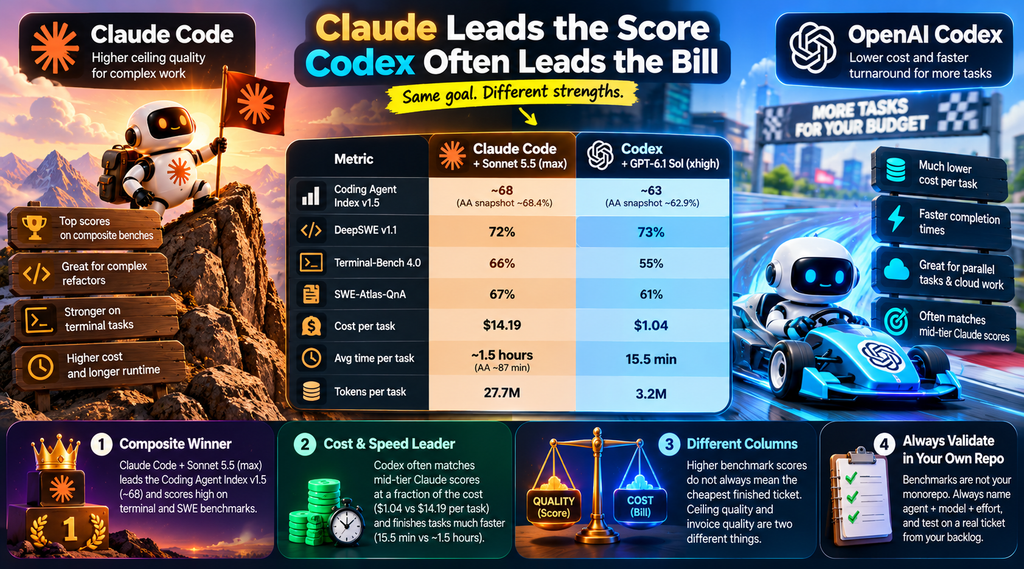
Public benches are not your monorepo. Still, independent numbers explain why the internet argues in two directions at once. Always name agent + model + effort “Claude Code wins” without those three is marketing grammar.TechRepublic’s 1 October 2026 write-up of Artificial Analysis’ Coding Agent Index v1.5 (and AA’s own coding-agent board around mid-October) lines up like this for the common headline pair:
| Metric | Claude Code + Sonnet 5.5 (max) | Codex + GPT-6.1 Sol (xhigh) |
| Coding Agent Index v1.5 | ~68 (AA snapshot ~68.4%) | ~63 (AA snapshot ~62.9%) |
| DeepSWE v1.1 | 72% | 73% |
| Terminal-Bench 4.0 (in that TR composite row) | 66% | 55% |
| SWE-Atlas-QnA | 67% | 61% |
| Cost per task | $14.19 | $1.04 |
| Avg time per task | ~1.5 hours (AA ~87 min) | 15.5 min |
| Tokens per task (TR) | 27.7M | 3.2M |
Equalizing effort changes the story. On AA’s board, Claude Code + Sonnet 5.5 (xhigh) and Codex + GPT-6.1 Sol (xhigh) both land around 62.9%, while Codex stays near $1.04 / ~15.5 min per task versus about $3.33 / ~27 min for that Sonnet xhigh run. Ceiling quality and invoice quality are different columns.
Terminal-Bench 4.0 alone is a rolling submission board, not a frozen trophy. Through early October 2026 the top rows flipped more than once (Codex/GPT-6 Astra and Claude configs traded places; Claude Opus 5.5 + Claude Code entries appeared later). Date-stamp any “who wins Terminal-Bench” sentence, and label Anthropic’s own higher internal Terminal-Bench quotes as vendor-claimed when they are not on the public board.
Two readings matter more than the leaderboard screenshot.
- Ceiling vs cost. Claude’s max configs own the top composite. Codex often matches mid-tier Claude scores at a fraction of measured cost and time.
- Your default model is part of the product. Claude Code’s everyday feel often pushes toward stronger, hungrier models. Codex’s everyday feel often pushes toward models that finish more work per dollar. That is a product decision dressed up as a model war.
If a post only quotes vendor launch benches, treat it as marketing with footnotes. Prefer named third parties, and still validate on one painful ticket from your own backlog.
How to choose without buying both on day one:

Use this order. It is boring on purpose.
1. What bill already exists?
If Claude Pro is already on the card, turn on Claude Code before you add a second AI tax. If ChatGPT Plus or Pro is already on the card, push Codex for a week before you open another subscription tab.
2. What does the work look like?
- Multi-file refactor with lots of steering → Claude Code first.
- Many small, well-scoped tickets, unattended cloud runs, or PR review automation → Codex first.
- Native Windows without wanting WSL drama → trial Codex’s sandbox path first.
- Team already standardized on GitHub review + Microsoft billing → keep Copilot in the mix; do not pretend this article deleted it.
3. What fails first when you are honest?
- Quality / judgment failures → move toward Claude’s stronger configs before you blame “agents” in general.
- Quota / cost / waiting on resets → try the other agent or a cheaper model tier before Max/Pro 20×.
4. When both is rational
Both is rational when one agent builds and the other reviews, when you want a local daily driver and cloud-isolated automation, or when you keep hitting limits on a single $20 plan and your shipping calendar cannot wait for reset windows. Sharing AGENTS.md / import paths between ecosystems helps; it is not magic, and global AGENTS.md loading has had rough edges (especially on Windows Desktop). Two $20 plans that you actually use beat one $200 plan you opened twice.
5. Security is not a footnote
Both vendors have shipped permission and token issues that security writers covered in 2026. Sandbox settings, command approvals, and MCP / plugin scope deserve a real pass before you give either agent cloud credentials. Benchmark bragging rights do not patch a leaked token.
A one-week test that beats another comparison tab:
Pick five tickets from a real repo:
- One bug with a failing test.
- One small feature behind a flag.
- One dependency bump that touches lockfiles.
- One flaky CI log.
- One refactor you have been avoiding.
Run the same five through Claude Code on Claude Pro (or Max if you already pay it) and through Codex on the ChatGPT plan you already own. Score only four things: merged or not, time to first useful diff, how much you rewrote by hand, and whether you hit a usage wall. Ignore Twitter demos. Keep the agent that wins three of five on your code.
That test is the information gain most “ultimate 2026 guides” never ship.
FAQ:
Is Codex or Claude Code better in 2026?
Neither is universally better. Claude Code leads Stack Overflow usage in the 2026 coding-agent sample and leads several independent composite scores. Codex often wins on measured cost and speed per task. Pick from your existing bill and your ticket shape.
Does Claude Code work on the free Claude plan?
Anthropic’s pricing FAQ says Claude Code is included on paid plans, not Free. Free is for trying Claude chat features; coding agent work expects Pro or higher.
Can I use Codex without ChatGPT Plus?
OpenAI lists limited Codex on Free and Go, expanded usage on Plus ($20/mo), and heavier allowance on Pro ($100 / $200 / $500). Limits are the product. Check https://chatgpt.com/codex/pricing/ for the current matrix.
Is ChatGPT Plus enough for Codex, or do I need Pro?
Start on Plus if you already have it. Move to a Pro tier only after the same weekly or session wall stops real work twice. Pro 500 is for people who already proved Pro 200 is tight not a day-one flex.
Can Codex run on Windows without WSL?
Recent Codex CLI builds advertise a native Windows sandbox path. Claude Code’s stronger sandbox story still leans on WSL2 on Windows. Verify your CLI version before you trust either claim in production.
Does Claude Code work with AGENTS.md?
Yes in the interoperability sense: Claude Code can use an existing repo AGENTS.md in place of CLAUDE.md when present. Codex treats AGENTS.md as its native instruction format.
Should I cancel Cursor if I pick an agent?
No by default. Cursor is still an editor-shaped workflow. Agents can pair with an IDE. The three-way pay decision is covered separately on Bytereviewer.
Why do some benches say Claude wins and others say Codex is close enough?
Different harnesses, models, and effort settings and Terminal-Bench rows move by submission date. Equalizing effort on Artificial Analysis often shrinks the quality gap while leaving Codex cheaper and faster.
What should a team standardize on?
Standardize on permissions, review, and CI not on logo loyalty. Pilot both agents on one service, measure merge rate and incident rate for two sprints, then pick a default and an escape hatch.
Conclusion:
Codex vs Claude Code is a budget and workflow problem wearing a benchmark costume. Claude Code is the agent more developers in the Stack Overflow 2026 sample already touched, and it still owns the “hard interactive job” lane. Codex is the agent you reach for when ChatGPT is already paid, when cost per task matters, or when you want sandboxed / parallel / cloud-PR work without lighting money on fire. The interesting 2026 fact is that adoption and cost-efficiency can point opposite ways which is why a five-ticket test on your repo beats another screenshot war. Start on the $20 ecosystem you already inhabit, then climb to $100 / $200 / $500 tiers only after the wall is real.