


GPT-6 Astra vs Claude Code is the question every developer is asking this week and the timing makes it genuinely interesting. GPT-6 Astra launched September 3, 2026 with OpenAI calling it a ‘generational leap’ and hinting at AGI. Sam Altman apologized within hours for a messy rollout that left paying Pro subscribers locked out. Claude Code with Fable 5.1, which launched September 1, was already fully available and processing developer sessions. The comparison is not just about benchmarks. It is about what you can actually use today.
This post uses verified numbers from Artificial Analysis, OpenAI’s published benchmarks, and Anthropic’s system card no vendor marketing, no guesses. Here is what the data actually says and which tool fits which workflow.

The Availability Problem Nobody Is Talking About
Before benchmarks, there is a practical reality. Claude Code with Fable 5.1 is fully available right now on claude.ai, the API, VS Code, JetBrains, and the terminal. You can open it and start a session today.
GPT-6 Astra launched with what OpenAI called ‘Daybreak Access’ enterprise customers on the Daybreak cybersecurity platform got in first. ChatGPT Plus, Pro, Business, and Enterprise subscribers were told to wait ‘in the coming days.’ API access was similarly staged. Altman’s apology post on X confirmed what many Pro subscribers were already experiencing: they paid more and got access later. By September 5, broad access had rolled out — but the rollout itself became the story.
This matters for developers evaluating both tools. Claude Code has a proven rollout track record. GPT-6 Astra’s first week showed that even paying customers cannot assume immediate access when OpenAI launches a major model. If your workflow depends on uninterrupted access, that is a relevant data point not just a launch hiccup.
What the Coding Benchmarks Actually Show
Here is where it gets interesting and where most coverage gets it slightly wrong.
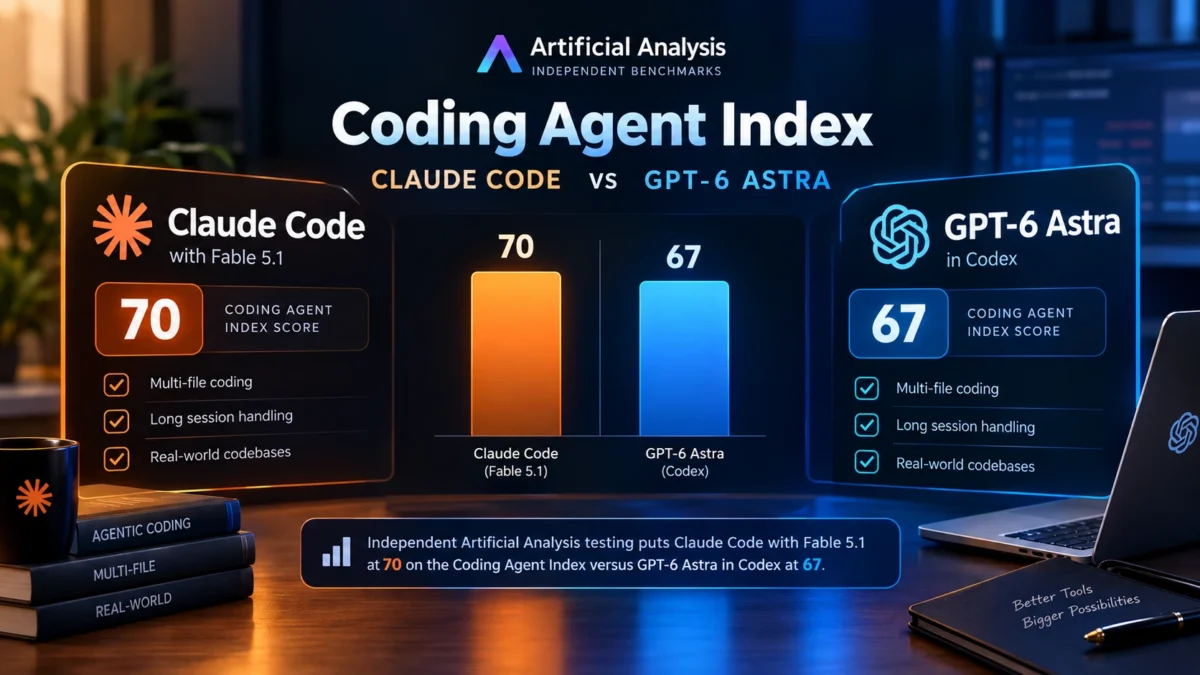
Artificial Analysis, the independent testing lab, gave Claude Fable 5.1 running in Claude Code a score of 70 on its Coding Agent Index. GPT-6 Astra running in Codex scored 67. That three-point gap puts Claude Code ahead on the only fully independent coding agent benchmark published so far. OpenAI’s own published numbers show Astra leading on several individual benchmarks Terminal-Bench 4.0, DeepSWE, and BenchCAD but these are vendor-reported figures, not independent tests.
The honest read: for agentic coding specifically the kind of multi-file, long-session work that Claude Code is built for Fable 5.1 in Claude Code currently leads the independent scoring. Astra leads on math, science, computer use, and cybersecurity tasks. The split is clean once you stop looking for a single winner.
One benchmark worth flagging: SWE-bench Pro, which measures real GitHub issue resolution across complex codebases, shows Claude Fable 5.1 at 81.2%. OpenAI has not published a comparable Astra score on this specific benchmark. That absence matters when choosing a tool for production coding work.
Pricing Reality: The Cache Cost Nobody Mentions
Both models list at $10 per million input tokens and $50 per million output tokens at standard API rates. On that surface, they look identical. They are not.
Fable 5.1 charges $0.25 per million cache read tokens. Astra charges $1.00 per million cache read tokens. That is a four-times difference and it only shows up on high-volume agentic work where the same system prompt or context window gets reused repeatedly. For a developer running Claude Code sessions all day, cache reads can represent 40 to 60 percent of total token spend. At that volume, the pricing gap between the two tools is significant even though the headline rate is identical.
There is also the question of efficiency. Artificial Analysis found Astra uses roughly 10 percent fewer output tokens than GPT-5.6 Sol at max effort but because the price increased 2.5x from Sol, Astra ends up approximately 75 percent more expensive per task than its predecessor at max effort. Claude Code with Sonnet 5 available at $3/$15 per million tokens from September remains the better value for most daily developer work, as covered in the AI coding tools cost breakdown on this site.
GPT-6 Astra vs Claude Code: Full Comparison
| Factor | GPT-6 Astra (in Codex) | Claude Code (Fable 5.1) |
| Availability right now | Phased Pro users still waiting | ✅ Fully available |
| Coding Agent Index (AA) | 67 / 100 | 70 / 100 ✅ Leads |
| Terminal-Bench 4.0 | Leads ✅ | 55.8% |
| SWE-bench Pro | Leads ✅ | 81.2% |
| Computer use (OSWorld 2.0) | 72.6% ✅ | Comparable |
| Input pricing | $10 / M tokens | $10 / M tokens (Fable 5.1) |
| Output pricing | $50 / M tokens | $50 / M tokens (Fable 5.1) |
| Cache read cost | $1.00 / M tokens | $0.25 / M tokens ✅ 4x cheaper |
| Knowledge cutoff | April 30, 2026 | June 2026 ✅ More recent |
| IDE integration | Codex (OpenAI) | VS Code, JetBrains, Terminal ✅ |
| Cybersecurity tasks | ✅ Critical-rated | Restricted by design |
| Best for | Math, science, computer use | Agentic coding, long sessions ✅ |
GPT-6 Astra vs Claude Code: Which One Fits Your Workflow
Use GPT-6 Astra When:
Your work is math-heavy, scientific, or involves complex computer use and browser automation. Astra’s OSWorld 2.0 score of 72.6% leads the field on autonomous computer tasks. Its FrontierMath Tier 4 score of 97.6% and ARC-AGI-3 score of 99.9% are genuinely impressive on those specific benchmarks. If cybersecurity research is your primary workload with appropriate authorization Astra is the first model to reach OpenAI’s Critical cybersecurity threshold, though that capability is gated.
Use Claude Code When:
Your primary work is agentic coding multi-file refactors, long debugging sessions, repository-wide changes, and anything where you want to delegate a complex engineering task and review a diff. Fable 5.1 in Claude Code leads the independent Coding Agent Index. It has a more recent knowledge cutoff (June 2026 vs Astra’s April 30), significantly cheaper cache reads for sustained sessions, and full availability across VS Code, JetBrains, and the terminal right now without a staged rollout.
The practical reality for most developers: Claude Code is where you spend most of your working hours, and it currently leads on the metric that most directly reflects that kind of work. For the narrow band of tasks where Astra’s math and science benchmarks matter most, Astra earns the premium. For everything else, Claude Code is the better daily tool.
If you are already hitting Claude Code rate limits a common frustration for heavy users the rate limit fix guide on this site covers exactly how to manage session length and model routing to get the most out of your plan before considering a switch.

Mistakes Developers Make in This Comparison
Treating vendor benchmarks as independent results. OpenAI’s published Astra benchmark numbers are company-reported. The only fully independent coding agent comparison as of September 2026 is Artificial Analysis and that puts Claude Code ahead. Read both, weight accordingly.
Assuming identical headline pricing means identical cost. The $10/$50 rate looks the same on both. The $0.25 vs $1.00 cache read difference is where the real cost diverges for any developer running sustained agentic sessions.
Switching tools based on launch week hype. Astra’s first week was a rollout story as much as a capability story. Benchmark performance and real-world developer experience often diverge significantly in the first few weeks after a major launch. The Claude Code vs Astra picture will be clearer in October once independent real-world testing accumulates.
Ignoring the almost-right problem in AI-generated code. Whichever tool you choose, the review discipline matters more than the model. The guide on AI generated code almost right covers exactly where AI output from any model is most likely to look correct and fail in production.
Frequently Asked Questions: GPT-6 Astra vs Claude Code
Is GPT-6 Astra better than Claude Code for coding?
On vendor-reported benchmarks, Astra leads on several individual coding tests. On the only fully independent coding agent benchmark available as of September 2026 Artificial Analysis’s Coding Agent Index Claude Fable 5.1 in Claude Code leads 70 to 67. For everyday agentic coding work, Claude Code currently has the stronger independent case. For math-heavy or scientific coding tasks, Astra’s benchmark leads are more convincing.
Can I use GPT-6 Astra in Claude Code?
No. Claude Code is Anthropic’s terminal-based coding agent it runs Claude models (Sonnet 5, Opus 5, Fable 5.1) not OpenAI models. GPT-6 Astra runs in OpenAI’s Codex agent. They are separate products from competing companies. Some developers use both through their respective APIs and route tasks by type.
Why did Sam Altman apologize about GPT-6 Astra?
OpenAI prioritized enterprise Daybreak cybersecurity platform customers for launch-day access, leaving Plus, Pro, Business, and Enterprise subscribers including those paying $200/month for Pro unable to access the model they had been waiting for. Altman posted on X calling it a ‘messy rollout’ and said broader access would follow ‘in the near future.’ By September 5, 2026, access had largely rolled out to paying subscribers.
Which has better pricing GPT-6 Astra or Claude Code?
At standard API rates both charge $10/$50 per million input/output tokens for their respective flagship models. The meaningful difference is cache reads: Fable 5.1 charges $0.25 per million versus Astra’s $1.00 — a four-times difference that compounds significantly for developers running long agentic sessions where system prompts and context get reused repeatedly.
The Bottom Line on GPT-6 Astra vs Claude Code
GPT-6 Astra is a genuinely impressive model the math, science, and computer use benchmark numbers are real. But for developers whose primary work is agentic coding, Claude Code with Fable 5.1 currently leads the only independent coding agent benchmark, has cheaper cache reads, a more recent knowledge cutoff, and was fully available before Astra’s rollout began.
That could change. Astra is days old and independent real-world testing will accumulate over the next month. The benchmark picture may shift. The pricing will not. And the availability advantage Claude Code currently holds available everywhere, immediately, without a staged rollout is worth more to most developers than any marginal benchmark difference.
Use what you can use today. Right now, that is Claude Code. Check back in October when the real-world Astra numbers start arriving.