Introduction
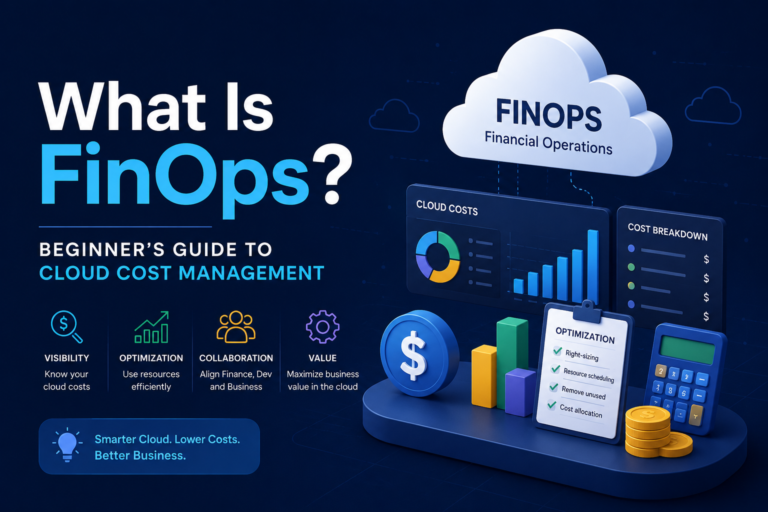
What Is FinOps? Beginner’s Guide to Cloud Cost Management is an essential topic for any organization using cloud services today. As more businesses move to the cloud, understanding FinOps becomes critical for controlling expenses and improving efficiency.
Without proper cost management, cloud spending can grow quickly and reduce profitability. This is exactly why FinOps (Financial Operations) is becoming a key practice in modern cloud environments.
FinOps helps organizations track, manage, and optimize cloud costs by bringing finance, engineering, and business teams together. In addition, FinOps ensures that every dollar spent in the cloud is visible, accountable, and aligned with business goals.
Therefore, this beginner’s guide will explain what FinOps is, how it works, and why FinOps is essential for better cloud cost management and long-term financial efficiency.
What Is FinOps?
FinOps is a set of practices and a cultural shift that helps organizations manage cloud financial operations. In other words, it allows companies to clearly understand where their cloud money goes and how they can use it more efficiently.
Instead of treating cloud costs as a fixed IT expense, FinOps encourages teams to actively monitor usage, analyze spending patterns, and continuously optimize resources in real time.
Moreover, FinOps helps you answer three key questions:
How can we optimize it?
What are we spending in the cloud?
Why are we spending it?
Why FinOps Matters in Cloud Computing
Cloud platforms like AWS, Azure, and Google Cloud use a pay-as-you-go model. While this model offers flexibility, it can also lead to unexpected costs if not managed properly.
Consequently, FinOps helps organizations:
- Avoid unnecessary cloud spending
- Improve cost transparency
- Align cloud usage with business goals
- Make data-driven financial decisions
Without FinOps, businesses often struggle with unpredictable bills and wasted resources. Therefore, implementing it becomes essential for cost control.
How FinOps Works
FinOps works by bringing three major teams together. In fact, its success depends on continuous collaboration between them:
1. Finance Team
The finance team sets budgets, tracks expenses, and ensures spending aligns with company goals.
2. Engineering Team
Meanwhile, engineers build and manage cloud systems while optimizing performance and resource usage.
3. Business Team
On the other hand, the business team focuses on growth and ensures cloud investments support strategic objectives.
Together, these teams collaborate continuously under FinOps to analyze usage data, control costs, and improve efficiency.
Core Principles of FinOps
FinOps follows three main principles. Firstly, it promotes collaboration, secondly it ensures transparency, and finally it focuses on continuous improvement.
1.Team Collaboration
All stakeholders work together instead of operating in isolation.
2.Real-Time Data Access
Additionally, teams use real-time cloud cost data to make faster and more accurate decisions.
3.Continuous Optimization
Finally, organizations constantly improve cloud usage instead of reviewing costs only monthly.
Benefits of FinOps
Implementing FinOps brings several important advantages. For example:
- Better control over cloud spending
- Improved financial transparency
- Reduced wasted resources
- Faster and smarter decision-making
- Stronger alignment between IT and business goals
As a result, organizations gain more value from their cloud investments.
FinOps Best Practices
To get the most out of FinOps, organizations should follow these best practices:
- First, monitor cloud usage regularly
- Next, set clear budgets and alerts
- In addition, use cost allocation tags for services
- Moreover, automate cost optimization where possible
- Finally, review and optimize unused resources
Common Challenges in FinOps
Even though FinOps is highly effective, companies may still face some challenges. For instance:
- Lack of cost visibility across teams
- Difficulty in tracking resource usage
- Resistance to change in engineering teams
- Complex cloud billing structures
However, these challenges can be overcome with strong collaboration and proper tools.
Conclusion
FinOps is no longer optional for businesses using cloud services—it is essential. It helps organizations gain full visibility into cloud spending, reduce unnecessary costs, and improve financial efficiency.
By adopting FinOps, companies can balance performance, innovation, and cost control while getting the maximum value from their cloud investments.