

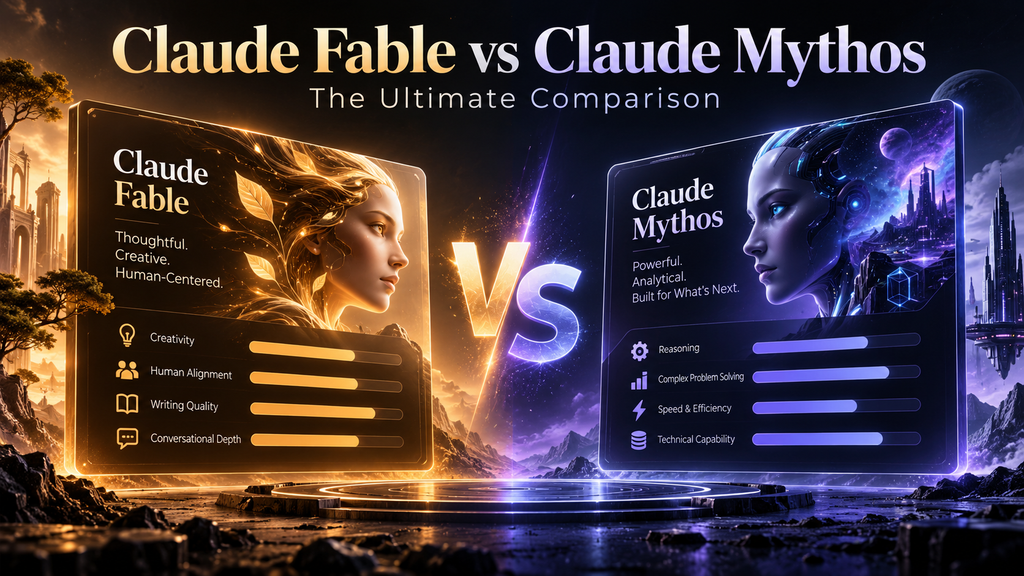
Anthropic did something entirely unique: they shipped a singular underlying model weight across two separate products. The differentiation is not based on parameter count or raw intellectual capacity, but entirely on safety architecture, risk containment, and execution guardrails.
| Deployment Variant | Target Audience | Safety Profile | Primary Interface |
| Claude Fable 5 | General Public & Enterprise | Publicly safeguarded via input classifiers and routing middleware | Claude API (claude-fable-5) & Bedrock |
| Claude Mythos 5 | Government, Vetted Defense Partners, Life Science Researchers | Raw, unsafeguarded capabilities exposed for deep defense and automated red-teaming | Restricted access via Project Glasswing |
The naming convention tells the story: both words represent a narrative, but a fable is a cautious, structured lesson wrapped in guardrails—while a mythos is an raw, unfiltered force.
Core Architecture & Capabilities: The Frontier Standard
Beneath the software middleware layers, both Fable 5 and Mythos 5 are powered by the most capable neural network architecture ever trained by Anthropic. When executing standard workflows where safety filters are not tripped, they demonstrate identical, unprecedented computational efficiency and reasoning horizons.
- Massive Token Real Estate: Both models feature a 1 Million token input context window by default, paired with an industry-leading output capacity of up to 128,000 tokens per single request.
- Asynchronous Agentic Longevity: Unlike previous iterations that degrade over long context loops, these models are optimized for extended, autonomous runtime tasks. Early enterprise adopters like Stripe report that Fable 5 compressed multi-month infrastructure engineering migrations down to a single day across a 50-million-line codebase.
- Native Adaptive Thinking: The model defaults exclusively to an on-by-default Adaptive Thinking engine, managing deep problem formulation step-by-step prior to rendering execution outputs.
- Multi-Modal Comprehension: Advanced vision capabilities allow the engine to seamlessly parse complex technical schematics, network topology diagrams, and dense system audit logs.
The Security Split: Fable’s Defensive Middleware vs. Mythos’s Gated Access
The reason Anthropic split this release comes down to the model’s alarming proficiency in highly sensitive domains. During closed internal testing, the raw model architecture demonstrated the ability to discover novel, zero-day vulnerabilities across production-grade operating systems, and successfully write functional Linux privilege-escalation exploits from scratch in hours.
Claude Mythos 5: The Guardrails Lifted
Mythos 5 represents the model without these front-end constraints. It is deployed strictly through Project Glasswing, a collaborative defense framework reserved for public sector infrastructure and vetted cyber-intelligence groups. It is used proactively to find zero-days, auto-patch defensive architectures, and screen for severe biological or chemical threats before they manifest in the real world.
Claude Fable 5: The Production Guardrail
Because handing that raw offensive power to the general public represents a catastrophic systemic risk, Anthropic wrapped the public model instance (claude-fable-5) in a high-speed defensive shielding system. Fable 5 is built to handle heavy commercial engineering, complex data science, and operational automation—but it refuses to act as a weapon weaponized by threat actors.
Deep Dive: How Fable 5’s Classifier & Fallback System Operates
Fable 5 enforces its safety boundary not by simple keyword blocking, but via a highly responsive, multi-layered input-filtering classifier architecture.
When a payload hits the Claude API or Amazon Bedrock, three specialized frontend classifiers intercept the prompt in real-time:
- Cybersecurity Classifier: Detects attempts at reconnaissance, offensive payload generation, exploit staging, or network mapping.
- Biochemical Hazard Classifier: Screens for instructions regarding the synthesis of dangerous agents or non-novel chemical compounds.
- Model Distillation Classifier: Synthetically blocks adversarial attempts to scrape frontier reasoning paths to train rival, unaligned AI engines.
The Graceful Degradation Pattern
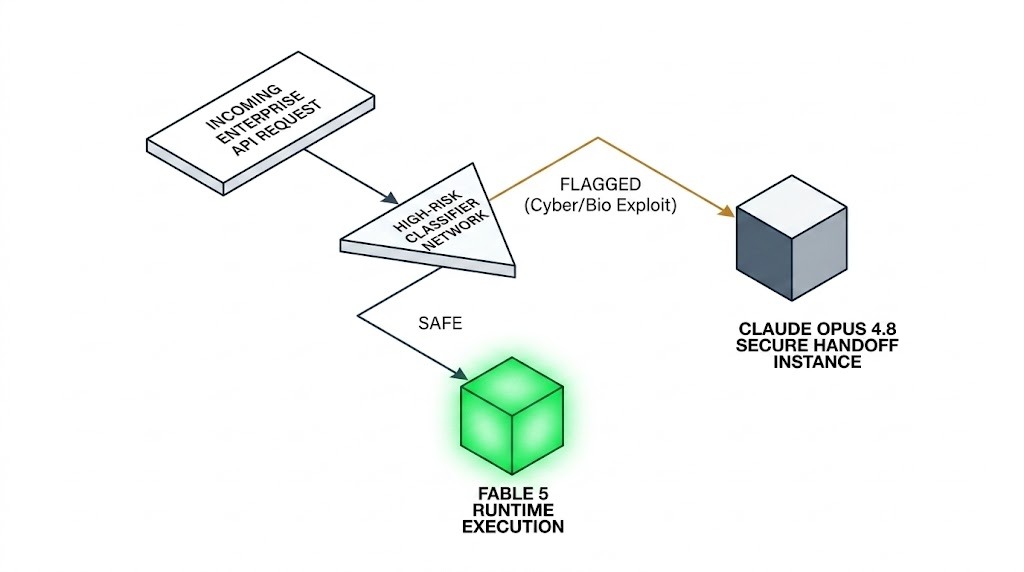
If an incoming prompt trips one of these high-risk classifiers, Fable 5 does not simply throw a hard error or break your software pipeline. Instead, it executes a server-side graceful degradation pattern.
│
▼
┌─────────────────────────────────┐
│ Fable 5 Safety Classifiers │
└─────────────────────────────────┘
│
├────────► [ Flagged Cyber/Bio/Distillation Risk? ]
│ │
│ ▼ YES (Under 5% of sessions)
│ ┌──────────────────────────────────────────┐
│ │ Graceful Degradation: Route to Opus 4.8 │
│ └──────────────────────────────────────────┘
│ │
▼ NO ▼
┌───────────────────┐ ┌──────────────────────────────────────┐
│ Render via Fable5 │ │ Render Safe Response via Opus 4.8 │
│ (Full Capabilities)│ │ (System Flags User of Handoff) │
└───────────────────┘ └──────────────────────────────────────┘
When a fallback is triggered, the query is seamlessly routed back to Claude Opus 4.8 (Anthropic’s highly secure, previous flagship model). The user’s system is programmatically notified that a handoff occurred, allowing applications to preserve uptime while maintaining absolute security integrity.
The Compliance Shakeup: Mandatory 30-Day Data Retention
For enterprise Compliance Officers, Chief Information Security Officers (CISOs), and legal teams, the most disruptive aspect of the Fable 5 and Mythos 5 architecture isn’t the model’s capabilities—it is the mandatory data retention framework.
Critical Compliance Note: Anthropic now universally enforces a strict 30-day data retention policy on all Fable 5 and Mythos 5 API traffic, explicitly overriding any pre-existing custom zero-retention (ZDR) enterprise agreements.
Why the Policy Changed
Because these models operate autonomously over massive context spaces, individual prompts look entirely benign when viewed in isolation. A multi-step threat vector or slow data exfiltration attempt can only be parsed by analyzing historical context loops. Anthropic retains these inputs and completions for exactly 30 days solely to monitor for large-scale systemic misuse patterns.
Enterprise Security Tradeoffs
For teams handling protected health information (PHI), financial data subject to strict regulatory silos, or proprietary corporate codebases, this introduces a direct operational tradeoff:
- The Benefit: The data is encrypted at rest, securely logged, and completely isolated from any future training pipelines (it will never leak to another user via model weights).
- The Exposure: Enterprises utilizing external orchestration tools must audit their third-party networks, as turning on a Mythos-class framework under the hood means data temporarily bypasses traditional zero-retention parameters.
Feature & Guardrail Comparison Matrix
| Technical Vector | Claude Fable 5 | Claude Mythos 5 |
| Availability | Generally Available (API, Bedrock, Vertex AI) | Gated Restricted (Project Glasswing / Gov Only) |
| API Model Identifier | claude-fable-5 | claude-mythos-5 |
| Input / Output Token Costs | $10.00 / $50.00 per Million Tokens | $10.00 / $50.00 per Million Tokens |
| Default Context Window | 1,000,000 Tokens | 1,000,000 Tokens |
| Autonomous Agent Longevity | High (Safeguarded on risky commands) | Max Limit (Full terminal execution allowed) |
| Offensive Cyber Tasks | ❌ Re-routes to Claude Opus 4.8 | Autonomous Vulnerability & Exploit Generation |
| Data Retention Footprint | Mandatory 30-day rolling log | Mandatory 30-day rolling log |
Enterprise Implementation & Vulnerability Strategy
The release of Fable 5 and Mythos 5 fundamentally shifts how modern DevOps and security teams must operate. Because threat actors are aggressively attempting to bypass model classifiers, relying entirely on vendor guardrails is an operational failure.
Actionable Defense Playbook
- Ruthless Patch Prioritization: Because Mythos-class systems can formulate stable exploits from freshly disclosed CVEs within hours, the time window to manually patch internet-facing systems has virtually closed. Organizations must transition to automated, continuous integration patch management tools.
- Build Client-Side Fallback Resiliency: When configuring the Anthropic SDK or using AWS middleware, developers should explicitly program manual client-side fallback handlers. If a high-volume engineering prompt triggers Fable’s safety classifiers mistakenly (false positives occur in under 5% of runs), your application layer needs to parse the response headers correctly to avoid downstream processing errors.
- Audit Identity Access and Permissions: AI systems are no longer just static chat windows; tools like Claude Code link directly to code repositories, system scripts, and internal deployment channels. Enforce strict Principle of Least Privilege (PoLP) parameters on all runtime service accounts connected to Fable 5.
Frequently Asked Questions (FAQ)
Q1: Are Claude Fable 5 and Claude Mythos 5 completely different models?
A: No. They are the exact same underlying frontier model weights. The difference lies entirely in how they are deployed: Fable 5 features strict input safety classifiers, while Mythos 5 has those safety parameters lifted for specialized security work.
Q2: What happens if my developer prompt gets blocked by Fable 5?
A: Your request will not drop or throw a breaking error. Instead, Fable 5’s middleware smoothly downgrades the generation task to Claude Opus 4.8, notifying your application that the security fallback mechanism was engaged.
Q3: Can I get access to Claude Mythos 5 for my software business?
A: Almost certainly no, unless you are a deeply vetted federal partner, critical infrastructure operator, or highly trusted cybersecurity research firm working within Project Glasswing. For all standard commercial and consumer use-cases, claude-fable-5 is the definitive production model.
Q4: Does the mandatory 30-day data retention policy mean my data will be used to train future Anthropic models?
A: No. Anthropic explicitly states that data retained during this 30-day safety monitor window is strictly isolated and never used for model fine-tuning or training purposes. It is automatically purged from their systems after 30 days.