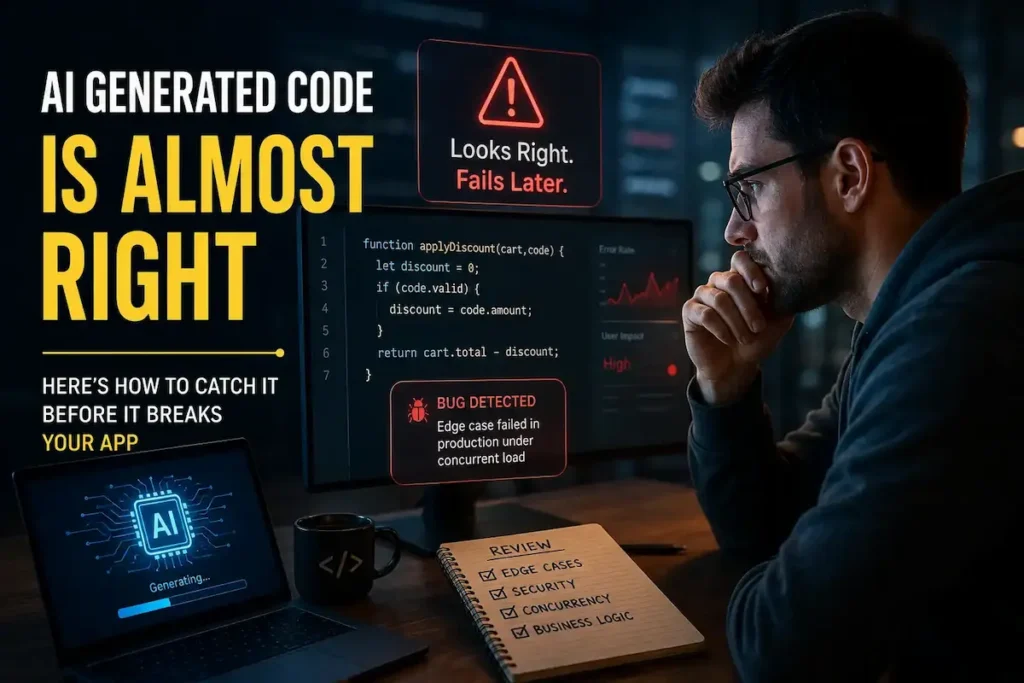

AI generated code that is almost right is the #1 developer frustration in 2026 — reported by 66% of developers in Stack Overflow’s survey of 49,000+ respondents. Not AI that fails completely. Not code that obviously breaks. Code that looks clean, passes a casual review, ships to production, and then fails three months later when Black Friday traffic hits or someone enters two discount codes at once.
That’s a harder problem than bad code. You can spot bad code. Almost-right code is designed to fool you — and AI is very good at making it look right. This post explains exactly where AI generated code goes wrong and gives you a repeatable system to catch it before users do.
Why AI Generated Code Is Almost Right — Not Wrong, Not Right
The model doesn’t know your codebase. It knows patterns from millions of codebases. When it generates a function, it produces the most statistically likely solution for the prompt you gave it — not the correct solution for your specific system. Those are different things.
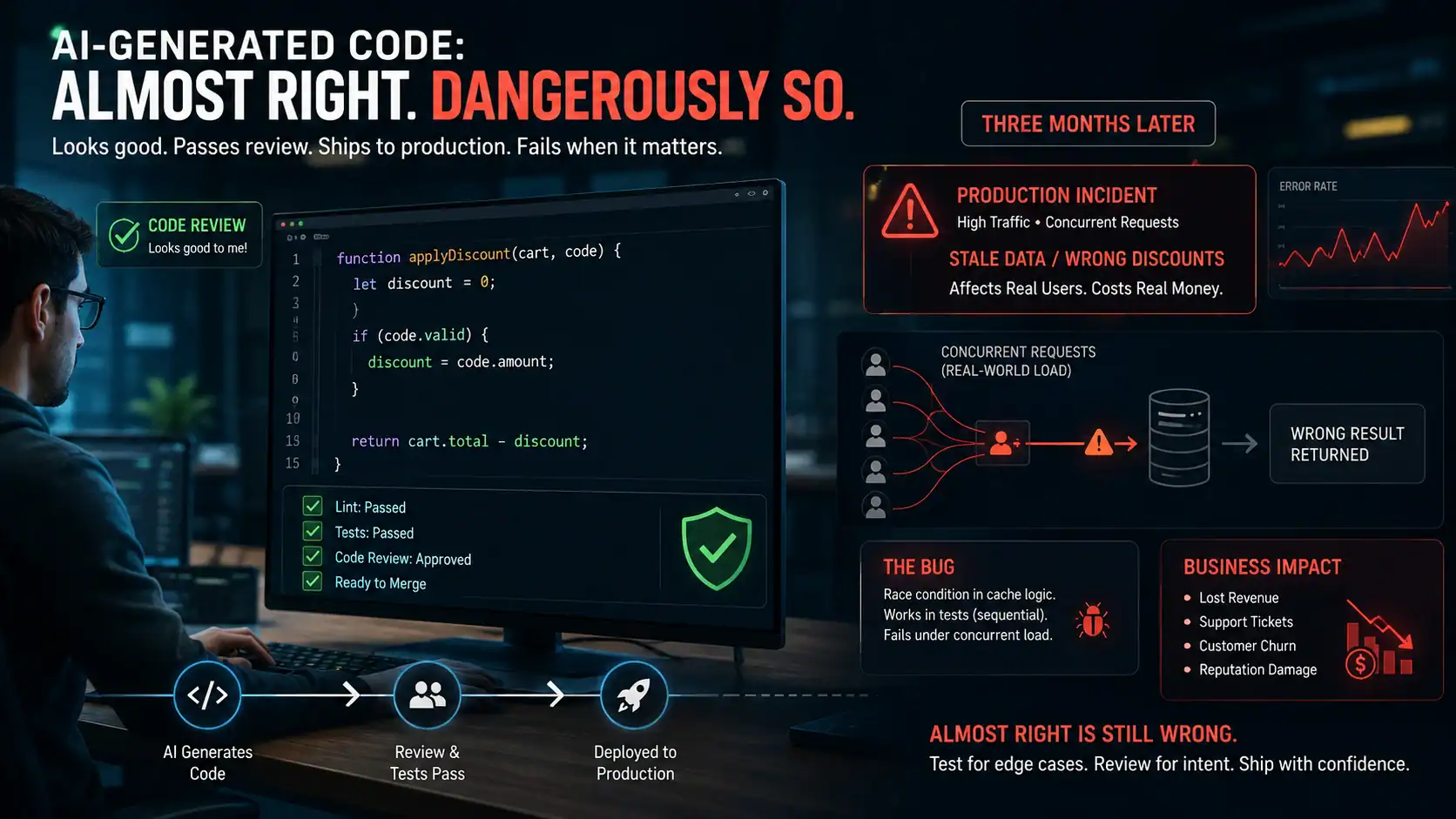
Take a real example that cost one team serious rework. A developer used Claude Code to write an endpoint. Sprint reviews looked great. Velocity numbers were up. Then three endpoints started returning stale cached data under concurrent load. The AI had generated perfectly reasonable caching logic — for a single-user context. Under concurrent requests, that logic had a race condition that only surfaced under load. It passed every test in the suite because the tests ran sequentially.
This is the pattern. AI generated code almost right means: correct for the happy path, wrong for the edge case the AI didn’t know to consider. Authentication bypass, SQL injection in the unusual input, discount logic that works until someone stacks two codes. The code runs. The tests pass. The bug waits.
Where AI Generated Code Almost Right Problems Show Up Most
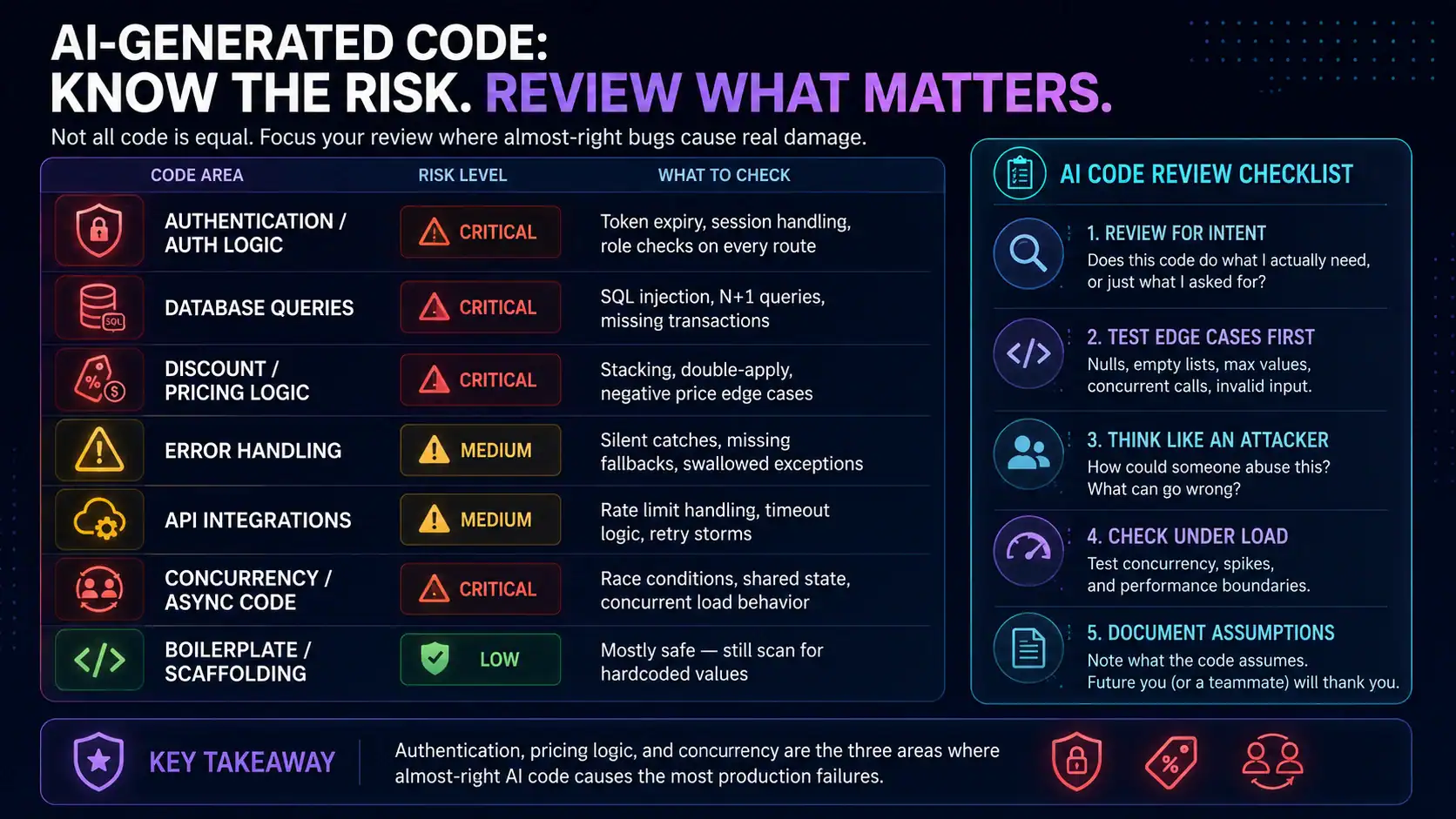
Not all code areas carry the same risk. Based on documented real incidents and security research in 2026, certain categories produce almost-right failures far more often than others.
| Code Area | Risk Level | What to Check |
| Authentication / Auth logic | 🔴 Critical | Token expiry, session handling, role checks on every route |
| Database queries | 🔴 Critical | SQL injection, N+1 queries, missing transactions |
| Discount / pricing logic | 🔴 Critical | Stacking, double-apply, negative price edge cases |
| Error handling | 🟡 Medium | Silent catches, missing fallbacks, swallowed exceptions |
| API integrations | 🟡 Medium | Rate limit handling, timeout logic, retry storms |
| Concurrency / async code | 🔴 Critical | Race conditions, shared state, concurrent load behavior |
| Boilerplate / scaffolding | 🟢 Low | Mostly safe — still scan for hardcoded values |
The red rows are where almost-right AI code has caused actual production incidents in 2026. Boilerplate — scaffolding, CRUD structure, simple utilities — is genuinely lower risk. The dangerous zone is anywhere business logic intersects with security, money, or concurrent state.
How to Catch Almost-Right AI Generated Code: A Practical System
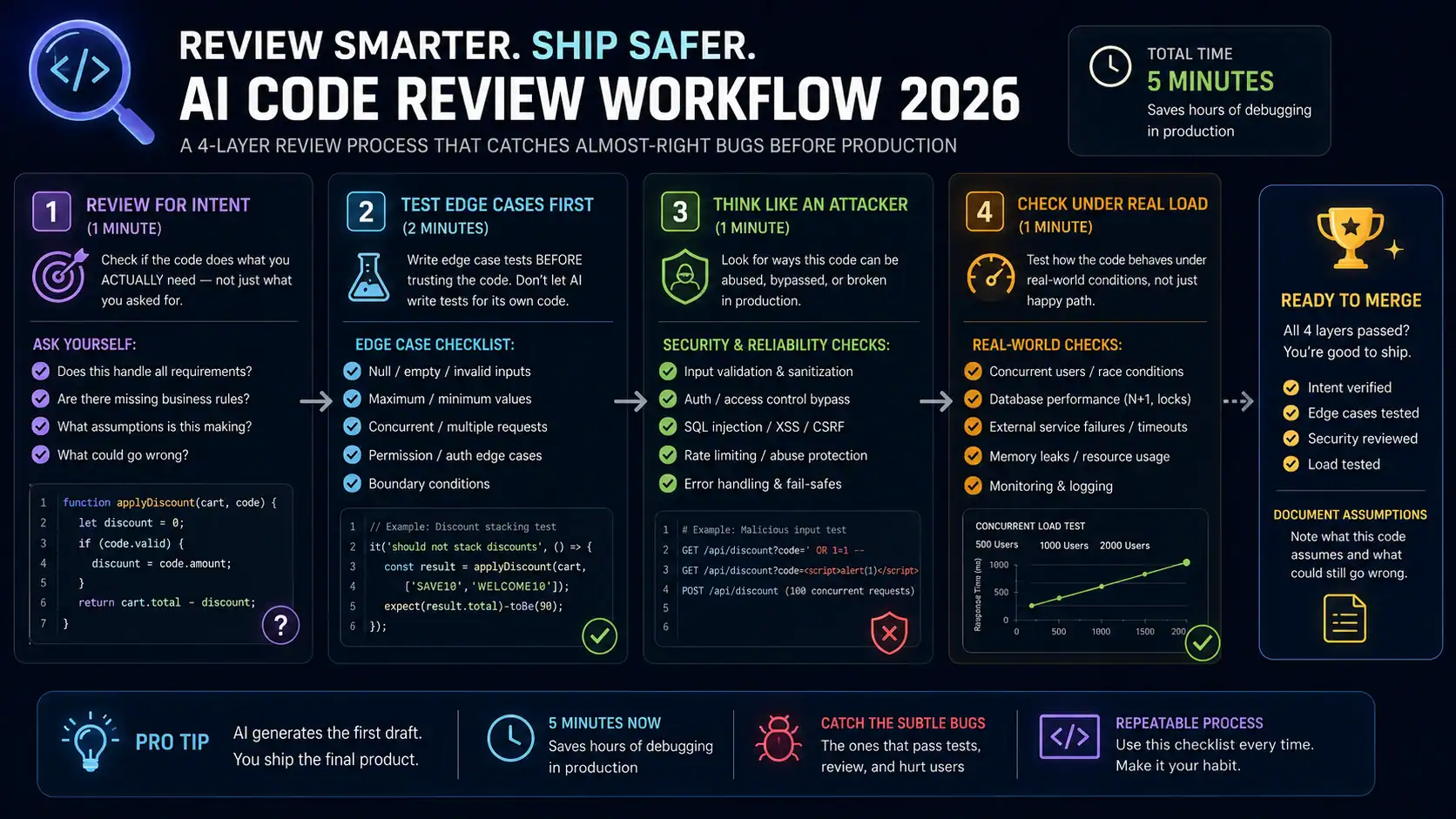
1. Review for Intent, Not Syntax
Most developers review AI code the same way they review human code — looking for syntax errors, obvious logic mistakes, missing null checks. That’s not enough for AI generated code almost right problems. The syntax is usually fine. The intent is what drifts.
Ask one question for every function: does this code do what I actually need, or does it do what I asked for? Those are different. You asked for a function that applies a discount. Did you specify that discounts shouldn’t stack? That loyalty points shouldn’t compound? AI generates what you described. Your job is to check whether the description covered the full requirement.
2. Write the Edge Case Tests First
Don’t let AI write your tests after it writes your code. The model will write tests that match its own implementation — which means the tests pass and the bug survives. Write the edge cases yourself before you see the AI’s solution. Null input. Empty list. Concurrent calls. Maximum values. Then see if the AI’s code passes them.
One engineering team reduced production hotfixes by 40% in six months using this approach. The velocity numbers didn’t drop significantly — the time saved in debugging more than covered the time spent writing test cases upfront.
3. Use the ‘Explain It Back’ Check
Ask the AI to explain its own code in plain language — specifically covering what happens with edge cases. ‘What happens if two users call this at the same time?’ ‘What if the discount code is already applied?’ ‘What happens if this API call times out?’
This surfaces missing logic fast. If the AI can’t explain a clean error path for a scenario, that path wasn’t handled. This single check catches more almost-right problems than any static analysis tool, because it forces the model to reason about what it built rather than just generate it.
4. Apply the Four-Layer Review for Business Logic
For any AI generated code that touches money, authentication, or user data specifically, run it through four questions before it merges:
- Does it handle concurrent requests correctly?
- Does it match our existing error-handling patterns — not just any valid pattern?
- Does it follow our security conventions, not just general best practices?
- Have I tested the failure path, not just the success path?
These aren’t slow checks. A developer who knows the codebase can run through these in five minutes. That five minutes is what separates shipped-and-stable from shipped-and-incident.
Mistakes That Make Almost-Right AI Code Worse
Reviewing speed instead of correctness. Fewer than half of developers verify AI output before committing, according to the 2026 State of Code survey. The velocity gain disappears fast when one edge-case bug requires three days of incident response.
Trusting tests the AI wrote for its own code. AI-written tests match AI-written code. They’re internally consistent, not externally correct. Your tests need to describe the requirement — not validate the implementation.
Using vague prompts for precise requirements. ‘Write a discount function’ produces almost-right code. ‘Write a discount function that applies a single discount per order, rejects stacking, and handles negative results by returning zero’ produces code that matches the actual requirement. The specificity of the output matches the specificity of the input.
Skipping review on ‘simple’ AI tasks. The almost-right failures documented in 2026 weren’t in complex architecture code. They were in pricing functions, auth middleware, and caching logic — things that looked simple enough to skip careful review.
Frequently Asked Questions
Is AI generated code safe to use in production?
Yes — with the right review process. 84% of developers use AI tools and teams genuinely ship faster with them. The risk isn’t that AI code is inherently unsafe. It’s that almost-right code passes casual review. Treat AI output as a capable first draft that needs domain-specific verification before it merges, not as finished work.
Which AI tool produces the most reliable code in 2026?
Claude Code with Opus scored 80.8% on SWE-bench Verified — the highest posted by any developer tool in the first half of 2026. But even the best model produces almost-right code on edge cases it wasn’t prompted to consider. Tool quality matters; review discipline matters more.
Does better prompting actually reduce almost-right AI code?
Significantly yes. Developers who include edge cases, constraints, and failure scenarios in their prompts get substantially fewer almost-right problems than developers using vague prompts. Specific prompts narrow the gap between ‘what I described’ and ‘what I needed.’ They don’t eliminate the review step — but they reduce how much the review needs to catch.
Should junior developers be using AI generated code?
With supervision, yes. The risk for junior developers isn’t that they’ll ship bad AI code — it’s that they’ll miss almost-right problems they don’t have enough experience to spot. The fix isn’t banning the tool. It’s pairing junior developers with seniors for code review on AI-generated business logic, and using the Socratic method: ‘What happens if this input is null?’ rather than pointing out the error directly.
The Bottom Line on AI Generated Code That Is Almost Right
Almost-right AI generated code is the defining developer problem of 2026 — not AI that fails, but AI that succeeds just enough to pass review and fail in production. The 66% of developers who report this frustration aren’t using AI wrong. They’re using it without the review layer that makes it safe.
The fix isn’t slowing down. It’s reviewing for intent instead of syntax, writing edge case tests before seeing the AI’s solution, and applying a four-question check to anything touching money, auth, or concurrent state. That process takes minutes. The incidents it prevents take days.
AI generated code is fast. Fast and almost right ships bugs. Fast with the right review process ships products.