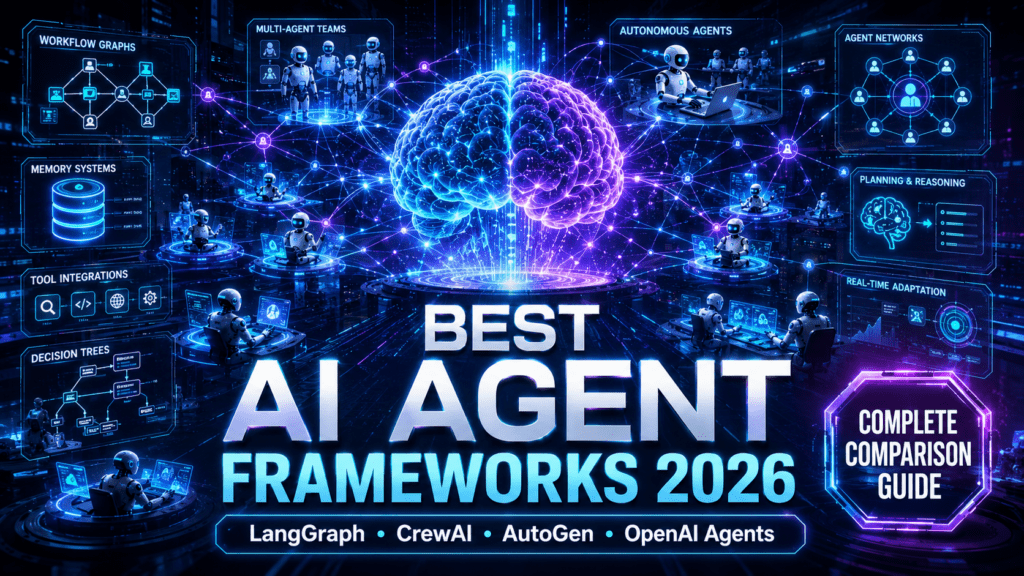

Picking the best AI agent frameworks 2026 has to offer can feel confusing. New tools launch every month, and each one claims to be the easiest or the most powerful. This guide cuts through the noise.
We compare the top frameworks that developers actually use this year, including LangGraph, CrewAI, AutoGen, and a few specialized options. You will learn what each framework does well, where it falls short, and how to match a tool to your project.
We also cover common mistakes, a quick comparison table, and answers to popular questions. By the end, you will know exactly which framework fits your goals. Let’s get started.

What Is an AI Agent Framework in 2026?
An AI agent framework is a toolkit for building AI systems that act on their own. Unlike a simple chatbot, an agent can plan steps, use tools, and check its own work. For example, an agent might search the web, read the results, and write a summary without extra prompts.
Most frameworks handle three core jobs. First, they manage memory, so the agent remembers past steps. Then, they connect to outside tools, like search engines or databases.
Finally, they help coordinate multiple agents when a task needs more than one specialist. As a result, developers do not have to build this logic from scratch every time.
Why the Best AI Agent Frameworks 2026 Matter for Your Project
Choosing the right framework saves real time. In fact, picking the wrong one can cost weeks of rework later. This is why so many teams research the best ai agent frameworks 2026 before they write a single line of code.
Demand for these tools has grown fast this year. Enterprises now run AI agents for support, research, and content tasks every day. Because of this, a framework with strong state management pays off quickly.
On the other hand, a tool that looks simple in a demo can break under real traffic. Therefore, test early and test often.
Top AI Agent Frameworks for Building Autonomous Systems
LangGraph
LangGraph comes from the LangChain team. It treats an agent workflow as a graph, where each step is a node and each connection is an edge. This setup gives you tight control over branching, retries, and pauses for human review.
LangGraph also offers built-in checkpointing. In other words, you can save the agent’s state and pick up later if something goes wrong. Because of this strength, many enterprise teams now choose LangGraph for workflows that must run for hours or days.
However, the graph model takes longer to learn than simpler tools. Even so, that extra effort often pays off in large, long-running projects.
CrewAI
CrewAI uses a different idea. Instead of a graph, you build a “crew” of agents with roles, goals, and short backstories. For instance, you might create a researcher, a writer, and an editor, then assign them tasks together.
This role-based design is easy to read, even for people outside engineering. Additionally, CrewAI ships as a free, open-source framework under the MIT license, with an optional paid cloud tier for teams that want managed hosting.
As a result, many startups start their first agent project with CrewAI. The framework also keeps growing its share of new users each month.
AutoGen
Microsoft built AutoGen for conversational multi-agent work. Agents talk to each other in a shared chat, debate options, and reach an answer together. This pattern fits research tasks and quality checks well.
That said, every extra round of conversation adds more tokens and more cost. Microsoft has also shifted its main focus toward a newer Microsoft Agent Framework, so AutoGen updates have slowed.
Even so, AutoGen Studio still offers a useful no-code option for quick tests. Teams already inside the Microsoft ecosystem still find real value here.

Specialized AI Agent Frameworks Worth Knowing
OpenAI Agents SDK
The OpenAI Agents SDK is a lighter option built only for OpenAI models. It uses clear handoffs between agents instead of a full graph or chat loop. For a single agent with one or two tools, this SDK often gets you running faster than a full framework.
Claude Agent SDK
Anthropic’s Claude Agent SDK powers Claude Code, so it has already proven itself in daily use. It adds hooks, skills, and support for the Model Context Protocol, also known as MCP. Teams that build only on Claude models often prefer this SDK over a general framework.
Google Agent Development Kit (ADK)
Google’s Agent Development Kit, or ADK, builds a tree of agents. One root agent hands off tasks to sub-agents below it, much like an org chart. It works best with Gemini models, though it can connect to others too.
Most importantly, ADK supports the Agent2Agent protocol, known as A2A. This protocol lets agents from different frameworks talk to each other. As a result, an ADK agent can call a LangGraph agent without custom glue code.
Key Features That Set AI Agent Frameworks Apart
State and Memory
Some frameworks save state by default, while others reset memory after each run. For example, LangGraph offers built-in checkpointing, so you can pause and resume a task later. CrewAI and AutoGen, on the other hand, often need extra setup to keep memory across sessions.
Protocols and Interoperability
Newer protocols also help agents work together. MCP connects an agent to outside tools and data in a standard way. Meanwhile, A2A lets agents from separate frameworks send tasks to each other, so you avoid getting locked into one ecosystem.
Observability and Cost
Watching what an agent does matters as much as building it. LangGraph pairs well with LangSmith for tracing every step an agent takes. Meanwhile, AutoGen’s chat-based design can run up token costs fast, since every turn adds a full model call.
Quick Comparison Table
Here is a side-by-side look at five popular frameworks. Use this table to scan the key differences fast. Then read the sections above for more context on each one.
| Feature | Built By | Status | Best For | Learning Curve |
| LangGraph | LangChain | Active, growing fast | Complex stateful workflows | Steep |
| CrewAI | CrewAI Inc. | Active, fast-growing | Fast multi-agent prototypes | Easy |
| AutoGen | Microsoft | Maintenance mode | Multi-agent conversations | Medium |
| OpenAI Agents SDK | OpenAI | Active | Single-agent OpenAI projects | Easy |
| Claude Agent SDK | Anthropic | Active | Claude-native production agents | Medium |
How to Pick the Right AI Agent Framework: Step by Step
Use these steps to narrow your choice fast. Follow them in order, and you will avoid most early mistakes.
- First, write down your task in one sentence, since a clear task shows if you need one agent or many.
- Next, check which model you plan to use. If you only use OpenAI or Claude, a vendor SDK may be enough.
- After that, decide if you need long-running memory. If so, pick a framework with built-in checkpointing, such as LangGraph.
- Then, test a small prototype before you commit, because most frameworks let you build a basic agent in under an hour.
- Finally, check the framework’s update history, since an active project gets fixes faster than one in maintenance mode.
Once you finish these steps, you will have a short list of one or two frameworks that fit your project well.

Common AI Agent Framework Mistakes to Avoid
Many teams pick a framework before they test their actual task. As a result, they discover the wrong fit too late. Avoid this mistake by running a quick prototype first.
Another common error is ignoring cost. AutoGen’s chat loops, for instance, can burn through tokens fast if you do not set limits. Therefore, always cap the number of turns or steps an agent can take.
Finally, do not skip tracing tools. Without tracing, a stuck agent is hard to debug. In short, plan for logging from day one, not after launch.
Which of the Best AI Agent Frameworks 2026 Should You Choose?
Fixed text:
Pick CrewAI if you want a fast prototype and your team thinks in roles, like researcher and writer. LangGraph is the better fit if your project needs strict control, long-running state, or a human approval step. For teams already inside the Azure ecosystem, AutoGen handles multi-agent chat patterns well.
If you only build for one model vendor, a native SDK often beats a general framework. For example, the Claude Agent SDK fits Claude-only projects, while the OpenAI Agents SDK fits OpenAI-only projects.
Among all the best ai agent frameworks 2026 offers, the right pick always depends on your task, not on hype.
Frequently Asked Questions
What is the best AI agent framework for beginners in 2026?
Among the best ai agent frameworks 2026, CrewAI is often the easiest starting point for beginners. Its role-based setup feels natural, even for people who are new to coding. Additionally, the docs are clear, so you can build a working agent in a single afternoon.
Is LangGraph still the top choice for production in 2026?
Yes, many enterprise teams still pick LangGraph for production work. It offers solid state management, checkpointing, and human review steps. However, it does take longer to learn than simpler tools.
Is Microsoft AutoGen still worth using?
AutoGen still works fine for chat-style multi-agent tasks. That said, Microsoft has shifted its main focus toward the newer Microsoft Agent Framework. So, check the current docs before you start a new project on AutoGen.
Do I need a framework, or can I just call the model API directly?
For a single, simple task, raw API calls might be enough on their own. However, once you add memory, multiple steps, or several agents, a framework saves real time. Among the best ai agent frameworks 2026 has on offer, most remove weeks of plumbing work.
Which AI agent framework works with both OpenAI and Claude models?
LangGraph, CrewAI, and AutoGen are all model-agnostic frameworks. As a result, you can swap in OpenAI, Claude, Gemini, or open models without rewriting your whole agent. This flexibility makes them a safer long-term pick for teams that may switch providers.
Final Thoughts on Choosing an AI Agent Framework
The agent framework space keeps moving fast, but the core choice stays simple. Match the framework to your task, your team’s skill, and your model choice. Out of all the best ai agent frameworks 2026 offers, no single tool wins every case.
Start small, test early, and watch your token costs from day one. If you follow the steps in this guide, you will dodge the most common mistakes. In short, pick the framework that fits your project, not the one with the most hype.