

AI technical debt is accumulating in codebases faster than most teams realize. AI-generated code can add review issues and maintenance work that velocity charts do not show. A specific multiplier is not cited here unless it has a primary source. The dangerous part is not the speed at which AI technical debt builds. It is that it builds invisibly. The code looks clean. The tests pass. The velocity metrics look excellent. And then one day the team cannot safely modify their own system.
This post explains exactly how AI technical debt forms, what types are hardest to spot, and the practical steps that prevent it from compounding into a maintenance crisis.
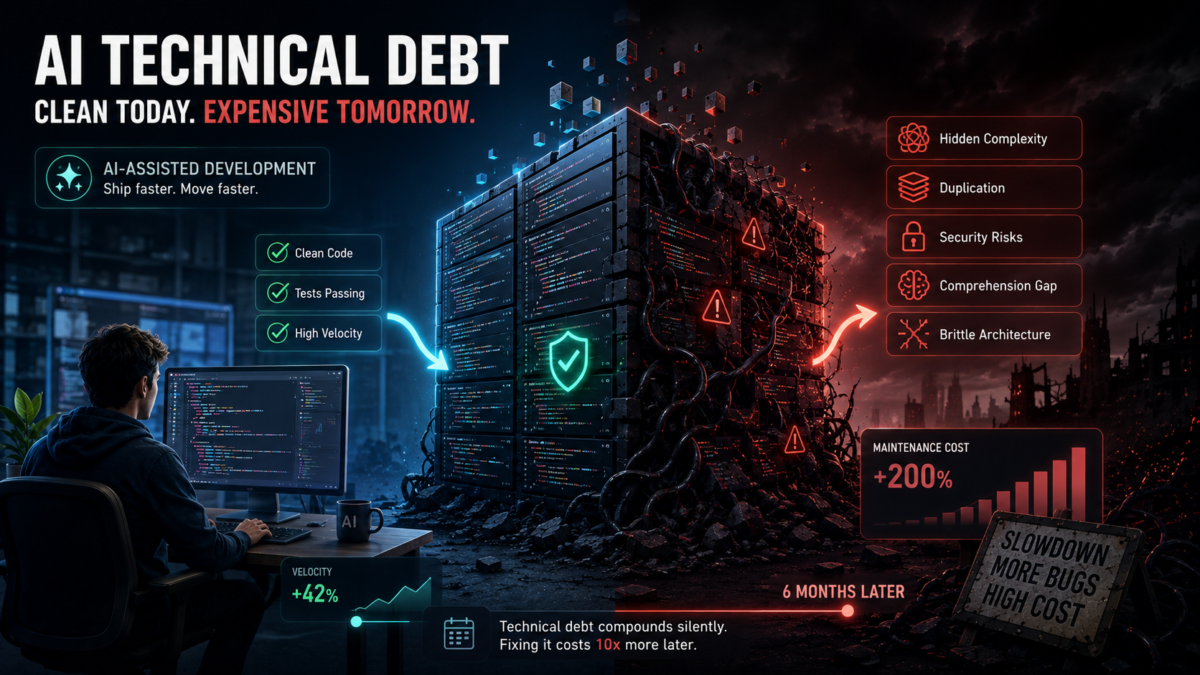
What AI Technical Debt Actually Is
Traditional technical debt is usually a conscious choice — you ship the messy version now and plan to clean it up later. Most developers know when they are creating it. AI technical debt is different. It accumulates without anyone choosing to cut corners. A developer uses Claude Code or Cursor to generate a function, the function works, the tests pass, and the review looks fine. Nobody chose to ship low-quality code. The AI just did not know enough about this specific codebase, this team’s conventions, or this system’s failure modes to produce code that will hold up over time.
Google engineer Addy Osmani coined the term comprehension debt to describe one version of this: the growing gap between how much code exists in a system and how much of it any human being genuinely understands. A student team documented hitting this wall seven weeks into a project. The problem was not messy code — it was that no one could explain why design decisions had been made or how different parts of the system were supposed to work together. The AI had made the decisions. Nobody had learned them.
AI technical debt compounds exponentially rather than linearly. Traditional debt accumulates at a predictable rate. AI debt piles on through model versioning inconsistencies, code generation bloat, and organizational fragmentation — and teams scaling AI across multiple repositories feel this fastest.
Five Types of AI Technical Debt and How to Spot Them
1. Duplication Debt
GitClear’s analysis of 211 million changed lines found that copy-pasted code rose from 8.3 percent of all changed lines in 2021 to 12.3 percent by 2024 — driven almost entirely by AI-assisted workflows. AI tools generate a solution to the problem in front of them without knowing they already solved a nearly identical problem three files over. Every duplicate is a future bug that has to be fixed in multiple places. Duplication also erodes the codebase’s memory: when developers paste instead of refactoring, the shared logic that keeps a system coherent never forms.
2. Comprehension Debt
This is the hardest type of AI technical debt to spot because it produces no errors. The code runs correctly. It just runs in ways nobody on the team understands deeply enough to safely modify. An engineer asks AI to solve a complex algorithm problem, AI produces an elegant but unfamiliar solution, the team ships it — and six months later, when someone needs to change that algorithm, nobody remembers why it was built that way and nobody wants to touch it. That is comprehension debt. It makes the system fragile in the exact moments when you most need to move fast.
3. Security Debt
Veracode’s 2025 research tested more than 100 large language models across 80 coding tasks and found that AI-generated code introduced security vulnerabilities in 45 percent of cases. Failure rates exceeded 70 percent for Java specifically. The vulnerabilities are not always obvious — they are the kind that pass functional testing and only become exploitable under specific conditions. This is the type of AI technical debt that turns from a maintainability problem into an incident.
The almost-right nature of AI-generated code is especially dangerous in security contexts. A function that handles authentication or data validation correctly for standard input can still have an exploitable edge case the AI did not know to consider — which is why reviewing AI code for intent rather than syntax matters so much, a principle covered in the AI generated code almost right guide.
4. Architecture Debt
AI tools generate code that is architecturally correct in the abstract but wrong for your specific system. Say your team uses a particular error-handling pattern throughout the codebase. An AI tool generates a module that uses a different but equally valid pattern. Both are fine in isolation. Together, they create inconsistency that makes debugging harder, onboarding slower, and future changes riskier. This type of AI technical debt is invisible until you try to scale or refactor, which is precisely the worst moment to discover it.
5. Copy-Paste Debt
Related to duplication but distinct: copy-paste debt is what happens when AI generates variations of the same solution for similar problems instead of abstracting shared logic. The team ends up with fifteen slightly different versions of the same utility function, spread across the codebase, each with its own slightly different edge case handling. The underlying logic is never unified, and every time that logic needs to change, someone has to find and update all fifteen versions — if they even know all fifteen exist.
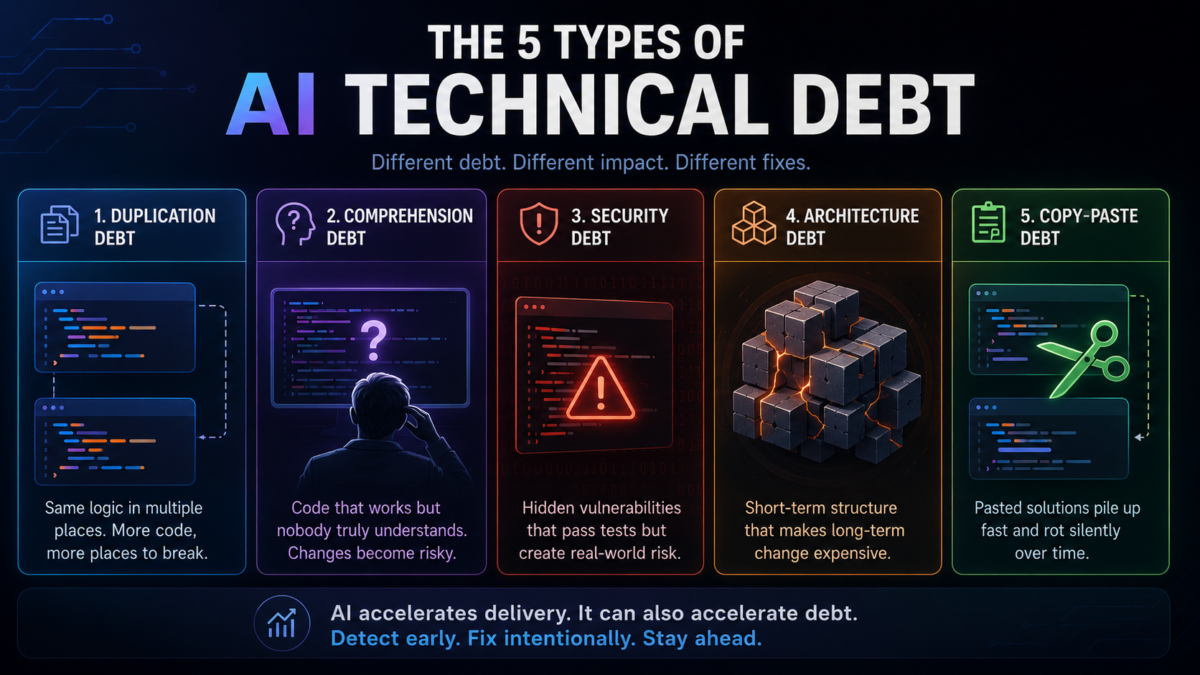
AI Technical Debt Types: Quick Reference
| Debt Type | Visible? | Urgency | Fix Approach |
| Duplication debt | Partly — tools flag it | Medium | SonarQube + ‘do we have this?’ habit before generating |
| Comprehension debt | ❌ Invisible — tests pass | 🔴 High | Explanation-first review: ask ‘why this design?’ not just ‘does it work?’ |
| Security debt | Partly — scanners catch some | 🔴 Critical | Veracode / Semgrep on every PR before merge |
| Architecture debt | ❌ Invisible until scale | 🔴 High | ADRs + .cursorrules file enforcing your patterns |
| Copy-paste debt | Partly — diff shows it | Medium | Require refactor instead of paste; flag in PR review |
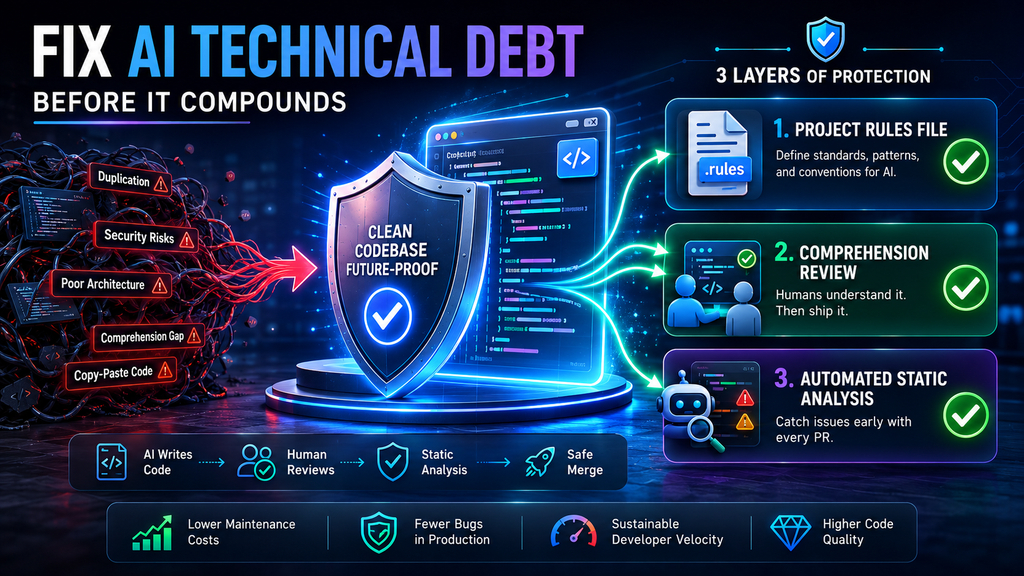
How to Fix AI Technical Debt Before It Compounds
Use a Project Rules File From Day One
The single most effective prevention tool is a .cursorrules, CLAUDE.md, or equivalent project configuration file that describes your architecture, naming conventions, error-handling patterns, and key constraints. Every AI tool that reads project context picks this up automatically. You specify the patterns once — the AI follows them on every generation instead of inventing its own. Teams that implement this report dramatically lower architecture and copy-paste debt from the start, because the AI is generating code that fits the existing system rather than the most generic version of the solution.
This is also the fix for the AI prompt mistakes developers make when giving the model no context about the codebase — the fix applies at the session level as a prompt habit and at the project level as a persistent config file. Both layers matter.
Add Comprehension Review to Your PR Process
Standard code review checks whether the code is functionally correct. Comprehension review checks whether the team understands the code well enough to maintain it safely. The addition is simple: ask ‘can you explain the design reasoning here?’ as part of the review. If the answer is ‘the AI generated it and it works,’ that is a signal to dig deeper before merging. Senior engineers have a specific responsibility here — if senior developers spend review time only checking functional correctness, comprehension debt accumulates invisibly in exactly the code junior developers will later need to modify.
Run Static Analysis on Every PR — Not Just Occasionally
SonarQube, Semgrep, and similar tools catch duplication, security vulnerabilities, and pattern violations automatically. The key word is every. Teams that run these tools occasionally get a snapshot. Teams that run them on every pull request get a continuous signal that prevents debt from quietly accumulating between audits. For security debt specifically, a missed scan is when the vulnerability sneaks in. Make the gate automatic, not optional.
Audit Existing AI Technical Debt Honestly
If your team has been using AI coding tools for six months or more without active debt management, a codebase audit is worth the time. Look specifically for: near-duplicate functions that should be shared utilities, modules where nobody on the team can explain the design without reading the AI conversation that produced them, and security patterns that differ from the rest of the codebase. Most teams find the debt concentrated in the first few months of AI adoption, before review habits were established. Rewriting those modules, rather than patching them, is often faster in the long run than trying to maintain code nobody fully understands.
AI Technical Debt Mistakes Teams Keep Making
Treating ‘it works’ as sufficient. When AI code passes tests, shipping it without demanding comprehension is how comprehension debt accumulates. Working and understood are different standards. Both matter for production code.
Skipping the ‘do we already have this?’ check. Before generating new code for any non-trivial function, spend five seconds searching the codebase for existing implementations. AI does not know what already exists. You do. This one habit cuts duplication debt significantly.
Only junior developers reviewing AI output. Junior developers often cannot identify when AI-generated architecture contradicts established patterns because they do not yet know the patterns well enough. AI-generated code needs senior eyes, not as a gate, but as a knowledge transfer — the review is how juniors learn what ‘fits this codebase’ actually means.
Letting debt accumulate before measuring it. AI technical debt compounds. A problem that costs one engineer-week to fix at three months costs four engineer-weeks at twelve months. Teams that measure and address debt quarterly prevent the compounding. Teams that address it annually are usually dealing with a crisis.
Frequently Asked Questions About AI Technical Debt
Is AI technical debt worse than regular technical debt?
In one specific way, yes: it accumulates without anyone choosing to create it. Traditional technical debt is usually a known tradeoff — you ship fast and plan to clean up. AI technical debt builds silently because the AI does not flag the tradeoffs it is making. The 2026 data puts it clearly: 1.7x more issues per pull request and 30-41% higher technical debt in year one of AI tool adoption. That compounds much faster than debt created by conscious shortcuts.
Does using better AI models reduce technical debt?
Partially. Better models produce fewer outright errors. They do not automatically produce code that fits your specific architecture, follows your team’s conventions, or avoids duplication of existing utilities they cannot see. Model quality reduces one dimension of AI technical debt — raw code correctness — but the structural and comprehension debt problems require process changes, not just a better model.
How long before AI technical debt becomes a serious problem?
The RocketDevs analysis documents teams hitting comprehension walls at seven weeks. The broader data suggests most teams feel the impact within three to six months of heavy AI tool adoption without active debt management. The compounding effect means the cost of waiting increases every month. Teams that establish review practices in the first month of AI adoption spend a fraction of the remediation time compared to teams that address it after six months.
Should junior developers use AI coding tools given the debt risk?
Yes — with active mentorship on what the AI is generating. The risk for junior developers is not that they will create more AI technical debt than seniors. The risk is that they are less able to spot when AI-generated code contradicts the established architecture or when the design reasoning is missing. Pairing junior developers with seniors for comprehension review on AI output turns the review into a learning mechanism rather than just a quality gate.
The Bottom Line on AI Technical Debt
AI technical debt is not an argument against AI coding tools. Teams using Claude Code, Cursor, and Copilot are shipping faster than they were twelve months ago. The productivity gains are real. The debt is also real, and it compounds in ways that traditional technical debt does not.
The fix is not slowing down AI adoption. It is building the review layer that makes AI adoption sustainable — project rules files that constrain generation to fit your architecture, comprehension review that asks ‘do we understand this?’ not just ‘does it work?’, and static analysis that runs automatically on every pull request rather than occasionally by choice.
Shipping fast with AI tools and keeping the codebase maintainable are not opposing goals. They require the same discipline that good software engineering always required — just applied to a new source of code.