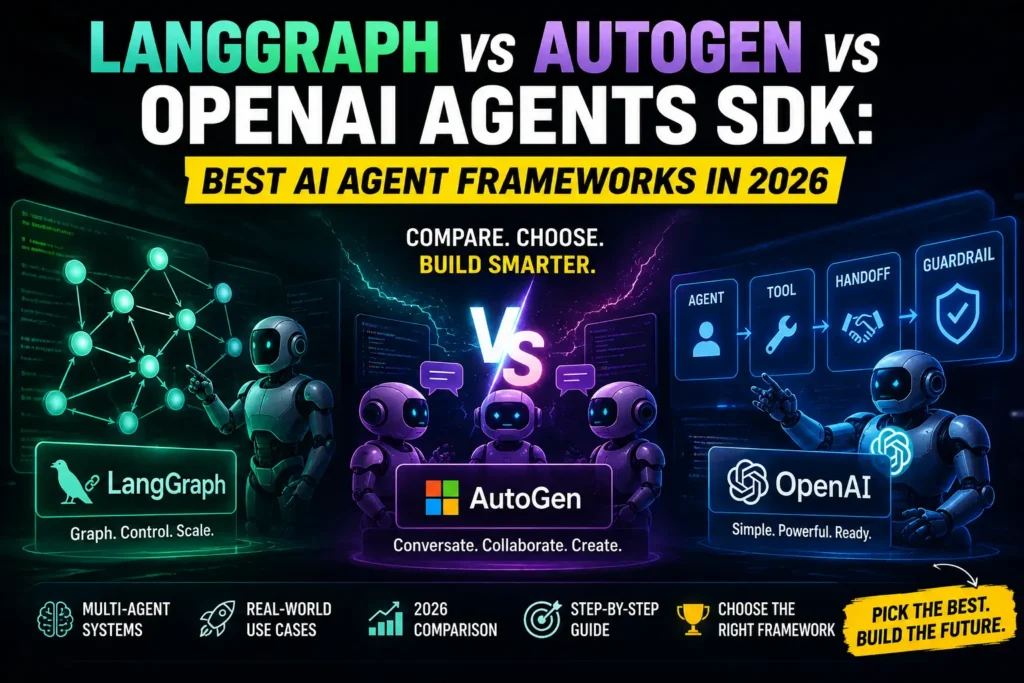

AI agent frameworks are everywhere in 2026. However, building a good AI agent is not always easy, so you need the right AI agent framework for the job. This guide compares three popular AI agent frameworks: LangGraph, AutoGen, and the OpenAI Agents SDK — the best AI agent frameworks in 2026. In addition, you will also find other top frameworks worth knowing this year. Furthermore, you will learn how to build a multi-agent application, step by step.
Best of all, this guide uses simple language with no heavy jargon — just clear facts you can use today.

What Is an AI Agent Framework?
An AI agent framework is a toolkit that helps developers build AI systems that act on their own. For instance, these systems can call tools, use APIs, remember past steps, and even work together with other agents.
Without a framework, however, you write all this logic by hand, which takes time and creates more bugs. Fortunately, a good framework handles the hard parts for you. Specifically, this includes memory, tool calls, error handling, and agent communication.
Why Multi-Agent Systems Matter in 2026
The AI world has moved fast. For example, most applications relied on single prompts in 2023. Then, by 2024, teams were using chains and retrieval-augmented generation to improve results. By 2025, AI agents learned how to use tools independently. Today, multi-agent systems have become the new standard for building advanced AI applications.
As a result, one agent often cannot do everything well. Instead, a team of small, focused agents usually works better. Each agent owns one job. This means the whole system becomes easier to test, debug, and scale.
LangGraph Explained
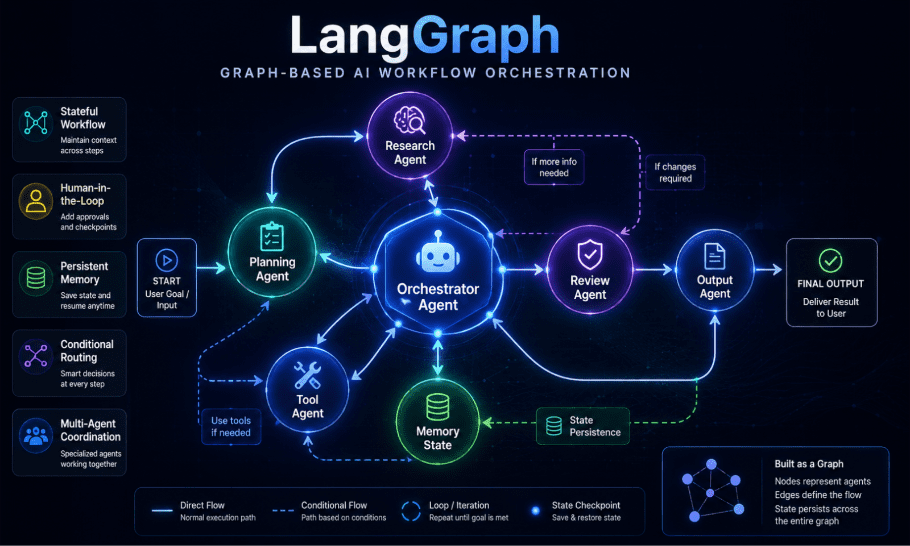
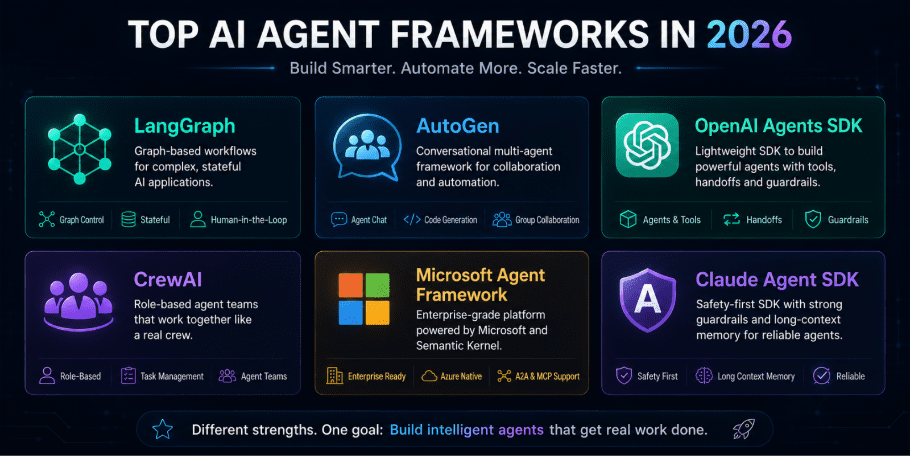
LangGraph, one of the best AI agent frameworks in 2026, comes from the LangChain team. Essentially, it treats your AI agent workflow as a graph. In this graph, each step is a node, and each connection between steps is an edge. Together, these two parts give you full control over how your LangGraph agents move through a task.
Key Features of LangGraph
- First, graph-based design for clear, visual workflow logic
- Additionally, built-in state persistence, which allows workflows to pause and resume safely
- Furthermore, strong support for human-in-the-loop checkpoints
- Finally, a good fit for long-running, multi-step tasks
Best For
LangGraph is a great choice for teams that need precise control over their AI agent framework. In particular, it works well for production systems that need state management and a clear audit trail. For example, banks, healthcare providers, and other regulated industries often pick LangGraph as their AI agent framework in 2026 for exactly this reason.
AutoGen Explained
AutoGen started as a Microsoft Research project. Essentially, it treats multi-agent systems as conversations, where agents talk to each other like people in a group chat. For example, one agent might plan a task, another might write code, and a third might review the result before it ships.
Key Features of AutoGen
- First, conversation-style AI agent design for natural, easy-to-follow workflows
- Additionally, strong support for code-writing and code-review agents in 2026
- Furthermore, flexible group chat patterns for brainstorming and debate
- Finally, a large base of public tutorials and example projects to help you get started fast
Important Update for 2026
Microsoft has placed AutoGen into maintenance mode. As a result, the project now only receives bug fixes and security patches. Instead, new features go into the Microsoft Agent Framework, which merges AutoGen with Semantic Kernel. Because of this shift, Microsoft now points new users toward the best AI agent framework option for large-scale projects in 2026 — the Microsoft Agent Framework — rather than classic AutoGen.
Best For
AutoGen still works well for research and small prototypes. However, it is not the best pick for a brand-new, large-scale production system in 2026. That said, new features and long-term support have both moved to the Microsoft Agent Framework, so starting fresh there makes more sense today.
OpenAI Agents SDK Explained
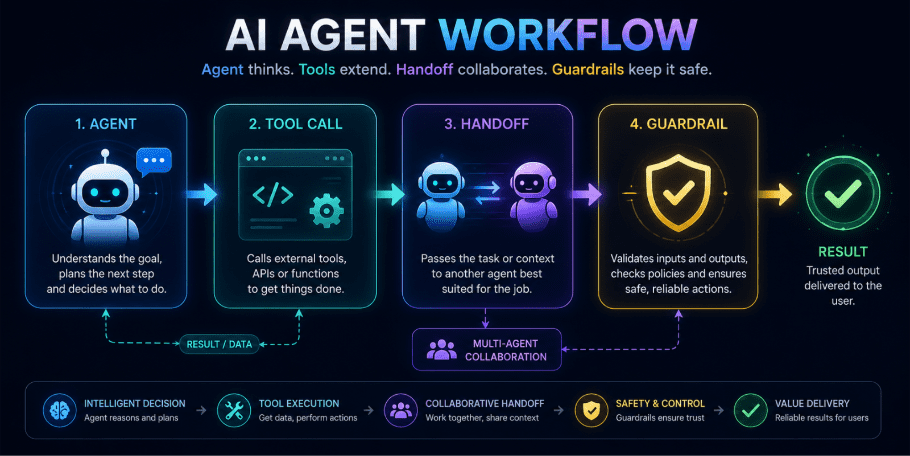
The OpenAI Agents SDK grew out of an earlier experiment called Swarm. As a result, it is lightweight and easy to learn. In fact, the whole AI agent framework is built around just five simple building blocks.
Key Building Blocks
- Agents: language models with instructions and tools
- Tools: functions an agent can call to get work done
- Handoffs: a clean way to pass a task to another agent
- Guardrails: checks that block bad input or output
- Sessions: built-in memory for ongoing conversations
Best For
This AI agent framework is a great starting point if you already use OpenAI models. Additionally, it works with other providers through compatible APIs. Because of this flexibility, teams that want a fast setup with less boilerplate code often choose the OpenAI Agents SDK as their first AI agent framework in 2026.
LangGraph vs AutoGen vs OpenAI Agents SDK: Quick Comparison
Here is a side-by-side look at how the three frameworks stack up.
| Feature | LangGraph | AutoGen | OpenAI Agents SDK |
| Built By | LangChain team | Microsoft Research | OpenAI |
| Core Idea | Graph of nodes and edges | Agent-to-agent conversation | Agents plus handoffs |
| 2026 Status | Actively developed | Maintenance mode | Actively developed |
| Best For | Complex, stateful workflows | Research and prototypes | Fast OpenAI-based apps |
| Learning Curve | Medium to high | Medium | Low |
| Vendor Lock-in | Low, model-agnostic | Low, model-agnostic | Tied to OpenAI-style APIs |
Best AI Agent Frameworks in 2026 (Beyond the Big Three)
Several other frameworks also deserve a place on your shortlist this year. ]
CrewAI
CrewAI groups agents into role-based teams. In fact, it feels like managing a small team of employees, where each agent has a clear job title and task list. Because of this, CrewAI is one of the easiest AI agent frameworks to learn for beginners in 2026. Additionally, it has added support for the Agent2Agent protocol, which helps AI agent teams from different systems talk to each other.
Microsoft Agent Framework
This is the official successor to AutoGen. Specifically, it combines AutoGen’s agent design with the enterprise tools from Semantic Kernel. Furthermore, it supports both the Model Context Protocol and the Agent2Agent protocol. As a result, it is built for large companies that need long-term support and stable APIs.
Claude Agent SDK
Anthropic’s SDK focuses on safety and reliability. In particular, it includes strong guardrails and a memory feature for longer tasks. Because of these features, many teams pick it as their go-to AI agent framework in 2026 for customer-facing agents or for work that involves sensitive data. for work that involves sensitive data.
Quick Reference: Which Framework Fits Which Job
Here is a simple overview to help you choose the right AI agent framework for your project in 2026.
| Framework | Best Use Case |
| LangGraph | Stateful, production-grade workflows |
| CrewAI | Role-based business workflows |
| Microsoft Agent Framework | Enterprise and Azure-based systems |
| OpenAI Agents SDK | Fast, OpenAI-native prototypes |
| Claude Agent SDK | Safety-critical, customer-facing agents |
| AutoGen | Research projects and legacy systems |
How to Build a Multi-Agent Application: Step by Step
Follow these five steps to plan and build your first multi-agent system.
Step 1: Define the Problem First
Before you pick an AI agent framework, write down the task in plain words and break it into smaller jobs. Then, ask yourself a simple question: can one agent handle this alone? If not, and the task needs different skills, you likely need more than one agent.
Step 2: Choose an Orchestration Pattern
There is no single right pattern. Instead, pick the one that matches your task.
- Orchestrator-Worker: one planner agent splits the task and sends jobs to worker agents
- Router: one agent reads the request, then sends it to the right specialist agent
- Hierarchical: a top-level agent manages mid-level agents, who manage workers below them
- Pipeline, also called Sequential: agents work one after another, each adding to the result
- Parallel, also called Split-and-Merge: many agents work at the same time, then a final step merges their answers
Step 3: Pick the Right Framework
Match the AI agent framework to your pattern and to your team’s skills.
- Need full control over a graph-like flow? Try LangGraph.
- Need fast setup with OpenAI models? Try the OpenAI Agents SDK.
- Need role-based teams for business tasks? Try CrewAI.
- Need enterprise-grade, long-term support? Try the Microsoft Agent Framework.
Step 4: Add Tools and Guardrails
Give each agent only the tools it truly needs, and add guardrails to check input and output. This way, bad data cannot break your system. More importantly, it also keeps your users safe.
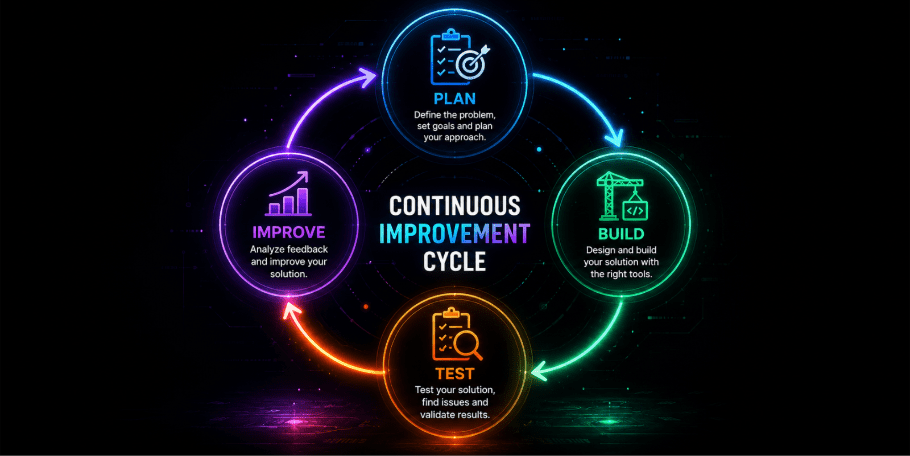
Step 5: Test, Observe, and Improve
Add logging and tracing from day one so you can watch how your agents talk to each other. Meanwhile, look for slow steps or repeated errors. Most importantly, fix small problems early before they grow into bigger ones.
Common Mistakes to Avoid
- Using too many agents for a simple task
- Skipping guardrails to save time early on
- Letting one orchestrator agent handle too much reasoning, which slows the whole system
- Not testing how agents behave when a tool call fails
- Picking a framework based on hype instead of real project fit
Which Framework Should You Choose?
There is no single best framework for every team. Instead, the right choice depends on your goal and what you are trying to build. For example, LangGraph is ideal for projects that require deep control and stability. On the other hand, the OpenAI Agents SDK is a good fit when you want a quick and simple setup with OpenAI models. CrewAI works particularly well for teams that think in terms of roles and task delegation. Meanwhile, for companies already using Microsoft or Azure tools, the Microsoft Agent Framework is usually the smarter long-term option over classic AutoGen.
That said, the framework itself matters less than most people think. In fact, what matters more is your testing process, your error handling, and how closely you watch your system once it goes live. So, build that part well, no matter which framework you pick.
Frequently Asked Questions
Is LangGraph better than AutoGen?
It depends on the job. LangGraph gives you more control over complex, stateful workflows. AutoGen is easier for conversation-style agent setups, but it is now in maintenance mode, so LangGraph is the safer pick for new production work.
Is AutoGen dead in 2026?
AutoGen is not dead, but it is no longer the active focus. Microsoft still issues bug fixes and security patches. New features now land in the Microsoft Agent Framework, so most new projects should start there instead.
Which framework is best for beginners?
The OpenAI Agents SDK and CrewAI are both friendly starting points. They need less setup and fewer lines of code than LangGraph or the Microsoft Agent Framework.
Can I mix frameworks in one project?
Yes, many teams already do this. It is common to use one framework for orchestration and a separate vendor SDK for a single specialist agent. Just keep your communication layer simple and well documented.
Final Thoughts
AI agent frameworks keep changing fast. What felt new last year may already be old news today. The good part is that the core ideas stay the same. Break your task into clear roles. Pick a pattern that fits the job. Add guardrails. Test often.
Start small. Pick one framework. Build a simple multi-agent app. Learn from it. Then grow your system step by step.