
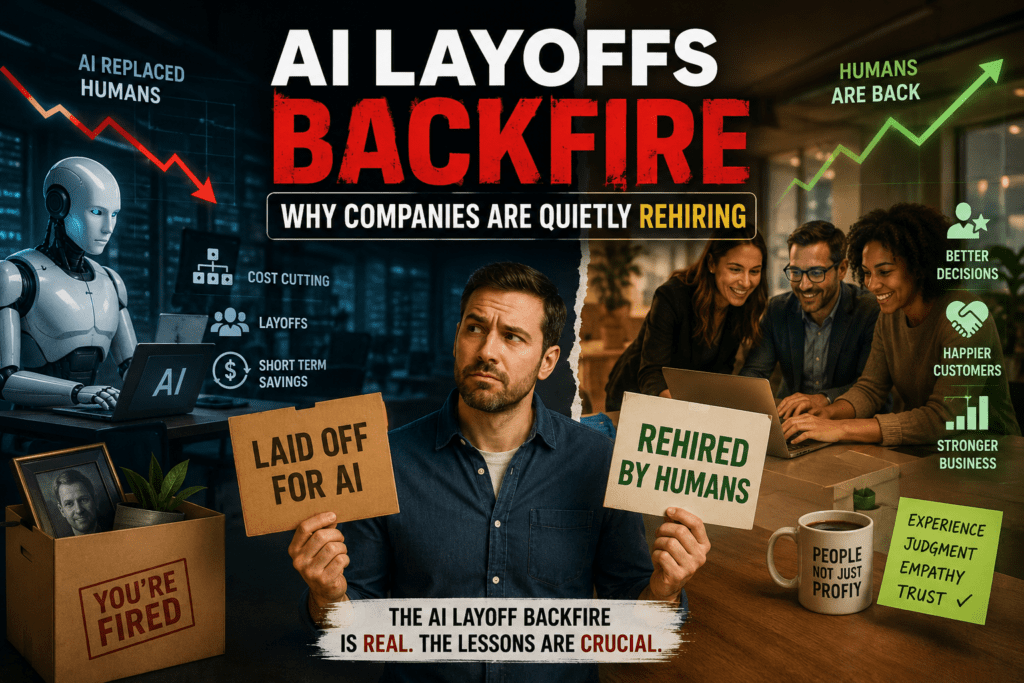

Something strange is happening in the job market. Companies spent the last two years cutting jobs and replacing workers with AI. Now many of those same companies are hiring people back.
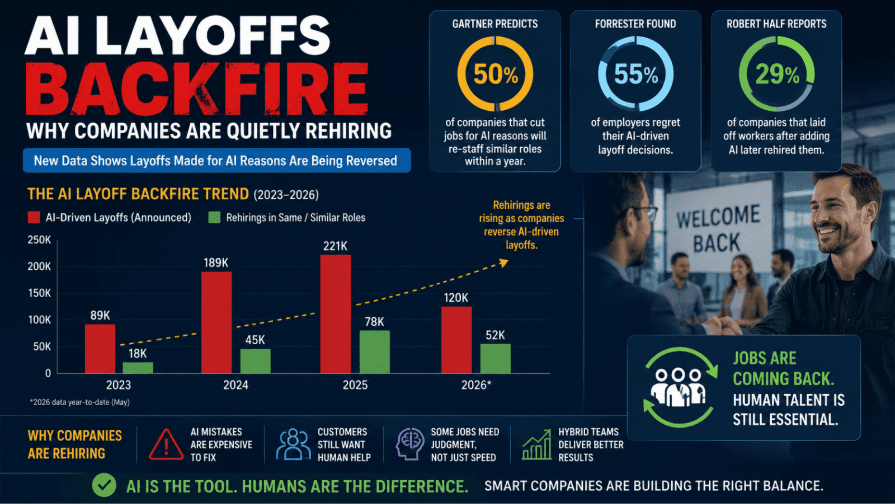
This is not a small glitch. Gartner expects half of all companies that cut jobs for AI reasons to restaff similar roles within a year. Forrester found that 55% of employers regret their AI-driven layoffs. So what went wrong, and why does the AI layoff backfire keep showing up at company after company?
What Is the AI Layoff Backfire?
The AI layoff backfire is a simple pattern. A company cuts staff and hands the work to AI tools. Then the quality drops, customers complain, or deadlines slip. The company ends up hiring people back into the same roles, sometimes within months.
Robert Half found that 29% of companies that laid off workers after adding AI later rehired them. Some firms even gave these returning workers a nickname: AI boomerangs. It is a fitting name, because the job just bounces right back to a human.
Why This Trend Matters Right Now
Layoff headlines are everywhere in 2026. Meta, Amazon, Oracle, Citi, and dozens of other large companies have announced cuts this year, and AI gets blamed in many of these announcements.
But the rehiring side of the story gets far less attention. Gartner projects that half of companies that replaced workers with AI will restaff those same functions. That is not a rounding error. That is a coin flip on whether a layoff decision actually holds up.
For job seekers, this changes how to read a layoff. A role getting cut today does not mean it is gone forever. For business owners, it is a warning. Cutting too fast for AI can cost more than it saves.
The Real Reasons Companies Are Rehiring
AI Mistakes Are Expensive to Fix
AI tools are fast, but they are not always accurate. A chatbot can invent a return policy that does not exist. A support bot can promise a discount the company never approved.
These are not rare events anymore. The HR Digest reported that AI hallucinations have caused billion-dollar setbacks for some companies, turning a payroll saving into a much bigger cleanup bill.
Customers Still Want a Human Option
People tolerate AI for simple questions. They do not tolerate it for anything that feels personal, urgent, or unclear.
A staffing executive at AtWork put it simply: AI has not advanced far enough to handle situations that need real human trust. When a customer is upset, a script does not fix that. A person usually does.
Some Jobs Need Judgment, Not Just Speed
The roles coming back first are telling. Mid-level managers, customer success leads, and quality assurance specialists are getting rehired at the highest rates.
These jobs share one thing in common. They need judgment calls that a model cannot confidently make on its own, things like reading a tense email or deciding when to escalate a problem.
How Companies Are Fixing Their AI Layoff Mistakes
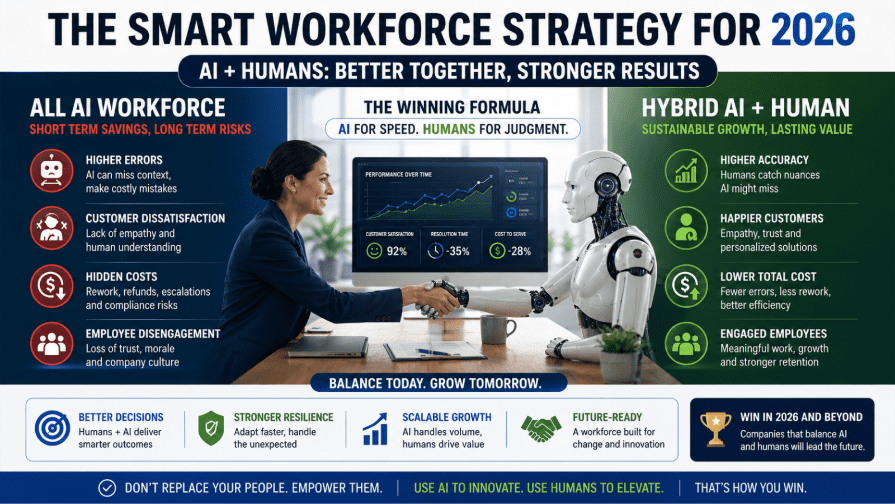
Most companies are not abandoning AI. They are rebuilding their teams around it instead, which is a smarter move than an all-or-nothing approach.
Here is the pattern showing up across industries:
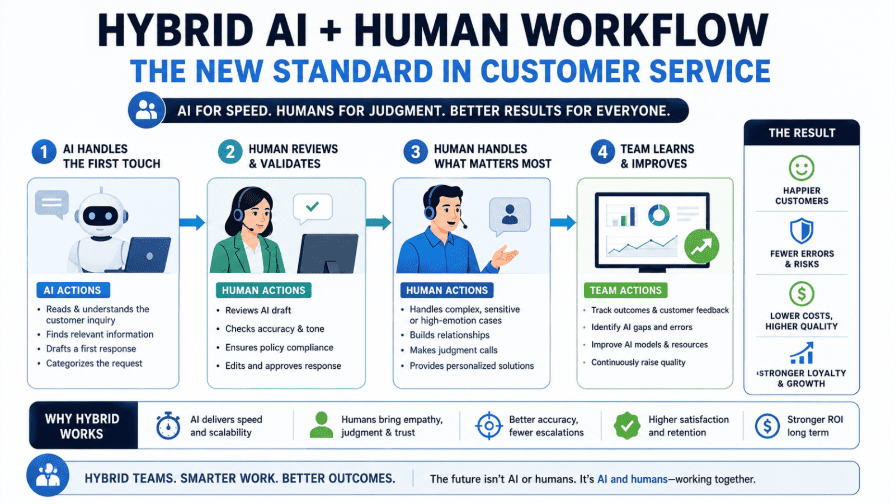
- First, AI handles the repetitive part of the job, like sorting tickets or drafting a first reply.
- Then, a human reviews the output before it reaches a customer.
- Next, the human handles anything unusual, emotional, or high-risk.
- Finally, the team tracks errors so the AI model keeps improving over time.
This hybrid setup is becoming the standard fix for the AI layoff backfire. It keeps the speed of AI without losing the judgment that only a person can offer.
Quick Comparison: Pure AI vs. Hybrid AI Teams
The table below shows why so many companies are shifting away from a pure AI setup.
| Setup | Cost Today | Risk Level | Best For |
| Pure AI | Lowest | High | Simple, low-stakes tasks |
| Hybrid AI + Human | Moderate | Low | Customer-facing, judgment calls |
| Full Human Team | Highest | Lowest | Highly sensitive or complex work |
How to Spot an AI Layoff Backfire Before It Happens
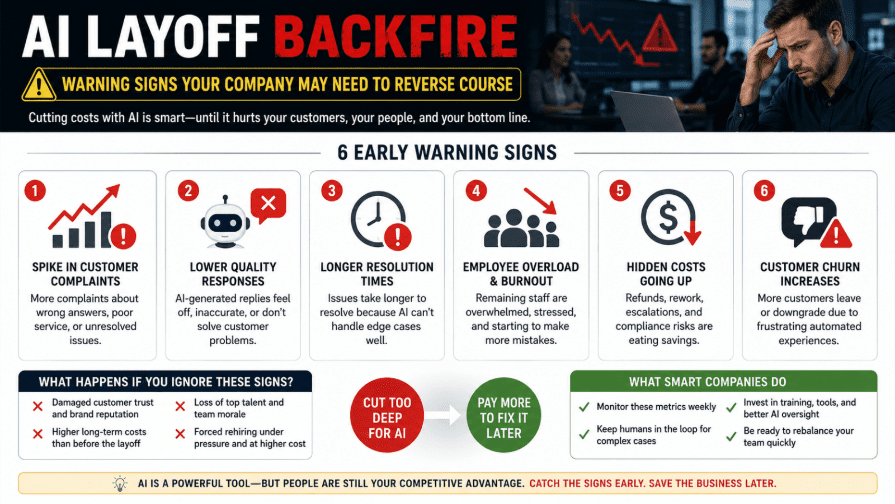
Leaders do not have to wait for a crisis to know an AI cut went too deep. There are early warning signs, and most of them show up fast.
Step 1: Watch Customer Complaint Volume
A sudden jump in complaints right after a layoff is the clearest signal. If tickets about wrong answers or confusing replies start piling up, the AI is likely carrying work it cannot handle alone.
Step 2: Track Quiet Costs, Not Just Payroll
Payroll savings look great on a spreadsheet. They look less great once refunds, compliance fixes, and reputation damage get added in.
Step 3: Ask What Judgment the Role Actually Needs
Some jobs are mostly repetitive. Others involve constant judgment calls. The second type is far riskier to hand fully to AI, no matter how good the model looks in a demo.
Step 4: Talk to the Team Before Cutting
Frontline employees usually know which parts of their job AI can handle and which parts it cannot. Skipping this conversation is how many of these layoffs went wrong in the first place.
Common Mistakes Companies Make With AI Layoffs
Most companies that got burned made one of these same mistakes.
- Cutting an entire team at once instead of testing AI on a small part of the work first.
- Assuming a good demo means the tool is ready for real customers.
- Ignoring the cost of fixing AI mistakes after they happen.
- Removing managers and senior staff who would have caught problems early.
- Treating the layoff as final instead of planning a fallback option.
Avoiding these mistakes does not mean avoiding AI. It just means rolling it out with a safety net instead of a clean break from people.
Should Your Company Worry About an AI Layoff Backfire?
Not every AI-driven cut will backfire. Routine, low-stakes tasks are usually safe to automate fully, and many companies handle this part well.
The risk grows fast in roles that involve trust, emotion, or judgment. Customer service, account management, and anything client-facing sit in the danger zone.
A safer path is the hybrid model already covered above. Let AI handle the first draft or the first response. Keep a person in the loop for anything that could go wrong in a way that costs real money or real trust.
Frequently Asked Questions
What does AI layoff backfire mean?
It means a company cuts jobs because of AI, then has to rehire workers once AI alone cannot handle the job well. This is becoming common enough that some firms call returning staff AI boomerangs.
How many companies are rehiring after AI layoffs?
Robert Half found that 29% of surveyed companies rehired staff after laying them off for AI reasons. Gartner separately projects that half of companies that cut AI-related roles will restaff similar positions within a year.
Which jobs are most likely to come back after an AI layoff?
Mid-level managers, customer success roles, and quality assurance positions are seeing the highest rehiring rates. These roles need judgment and relationship skills that AI still struggles to replace.
Is AI a bad investment for businesses because of this trend?
Not at all. The problem is usually the rollout, not the technology itself. Companies that pair AI with human oversight tend to avoid the AI layoff backfire entirely.
Final Thoughts
The AI layoff backfire is not a sign that AI has failed. It is a sign that many companies moved faster than their AI tools could support.
Forrester found that 55% of employers already regret their AI-related layoffs, and that number is hard to ignore. The smarter path forward looks less like replacing people and more like pairing them with AI.
Companies that get this balance right will likely avoid the next wave of expensive rehiring. The ones that ignore it may end up calling their old team back anyway.