
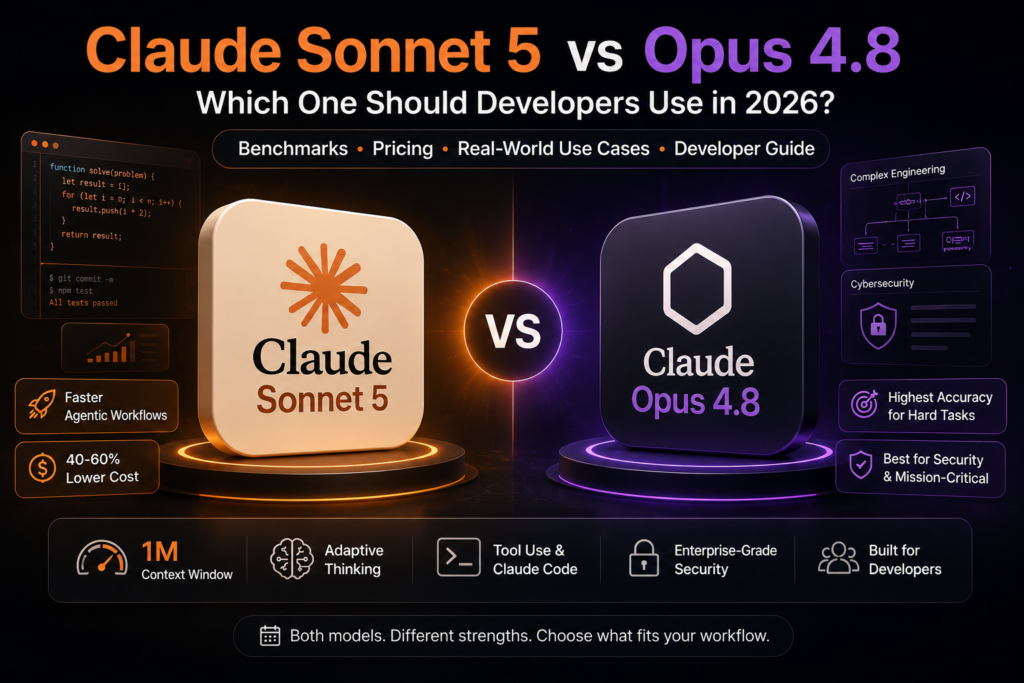

Claude Sonnet 5 launched June 30, 2026, and ever since, the same question keeps coming up: should you stick with Opus 4.8 or switch? It sounds simple. It isn’t, really — because the right answer depends entirely on what kind of work you’re actually doing.
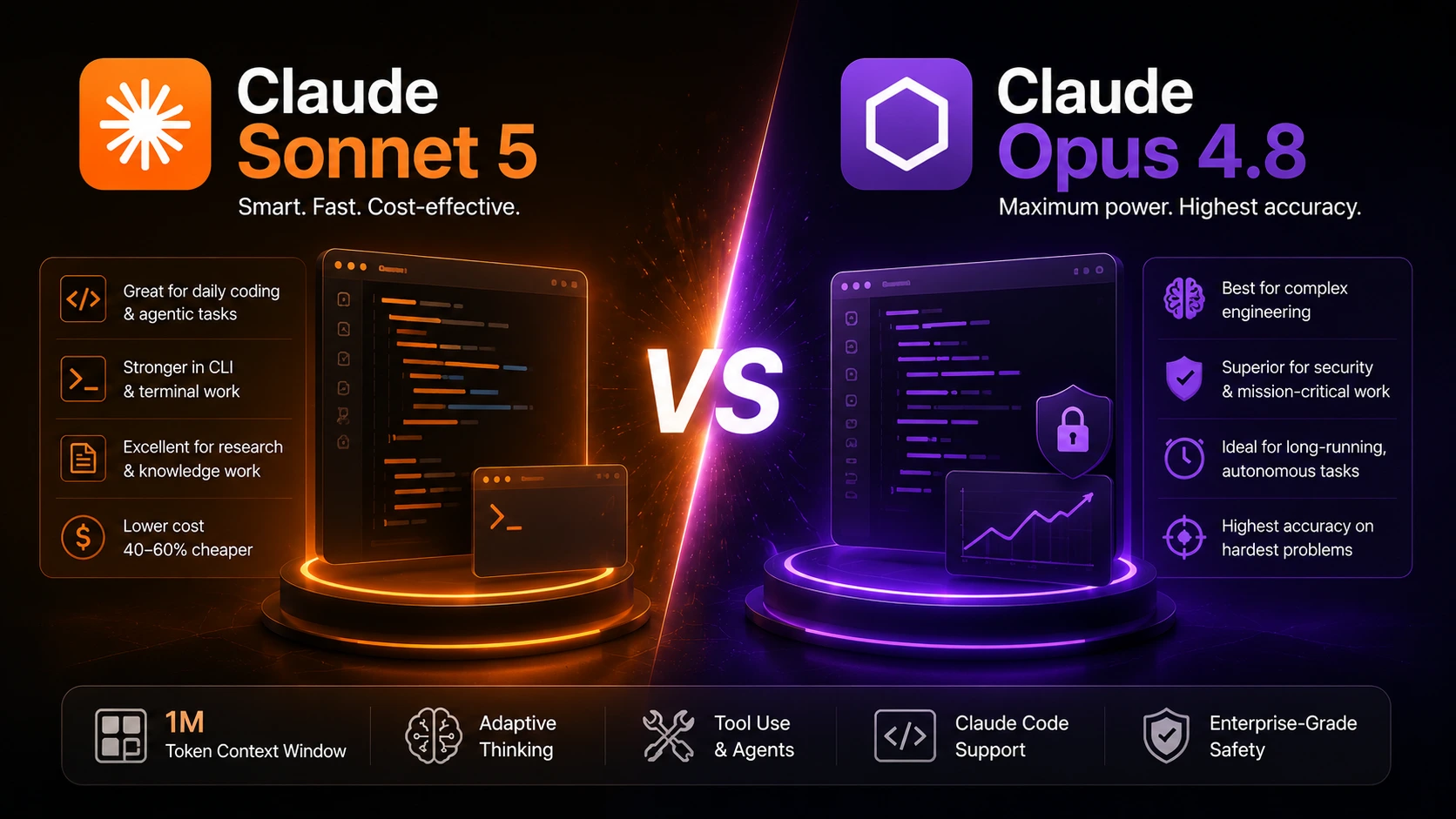
Both models have a 1M-token context window. Both support adaptive thinking, tool use, and Claude Code. The differences are in benchmark performance on specific task types, cost, and which plan tier you’re on. This post breaks it all down using only Anthropic’s own published numbers — no unofficial guesses, no third-party extrapolation.
Where Claude Sonnet 5 vs Opus 4.8 Fits in the Lineup
Anthropic’s current publicly available model lineup runs three tiers: Haiku 4.5 (fast and cheap), Sonnet 5 (mid-tier, now the default for Free and Pro), and Opus 4.8 (flagship, available on Max, Team, and Enterprise). Fable 5 and Mythos 5 exist above Opus but have been suspended under a US export-control directive since June 12, 2026 — so Opus 4.8 is effectively the ceiling most developers can reach right now.
Sonnet 5 was released specifically to close the gap with Opus on agentic tasks. For the past year, the most capable agentic work — multi-step planning, tool chaining, browser and terminal control — was concentrated in the Opus tier. Sonnet 5 changes that picture, but not completely. Knowing where the gaps still exist is the whole point of this comparison.
Claude Sonnet 5 vs Opus 4.8 Benchmark Comparison
All numbers below are from Anthropic’s official June 30, 2026 launch post and system card. No third-party scores, no unofficial tests.
| Feature / Factor | Claude Sonnet 5 | Claude Opus 4.8 |
| Release Date | June 30, 2026 | May 28, 2026 |
| API Model ID | claude-sonnet-5 | claude-opus-4-8 |
| Context Window | 1M tokens | 1M tokens |
| Max Output | 128K (300K via batch beta) | 128K (300K via batch beta) |
| Intro Pricing (Input) | $2/M tokens (till Aug 31) | $5/M tokens |
| Standard Pricing (Input) | $3/M tokens (Sep 1+) | $5/M tokens |
| Standard Pricing (Output) | $15/M tokens | $25/M tokens |
| SWE-bench Pro | 63.2% ✓ | 69.2% (winner) |
| Terminal-Bench 2.1 | 80.4% (WINS) ✓ | 74.6% |
| OSWorld-Verified | 81.2% | 83.4% (winner) |
| GDPval-AA v2 (Knowledge) | 1,618 Elo (WINS) ✓ | 1,615 Elo |
| HLE with tools | 57.4% | 57.9% (winner) |
| Adaptive Thinking | Yes (5 effort levels) | Yes |
| Default Plan | Free & Pro ✓ | Max / Team / Enterprise |
| Cybersecurity work | Not recommended | Recommended ✓ |
| Real-time cyber safeguards | Yes (by default) | Yes (by default) |
| Cost vs Opus 4.8 | 40–60% cheaper ✓ | Baseline |
Two things jump out of this table. First, Sonnet 5 actually beats Opus 4.8 on two benchmarks — Terminal-Bench 2.1 (80.4% vs 74.6%) and GDPval-AA v2 knowledge work (1,618 vs 1,615 Elo). That’s a first for a mid-tier Sonnet model. Second, the SWE-bench Pro gap is 6 full points, and that benchmark measures exactly the kind of hard agentic coding that Opus was built for.
Claude Sonnet 5 vs Opus 4.8 Pricing: The Real Cost Difference
This is where the decision often gets made. Sonnet 5 is 40–60% cheaper than Opus 4.8 depending on the pricing window you’re in.
- Sonnet 5 introductory (till August 31, 2026): $2/M input, $10/M output
- Sonnet 5 standard (September 1 onwards): $3/M input, $15/M output
- Opus 4.8 (unchanged): $5/M input, $25/M output
Take a real-world example. Say you’re running a workflow of 10 million tokens per day, split 70% input and 30% output. At introductory Sonnet 5 pricing, that’s roughly $44/day. At standard Sonnet 5 pricing from September, about $66/day. At Opus 4.8 pricing, that same workload runs $110/day. The gap is real and it compounds fast at scale.
One catch worth knowing about: Sonnet 5 uses a new tokenizer that produces 1.0–1.35x more tokens from the same input text compared to Sonnet 4.6. English prose trends toward the higher end of that multiplier. Anthropic set the introductory pricing to make the switch roughly cost-neutral versus Sonnet 4.6, but this changes after August 31. Budget for it before September.
Which Tasks Suit Claude Sonnet 5 vs Opus 4.8?
Benchmarks tell part of the story. Use cases tell the rest.
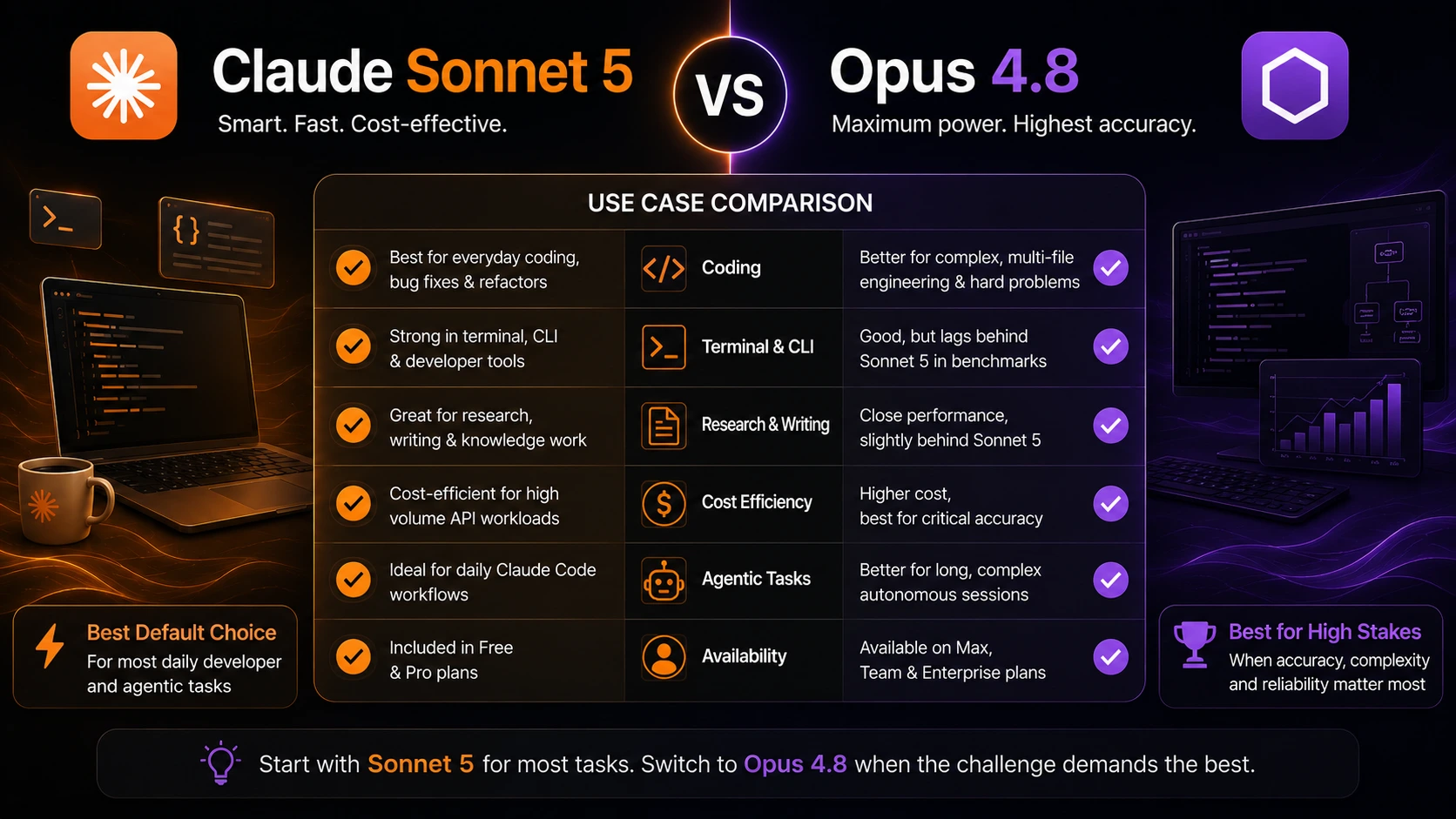
| Use Case | Sonnet 5 | Opus 4.8 |
| Everyday coding & bug fixes | ✅ Best choice | Overkill |
| Multi-file agentic refactor | ✅ Good fit | ✅ Better on hardest |
| Claude Code daily workflows | ✅ Default | ✅ If precision critical |
| Long autonomous sessions (30+ min) | Good | ✅ Recommended |
| Cybersecurity / exploit research | ❌ Avoid | ✅ Use this |
| High-volume API calls | ✅ Cost-efficient | Expensive |
| Knowledge work / research | ✅ Edges Opus slightly | ✅ Close |
| Computer use / browser agents | ✅ 81.2% | ✅ 83.4% |
| Hard math / USAMO-level | Weaker | ✅ Better |
| Free / Pro plan users | ✅ Default available | ❌ Not available |
The pattern is consistent: Sonnet 5 handles most of what developers do day-to-day at a fraction of the cost. Opus 4.8 earns its price on the tasks where being wrong is expensive — complex multi-file engineering with minimal supervision, cybersecurity research, and anything that needs the best available accuracy on hard reasoning.
Where Claude Sonnet 5 Beats Opus 4.8
Terminal and CLI Work
Sonnet 5 scores 80.4% on Terminal-Bench 2.1, vs Opus 4.8’s 74.6%. That’s not a marginal difference — it’s a meaningful 6-point lead on exactly the kind of command-line, shell scripting, and terminal-agent workflows that a lot of backend developers spend their time on. If your Claude Code sessions involve heavy terminal work, Sonnet 5 is actually the better model here.
Knowledge Work and Professional Tasks
On GDPval-AA v2, Sonnet 5 edges Opus 4.8 by 3 Elo points (1,618 vs 1,615). This benchmark covers professional writing, research synthesis, document analysis — the kind of everyday work that isn’t purely coding. The gap is narrow enough that it could be within methodology noise, but it’s worth noting that Sonnet 5 doesn’t lose here.
Cost-Sensitive Production Workloads
If you’re making thousands of API calls a day — summarization pipelines, code review bots, documentation generators — Sonnet 5 at $2–3/M input tokens vs Opus at $5/M input is a straightforward budget decision. At high volume, the quality difference on routine tasks rarely justifies double the price.
Where Opus 4.8 Still Beats Claude Sonnet 5
Hard Agentic Coding
SWE-bench Pro is the most honest benchmark for this. Opus 4.8 at 69.2% vs Sonnet 5 at 63.2% is a 6-point gap on real GitHub issue resolution. If your agent needs to work through genuinely complex, multi-file bugs with minimal supervision over a long session, that gap translates to real task success rates. Anthropic’s own recommendation: use Opus for accuracy-critical agentic coding where failure is expensive.
Cybersecurity Work
Sonnet 5 is intentionally weaker here. Anthropic’s system card reports it couldn’t develop a working exploit in the Firefox 147 evaluation — by design, not by accident. Real-time cyber safeguards are on by default, blocking high-risk dual-use activities more aggressively than Opus. If you’re doing sanctioned security research or penetration testing workflows, Opus 4.8 with reduced guardrails is the correct tool.
Long Autonomous Sessions
For tasks running 30+ minutes with minimal human checkpoints, Opus 4.8’s deeper reasoning holds up better. Sonnet 5 is strong on agentic tasks that finish in minutes. For hours-long autonomous work where one wrong decision compounds into many downstream failures, the extra capability of Opus earns its cost.
Claude Sonnet 5 vs Opus 4.8: The Practical Decision
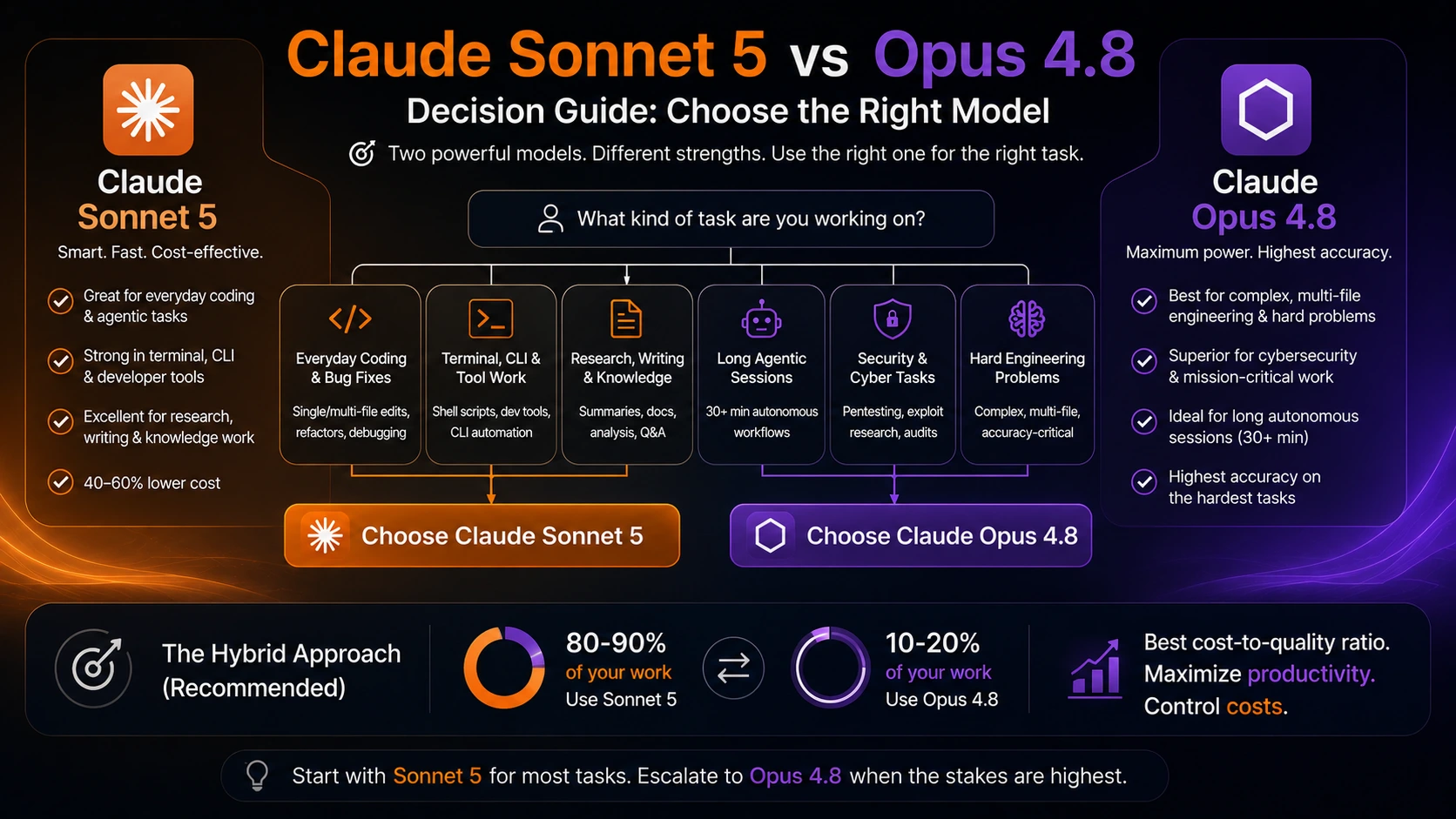
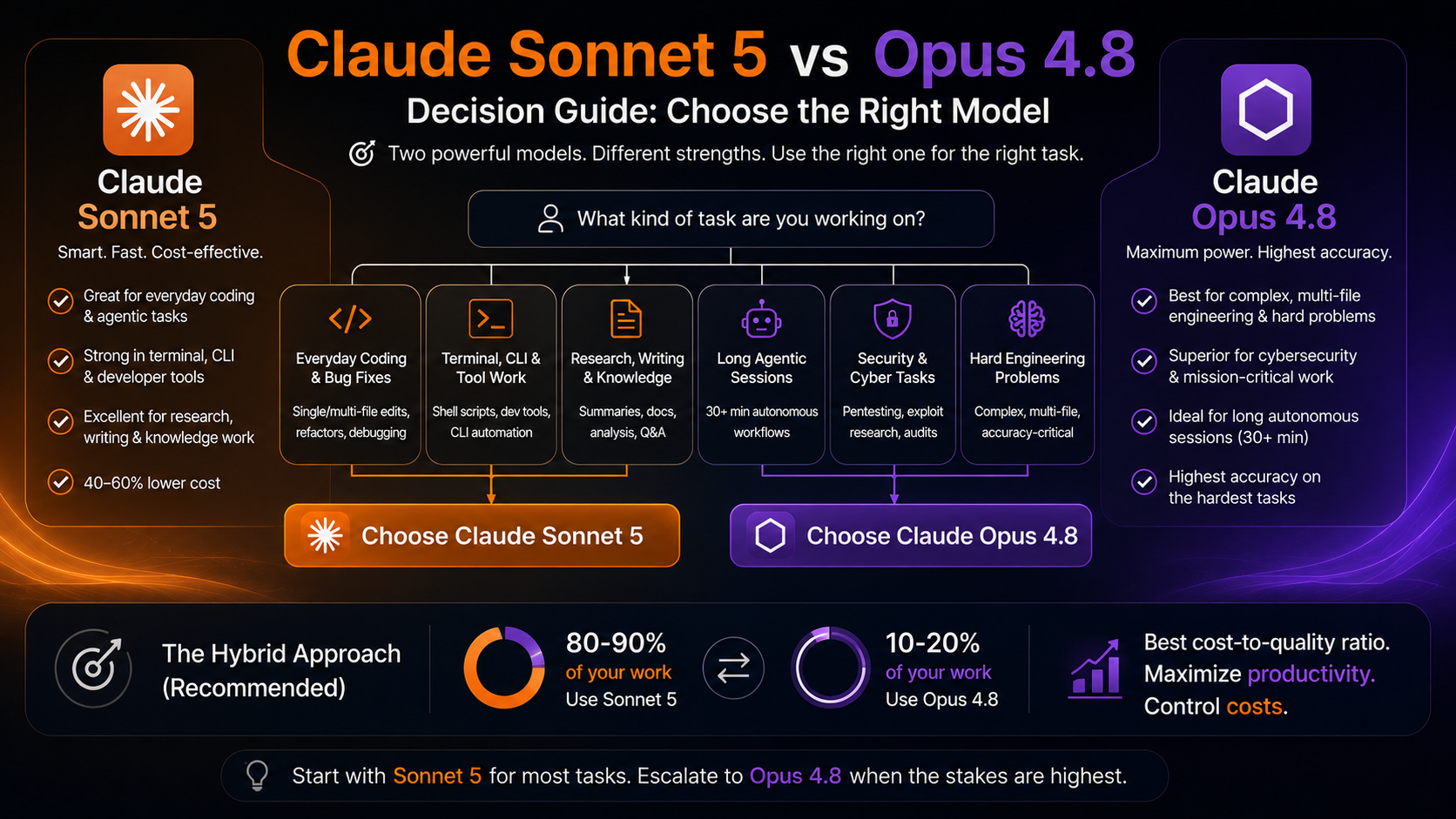
Honestly, for most developers the decision is already made: Sonnet 5 is your default. It’s cheaper, it’s available on Free and Pro plans, and it handles everyday agentic coding, Claude Code workflows, research, and professional tasks well. You won’t feel the 6-point SWE-bench gap on most tasks you’re actually working on.
Upgrade to Opus 4.8 when the task genuinely needs it. Good signals: you’re running sessions longer than 30 minutes with minimal supervision, you’re doing anything security-related, or you’ve tried Sonnet 5 on a specific hard engineering problem and the failure rate isn’t acceptable.
A practical setup many developers are using: Sonnet 5 for daily work and Claude Code sessions, with Opus 4.8 as the escalation model for the hardest problems. Route 80-90% of your traffic to Sonnet 5 and reserve Opus for the edge cases. The bill drops significantly without a meaningful quality hit on the majority of work.
Frequently Asked Questions: Claude Sonnet 5 vs Opus 4.8
Is Claude Sonnet 5 better than Opus 4.8?
On two specific benchmarks — Terminal-Bench 2.1 and GDPval-AA v2 knowledge work — Sonnet 5 actually edges Opus 4.8. On most others, Opus 4.8 leads, with the biggest gap on SWE-bench Pro (hard agentic coding). So the honest answer is: it depends on the task. Sonnet 5 is better value for most everyday work; Opus 4.8 is the better model when task complexity and accuracy matter most.
Can I switch from Opus 4.8 to Sonnet 5 in the API?
Yes — change the model string from claude-opus-4-8 to claude-sonnet-5 in your API call. That’s the only required change. Before switching production traffic, run your existing eval suite on both models and check token counts, since Sonnet 5’s updated tokenizer may change your per-task cost and context-window usage compared to older models.
Which is cheaper — Claude Sonnet 5 or Opus 4.8?
Sonnet 5 is 40–60% cheaper. Through August 31, 2026, it’s $2/$10 per million input/output tokens vs Opus 4.8’s $5/$25. After September 1, Sonnet 5 moves to $3/$15 but still costs significantly less. Factor in the new tokenizer when comparing real workload costs.
Is Opus 4.8 still worth using after Sonnet 5 launched?
Yes, for specific workloads. The SWE-bench Pro gap (69.2% vs 63.2%) is real for hard agentic coding. Cybersecurity work still belongs on Opus. And for long, highly autonomous sessions where failure is expensive, Opus 4.8’s reliability justifies the price. It’s not for every task — but the tasks it’s best at are precisely the ones where quality matters most.
Which model should I use in Claude Code?
Sonnet 5 is now the default in Claude Code and handles most coding workflows well, including multi-step debugging and multi-file edits. If you’re working on genuinely complex engineering problems — legacy codebases, intricate architectural changes, or anything where a wrong decision early costs hours later — switching to Opus 4.8 within Claude Code is worth the extra token cost.
The Bottom Line on Claude Sonnet 5 vs Opus 4.8
Sonnet 5 is the right default for most developers in 2026. It’s cheaper, it’s the model available on Free and Pro plans, and it genuinely beats Opus 4.8 on terminal work and knowledge tasks. The 6-point SWE-bench Pro gap is real, but it only shows up on hard agentic coding — not on the routine work that makes up most of a developer’s day.
Opus 4.8 still has a clear lane: complex autonomous sessions, cybersecurity work, and the hardest engineering problems where accuracy is non-negotiable. It’s not obsolete — Sonnet 5 just narrowed the use case where Opus is the obvious answer.
Start with Sonnet 5. Keep Opus 4.8 in your back pocket for the edge cases. That’s the most sensible setup for almost everyone right now.