

Claude Sonnet 5 dropped on June 30, 2026 — and it landed at an interesting moment. Anthropic’s top two models, Fable 5 and Mythos 5, are currently suspended under a US export-control order with no confirmed return date. That makes Claude Sonnet 5 effectively the best Claude model most people can access right now, sitting just below Opus 4.8 in capability and significantly below it in price.
The pitch is simple: near-Opus performance at mid-tier pricing. Whether that holds up depends on the task. This review uses only verified numbers from Anthropic’s official launch post and system card — no inflated claims, no unofficial extrapolations.

What Is Claude Sonnet 5?
Claude Sonnet 5 is Anthropic’s latest mid-tier model — sitting between the lightweight Haiku 4.5 and the flagship Opus 4.8. It was developed under the internal codename Fennec and replaces Sonnet 4.6, which launched back in February 2026. From launch day, it became the default model for every Free and Pro user on claude.ai automatically. You’re probably already on it.
The core design goal was to bring agentic capability — multi-step planning, tool use, browser and terminal control — down to Sonnet pricing. For the past year, those gains had been concentrated in the larger Opus-class models. Sonnet 5 narrows that gap significantly, which is the actual story here.
API model ID is claude-sonnet-5. Context window is 1 million tokens, matching Opus 4.8. Max output is 128K tokens, extendable to 300K via a batch-API beta header. Adaptive thinking is on by default, with effort defaulting to high in the API and Claude Code. Training knowledge cutoff is January 2026.

What’s New in Claude Sonnet 5 vs Sonnet 4.6
The four main areas of improvement over Sonnet 4.6, all verified from Anthropic’s launch post:
Agentic execution
Sonnet 5 can complete multi-step tasks end-to-end that previous Sonnet versions would stall partway through. Zapier’s team tested it on a two-part job updating Salesforce account tiers then sending a launch email to enterprise contacts, and it finished both without stopping. That kind of reliable chaining used to require Opus.
Selectable reasoning effort
Sonnet 5 exposes five effort levels: low, medium, high, max, and x-high. At x-high effort, it matches Opus 4.8 at medium-to-high effort on agentic search and computer-use benchmarks. This also means cost varies — cranking effort to max roughly doubles token usage without proportional gains on every task.
Updated tokenizer
Sonnet 5 uses a new tokenizer that produces roughly 1.0–1.35x more tokens from the same input compared to Sonnet 4.6. Anthropic set introductory pricing to make the switch roughly cost-neutral, but this changes from September 1 — more on that in the pricing section.
Improved safety profile
Anthropic’s pre-deployment evals show lower hallucination rates, lower sycophancy, better resistance to prompt injection in agentic contexts, and real-time cyber safeguards enabled by default. The same safeguards used in Opus 4.7 and 4.8.
Claude Sonnet 5 Benchmarks vs Sonnet 4.6 and Opus 4.8
These are Anthropic’s own published numbers from the June 30, 2026 system card. No third-party extrapolations, no unofficial comparisons against models Anthropic didn’t test against.
| Benchmark | Sonnet 4.6 | Claude Sonnet 5 | Opus 4.8 |
| SWE-bench Pro (agentic coding) | 58.1% | 63.2% | 69.2% |
| OSWorld-Verified (computer use) | 78.5% | 81.2% | 83.4% |
| Terminal-Bench 2.1 (CLI tasks) | — | 80.4% ✓ WINS | 74.6% |
| GDPval-AA v2 (knowledge work) | — | 1,618 Elo ✓ WINS | 1,615 Elo |
| BrowseComp (agentic search) | — | 84.7% | ~comparable |
| HLE with tools (reasoning) | — | 57.4% | 57.9% |
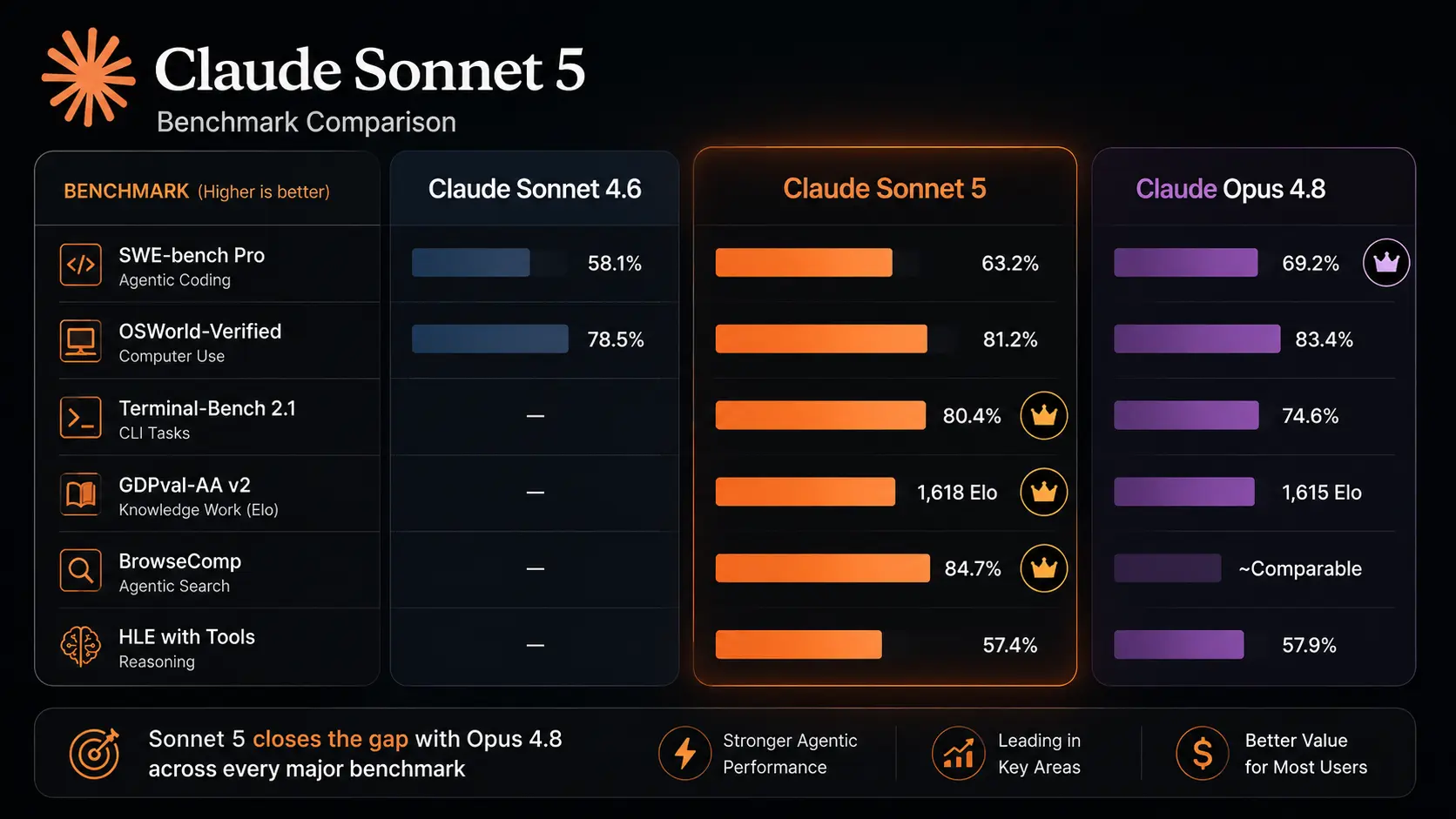
Two things stand out in this table. First, Sonnet 5 beats Opus 4.8 on Terminal-Bench 2.1 (80.4% vs 74.6%) and edges it on GDPval-AA v2 knowledge work (1,618 vs 1,615 Elo) — a first for a Sonnet-class model. Second, the SWE-bench Pro gap is real: Opus 4.8 leads by 6 full points (69.2% vs 63.2%) on hard agentic coding, which matters if you’re running complex, multi-file engineering work. For everything else, Sonnet 5 is close enough that the cost difference is the deciding factor.
Claude Sonnet 5 Pricing: The Full Breakdown
Claude Sonnet 5 launches with time-sensitive pricing. Through August 31, 2026, it costs $2 per million input tokens and $10 per million output tokens. From September 1, that moves to $3/$15 — the same standard rate Sonnet 4.6 charged. Opus 4.8 is $5/$25 at standard rates.
There’s a catch that most launch coverage skips: the new tokenizer. Because Sonnet 5 produces 1.0–1.35x more tokens from the same input text (English prose trends toward 1.35x, Python code toward 1.28x, Simplified Mandarin is roughly neutral), your actual cost per task may be higher than the token rate suggests. Anthropic set the introductory price to make it cost-neutral for the transition window. After September, factor the tokenizer multiplier into your budget.
| Model | Input (standard) | Output (standard) | Context Window | Default Plan |
| Claude Haiku 4.5 | $0.80/M | $4/M | 200K | — |
| Claude Sonnet 5 (intro, till Aug 31) | $2/M | $10/M | 1M | Free & Pro ✓ |
| Claude Sonnet 5 (standard, Sep+) | $3/M | $15/M | 1M | Free & Pro ✓ |
| Claude Opus 4.8 | $5/M | $25/M | 1M | Max/Team/Ent |
| Claude Fable 5* | $15/M | $75/M | 1M | Suspended |
Fable 5 pricing listed for reference only. Claude Fable 5 and Mythos 5 have been suspended since June 12, 2026 under a US export-control directive. No return date confirmed.
Prompt caching applies on top of standard pricing and can significantly cut input costs on repeated system prompts or shared long context. Rate limits have been raised across Chat, Cowork, Claude Code, and the API to handle the heavier token usage that higher effort levels generate.
Claude Sonnet 5 vs Sonnet 4.6: Should You Upgrade?
For most people, yes. The agentic gains are real and consistent across every benchmark Anthropic published. If you’re running Claude Code, multi-step tool-use pipelines, or any automated workflow that previously stalled halfway, Sonnet 5 completes what 4.6 couldn’t.
The one reason to hold off: the tokenizer. If you have tight latency SLAs or hard token-budget constraints, test your actual workloads before flipping production traffic. Run your existing eval suite on both models before September when introductory pricing ends. The sticker rate may look the same, but 1.35x more tokens on English text means 1.35x the cost.
Claude Sonnet 5 vs Opus 4.8: When Does Each One Make Sense?
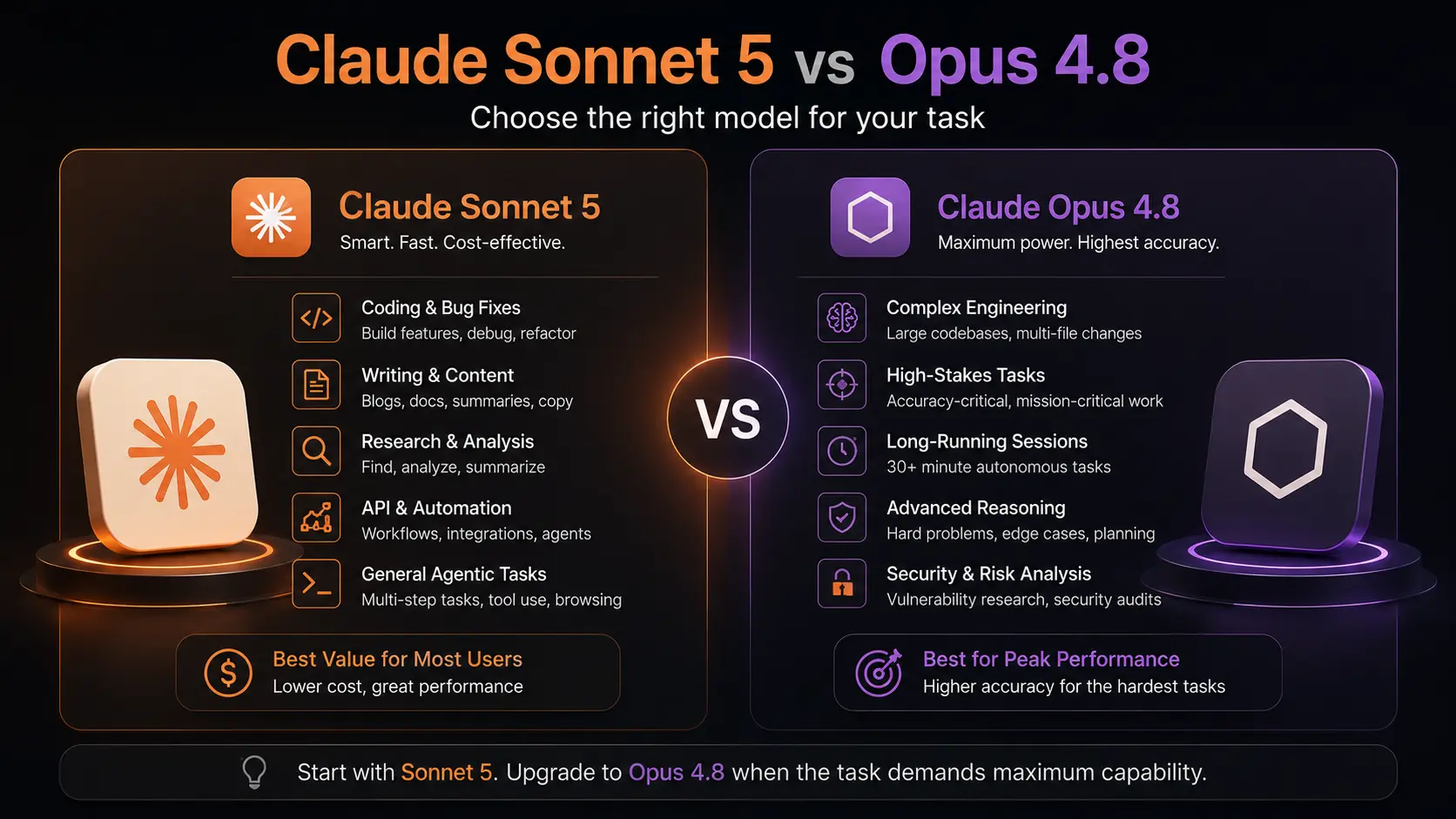
Sonnet 5 for the majority of daily work — coding features and bug fixes, writing, research, API workflows, agentic tasks that run for minutes. It’s fast, it’s less than half the price of Opus 4.8 at intro rates, and for most real tasks the quality gap won’t be the bottleneck.
Opus 4.8 for your hardest, highest-stakes tasks — complex multi-file engineering where being wrong is expensive, long-running autonomous sessions of 30+ minutes, and cybersecurity work (Sonnet 5 is notably weaker here by design — it couldn’t develop a working exploit in Anthropic’s Firefox 147 evaluation, which is intentional from a safety standpoint).
The practical framing: if Sonnet 4.6 was getting the job done for you, Sonnet 5 gets it done better and faster for roughly the same cost. If you were on Opus because nothing cheaper was reliable enough, Sonnet 5 is worth testing before your next billing cycle.
Where Claude Sonnet 5 Is Available
From launch day: claude.ai (Free, Pro, Max, Team, Enterprise), Claude Code, Claude Platform API (model ID: claude-sonnet-5), AWS Bedrock (anthropic.claude-sonnet-5), Google Vertex AI, Microsoft Foundry, GitHub Copilot (Pro, Pro+, Max, Business, Enterprise), Cursor, VS Code, and OpenRouter with matching $2/$10 introductory pricing.
One note for organizations: admins may need to enable the model through Copilot or workspace settings before it appears in model pickers. Check your admin controls if it’s not showing up automatically.
The Bigger Context: Fable 5 Is Still Offline
Claude Sonnet 5 launched into an unusual situation. On June 12, 2026 — less than three weeks before this release — the US Commerce Department issued an export-control directive requiring Anthropic to suspend access to Fable 5 and Mythos 5 for any foreign national, including non-citizen Anthropic employees. Both models have been offline since then with no confirmed return date.
This matters for Sonnet 5 because it means the model is effectively positioned as the best widely available Claude right now, not just a mid-tier option. Opus 4.8 is the only stronger model most users can reach. Sonnet 5 is unlikely to face the same restrictions — its cyber capabilities are substantially weaker than the Mythos-class models, which is precisely why Fable 5 was targeted.
Mistakes to Avoid When Switching to Claude Sonnet 5
Assuming the token rate is the whole cost story. It isn’t. The 1.35x tokenizer multiplier on English text is real. Test your actual workload cost before September when intro pricing ends.
Running x-high effort by default. The highest effort setting roughly doubles token usage. It’s not always worth it — independent testing found x-high effort caught fewer bugs per dollar than medium-to-high settings on code review tasks. Use it selectively.
Using Sonnet 5 for cybersecurity tasks. It’s explicitly weaker here, and that’s intentional. Anthropic recommends Opus 4.8 for any workload requiring reduced guardrails or serious security research. Sonnet 5 failed Anthropic’s Firefox 147 exploit evaluation by design.
Not pinning a model version in production. If you’re using the claude-sonnet-5 alias in production, behavior could shift if Anthropic releases a patched version under the same alias. For stable production deployments, check Anthropic’s API docs for pinned dated versions.
Frequently Asked Questions About Claude Sonnet 5
Is Claude Sonnet 5 free to use?
Yes. It’s the default model for Free and Pro plans on claude.ai from launch day. Free plan users get it without any changes to their account. API usage is not free — it’s billed at $2/$10 per million tokens through August 31, 2026.
What is the Claude Sonnet 5 API model ID?
The API model ID is claude-sonnet-5. For AWS Bedrock it’s anthropic.claude-sonnet-5. Anthropic may also release pinned dated versions — check the official API documentation for production deployments.
Does Claude Sonnet 5 replace Opus 4.8?
No. Sonnet 5 closes the gap significantly but doesn’t replace Opus 4.8 for the hardest tasks. On SWE-bench Pro, Opus 4.8 leads by 6 points (69.2% vs 63.2%). For complex, long-running agentic engineering work and anything cybersecurity-related, Opus 4.8 remains the stronger choice. For everyday agentic tasks, Sonnet 5 is the better value.
Why did the price change from introductory to standard?
Sonnet 5 uses a new tokenizer that produces roughly 1.0–1.35x more tokens from the same input text. Anthropic set the $2/$10 introductory rate to make the switch from Sonnet 4.6 roughly cost-neutral. After August 31, 2026, it moves to $3/$15 — the same standard rate Sonnet 4.6 already charged — but the tokenizer change means effective cost per task will be somewhat higher than Sonnet 4.6 was.
Is Claude Sonnet 5 available in Claude Code?
Yes, from launch day. It’s live in Claude Code and is the recommended model for most coding-agent workflows given the agentic improvements. Dynamic workflow support — where a single session coordinates parallel subagents — is also available in Claude Code, though still in research preview.
Verdict: Is Claude Sonnet 5 Worth Switching To?
For most users, the answer is yes, and you probably don’t need to do anything — it’s already your default model on Free and Pro. The agentic gains over Sonnet 4.6 are meaningful, the benchmarks are honest about where Opus 4.8 still leads, and the introductory pricing makes the timing good.
The two things to actually watch: your token costs before September (the tokenizer change affects your real bill more than the rate card suggests), and whether the tasks you need most fall in the SWE-bench-type coding category where Opus 4.8 still has a real lead. If they don’t, Claude Sonnet 5 is the obvious default for the rest of 2026.