

Introduction
Modern software development demands speed and reliability. Developers must release updates quickly without breaking applications. CI/CD pipelines in DevOps solve this problem by automating the entire delivery process.
CI/CD automates testing, building, and deployment so teams can ship software faster and with fewer errors.
In this article, you will learn what CI/CD is, how it works, and why DevOps teams use it.
What is CI/CD?
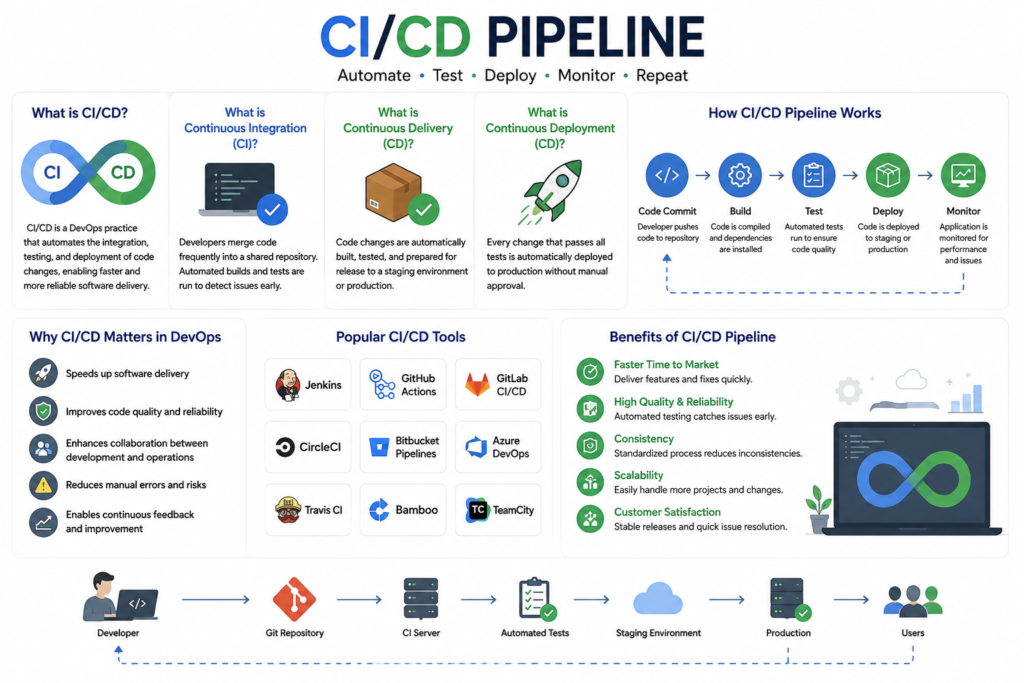
CI/CD stands for:
- Continuous Integration (CI)
- Continuous Delivery (CD)
DevOps teams use CI/CD to automate software development and deployment.
👉 Instead of manually testing and deploying code, teams automate the entire workflow.
What is Continuous Integration (CI)?
Continuous Integration allows developers to merge code into a shared repository regularly.
Every time a developer pushes code:
- The system runs automated tests
- It detects errors early
- It improves code quality instantly
👉 This process prevents major integration issues later.
What is Continuous Delivery (CD)?
Continuous Delivery keeps code always ready for release.
After CI testing:
- The system prepares code for deployment automatically
- Teams approve releases when needed
This process speeds up software delivery and reduces manual effort.
What is Continuous Deployment?
Continuous Deployment takes automation one step further.
👉 The system deploys every tested change directly to production.
Teams do not manually approve releases in this model.
Companies use this approach when they need rapid updates and fast release cycles.
How CI/CD Pipeline Works
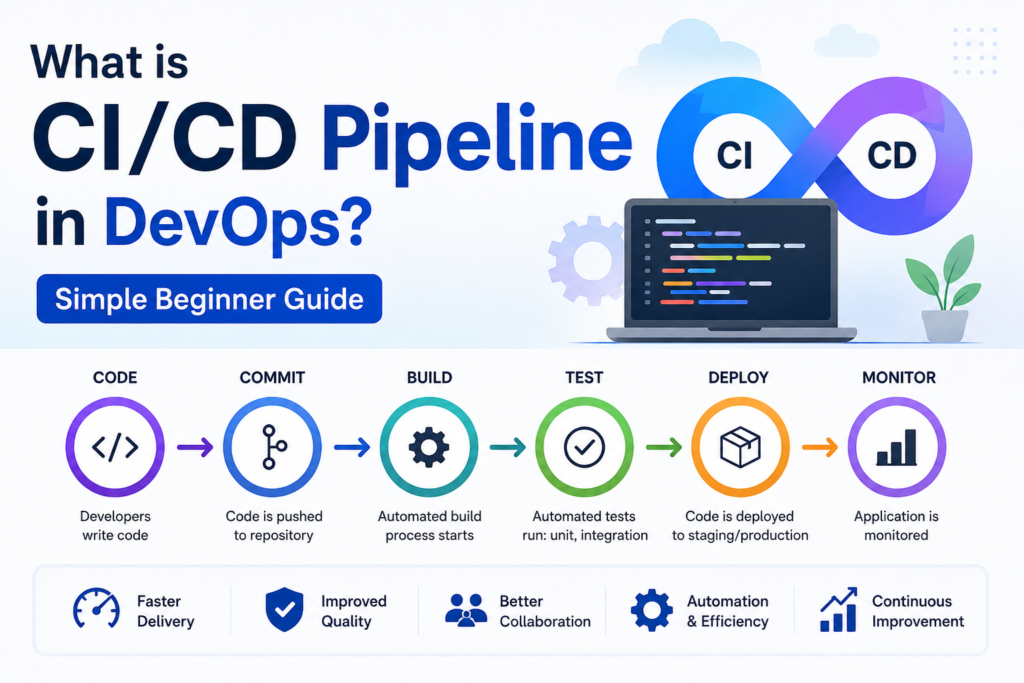
A CI/CD pipeline follows this flow:
- A developer writes code
- The developer pushes code to GitHub
- The system builds the project automatically
- Automated tests run
- If tests pass, the system deploys the application
- The application goes live
👉 This process removes manual steps and improves speed.
Why CI/CD Matters in DevOps
CI/CD plays a key role in DevOps because it:
- Reduces human errors
- Speeds up development cycles
- Improves software quality
- Automates repetitive tasks
- Helps teams deliver faster updates
Popular CI/CD Tools
DevOps teams use these tools widely:
- Jenkins
- GitHub Actions
- GitLab CI/CD
- CircleCI
- Azure DevOps
Benefits of CI/CD Pipeline
Teams deliver software faster
✔ Code quality improves
✔ Bugs get detected early
✔ Workflows become automated
✔ Collaboration becomes easier
Conclusion
CI/CD pipelines form the backbone of modern DevOps workflows. They automate software building, testing, and deployment so teams can release updates quickly and safely.
If you learn DevOps, you must understand CI/CD because it drives modern software delivery systems.