
Vibe coding is one of those terms that either excites you or makes you roll your eyes, depending on where you sit in the software world. It blew up in early 2025, got named Collins Dictionary’s Word of the Year, and by mid-2026 it’s become the kind of thing developers either swear by or argue against in Twitter threads. Both reactions make sense, honestly.
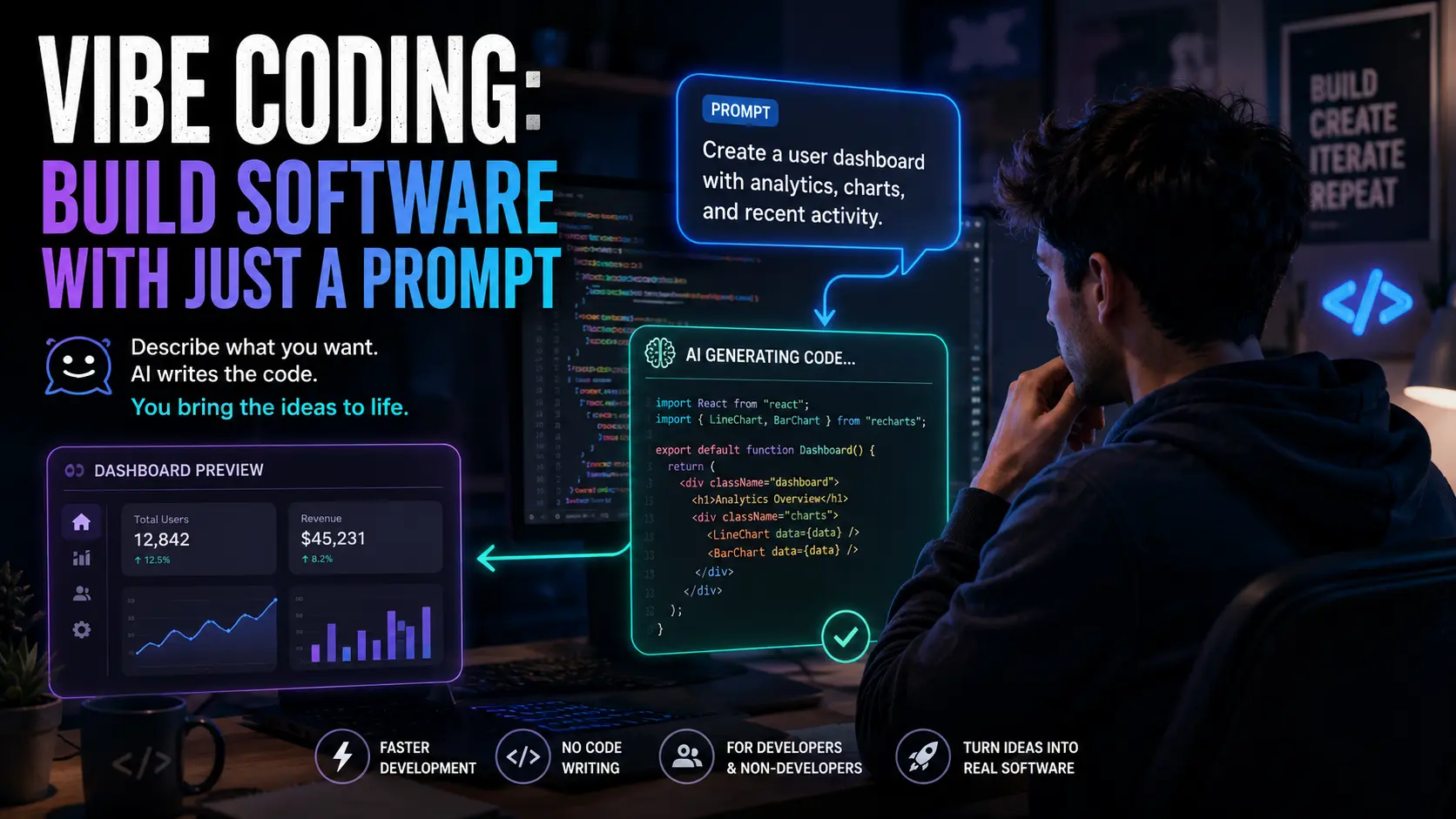
So what is vibe coding, and why does it keep sparking debate? The short version: you describe what you want to build in plain language, an AI generates the code, and you iterate from there — without necessarily reading every line it produces. That’s the core idea. Everything else is context.
What Vibe Coding Actually Means
The term was coined by Andrej Karpathy — former Tesla AI lead and OpenAI founding member — in a post in February 2025. His description was disarmingly casual: “There’s a new kind of coding I call vibe coding, where you fully give in to the vibes, embrace exponentials, and forget that the code even exists.” He wasn’t prescribing anything. He was describing how he’d been working lately.
The mechanics are simple. You open Cursor, Claude Code, Replit, or any similar tool. You describe what you want — a login page, a data processing script, an API endpoint. The AI generates it. You test it, describe what’s wrong or what you want next, and iterate. The role shifts from writing code to directing an AI that writes it.
What separates vibe coding from just using GitHub Copilot for autocomplete is the acceptance part. Traditional AI-assisted coding means reviewing suggestions, understanding them, and accepting the ones that fit. Vibe coding, in its pure form, means accepting the output and moving forward — trusting the AI to handle implementation while you focus on what you want to achieve. That distinction is also where most of the controversy lives.
Why Vibe Coding Took Off So Fast
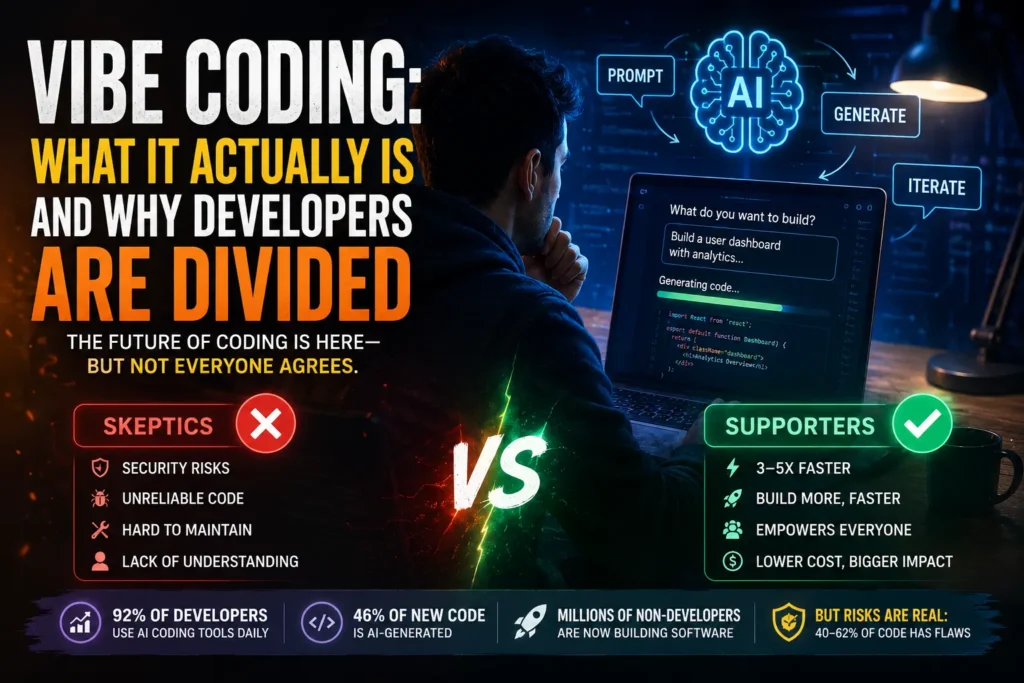
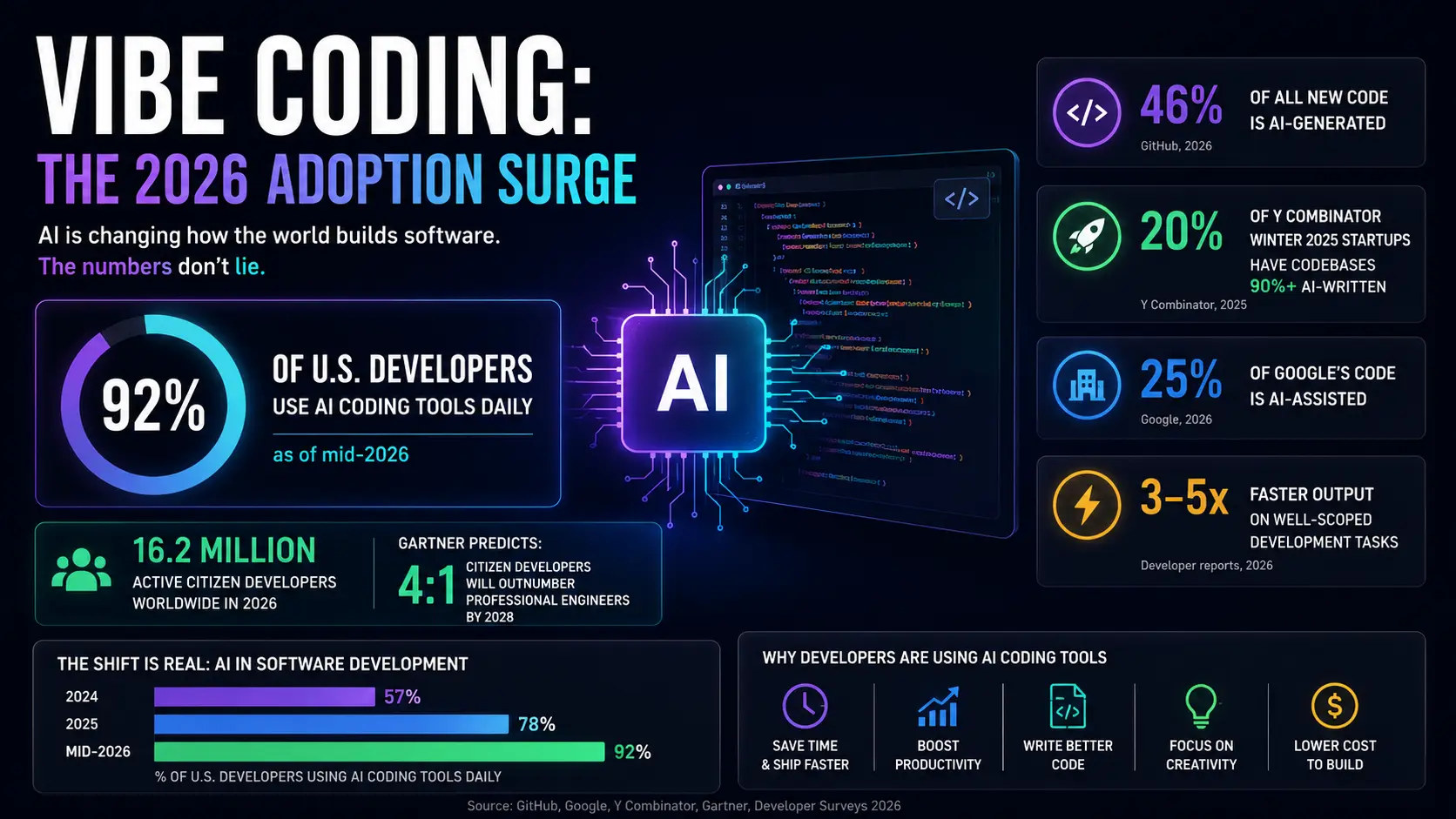
The numbers are hard to argue with. By mid-2026, 92% of US developers use AI coding tools daily. GitHub reports that 46% of all new code is now AI-generated. Among Y Combinator’s Winter 2025 batch, over 20% of startups had codebases that were more than 90% AI-written. Google says a quarter of their code is AI-assisted.
The speed gains are real. Developers report 3–5x faster output on well-scoped tasks. One developer built an entire SaaS product with Cursor — zero hand-written code — and shipped it to paying users. The cost of building a functional MVP dropped from roughly $200,000 to around $5,000. Timelines compressed from six months to six weeks.
For non-developers, vibe coding opened a door that previously required years of training to walk through. Product managers, designers, startup founders — about 63% of vibe coding users identify as non-developers. Forrester estimates 16.2 million active citizen developers worldwide right now, and Gartner predicts they’ll outnumber professional engineers 4:1 by 2028. That’s not a niche trend.
Why Experienced Developers Are Skeptical of Vibe Coding
Here’s where it gets uncomfortable. The same industry reporting 92% AI tool adoption also reports this: trust in AI-generated code has dropped from around 40% to just 29% in a single year. Among senior engineers specifically, only 2.6% report high trust in AI output, while 20% actively distrust it. Yet 52% of developers don’t always review AI-generated code before committing.
The security data is the most damning part. Depending on the study, 40–62% of AI-generated code contains security flaws. AI fails to protect against cross-site scripting 86% of the time. A 2026 security firm tested five popular vibe coding tools — Claude Code, Codex, Cursor, Replit, Devin — built 15 identical apps across them, and found 69 vulnerabilities. Six were critical.
The human cost side is real too. In early 2026, a vibe-coded app was also hacked where 1.5 million API keys and 35,000 user email addresses were leaked from a database with wrong configurations. The owner admitted they hadn’t written a single line manually. The app was built fast. It just wasn’t built safely. And when things went wrong, there was no one who understood the code well enough to fix it.
Robert Martin (Uncle Bob) and other engineering veterans have been making essentially the same argument: you can’t maintain what you don’t understand. The vibe coding debate is, in some ways, the craftsmanship argument the software industry has been having since the 1990s — just running on new hardware.
Vibe Coding vs. Traditional Engineering: Where Each One Fits
| Vibe Coding | Traditional Engineering | |
| Speed | 3–5x faster for prototypes | Slower but predictable |
| Security | 40–62% of code has flaws | Lower risk with reviews |
| Maintainability | Hard to debug what you didn’t write | Easier long-term ownership |
| Best for | MVPs, prototypes, demos | Production, critical systems |
| Who uses it | Founders, PMs, indie devs | Senior engineers, enterprise teams |
| Code understanding | Often shallow or none | Deep by default |
How to Use Vibe Coding Without Burning Yourself
The productive framing isn’t ‘vibe coding vs. real engineering.’ It’s knowing which tasks belong in which bucket.
Prototypes and MVPs are where vibe coding shines. You need user feedback fast, the codebase will probably be rewritten anyway, and speed matters more than polish. Ship it, learn from it, rebuild the parts that need to survive.
Production systems, anything handling payments or auth, and code that has to be maintained for years are where you want human understanding at every layer. Use AI to accelerate — generate boilerplate, write tests, suggest approaches — but review what goes into production.
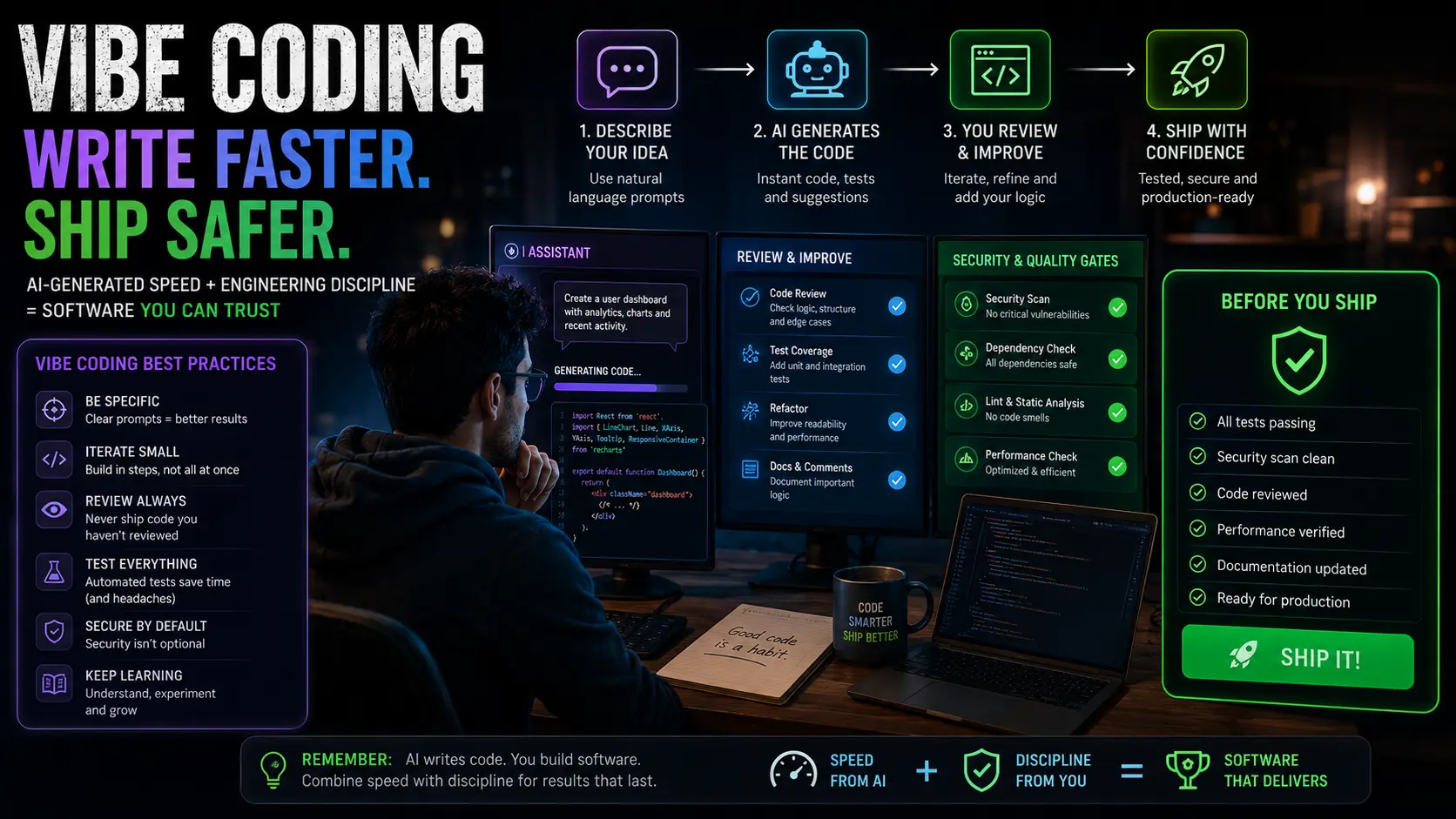
A practical middle path that’s working for a lot of teams: use vibe coding for the first draft of any feature, then treat that output as code under review rather than finished work. Set up test gates. Require security review before anything touches production. The AI speeds up the writing; the engineering process keeps it safe.
Prompt quality matters more than most people starting out realize. Vague descriptions produce vague code. Specific goals with examples, edge cases mentioned, and clear success criteria give the model enough context to produce something actually usable. Treat your prompts the way you’d treat a ticket given to a developer — the more thought you put in, the better the output.
Common Vibe Coding Mistakes That Come Back to Bite You
Shipping without review
This is the obvious one. 52% of developers don’t always review AI-generated code before committing. That’s not a workflow — that’s hope-driven development. Even a 15-minute review catches the most common failure patterns.
Treating speed as the only metric
At the task level, vibe coding is 3–5x faster. At the organizational level, teams only see about 10% improvement in overall delivery velocity — because the bottleneck was never code-writing. It was architecture, coordination, and quality assurance. Vibe coding doesn’t fix those.
Using it for security-critical components
Authentication, payment flows, encryption — these are not where you want to accept AI output without deep review. The failure patterns (hardcoded credentials, SQL injection exposure, broken auth logic) show up disproportionately in exactly these areas.
Building something you can’t debug
The indie developer story above is worth keeping in mind. He built a working SaaS, users signed up, and then ‘random things started happening.’ He couldn’t debug it because he didn’t write it. Vibe coding is fast until you need to fix something.
Frequently Asked Questions About Vibe Coding
Who invented vibe coding?
Andrej Karpathy coined the term in a post on X in February 2025. He was describing his own workflow — not making a prescriptive argument for how everyone should code. The phrase spread faster than the nuance behind it, which is probably why the debate became so heated.
Is vibe coding good for beginners?
It’s complicated. Vibe coding lowers the barrier to building something that works, which is genuinely useful for learning. The risk is building things you don’t understand, which makes debugging nearly impossible and can create bad mental models early on. For beginners, a better approach might be using AI to explain code as you go rather than accepting it blindly — get the speed benefit without skipping the understanding.
What are the best vibe coding tools in 2026?
Cursor and Claude Code are the two most adopted among professional developers — Cursor reached $2 billion ARR by February 2026, Claude Code processes 195 million lines of code weekly. For non-developers and rapid prototyping, Replit and Bolt.new are popular. Each tool has different strengths; the right choice depends on whether you’re a developer accelerating your workflow or a non-developer building from scratch.
Is vibe coding replacing traditional software engineering?
No, and the data actually suggests the opposite trend in some areas. As code gets cheaper to generate, engineering judgment — architecture decisions, security review, long-term system design — is becoming more valuable, not less. What vibe coding is replacing is the parts of development that were always about mechanical translation: turning a known solution into working syntax. The thinking parts remain human.
Can you vibe code a production app safely?
With the right governance, yes. Organizations that are doing this successfully treat AI-generated code as a starting point, require human review at production boundaries, and enforce test and security gates before deployment. Without that framework, the security and maintainability risks are real. The tools are fast enough that governance is now the bottleneck — not the code generation itself.
Where Vibe Coding Is Actually Heading
Karpathy, the person who named all of this, declared vibe coding ‘obsolete’ in February 2026 — exactly one year after coining the term. Not because it stopped working, but because the industry moved to something more structured: agentic engineering, where developers orchestrate AI agents rather than just describing intent and accepting output.
That evolution makes sense. Vibe coding was always a description of a moment in the workflow, not a complete methodology. The teams getting the most out of AI in 2026 aren’t the ones who picked a side in the debate. They’re the ones who figured out which parts of their work benefit from AI speed and which parts still need human judgment — and built their process around that distinction.
The debate will keep going. But the productive question was never ‘is vibe coding good or bad?’ It was always ‘for what?’