


The short answer
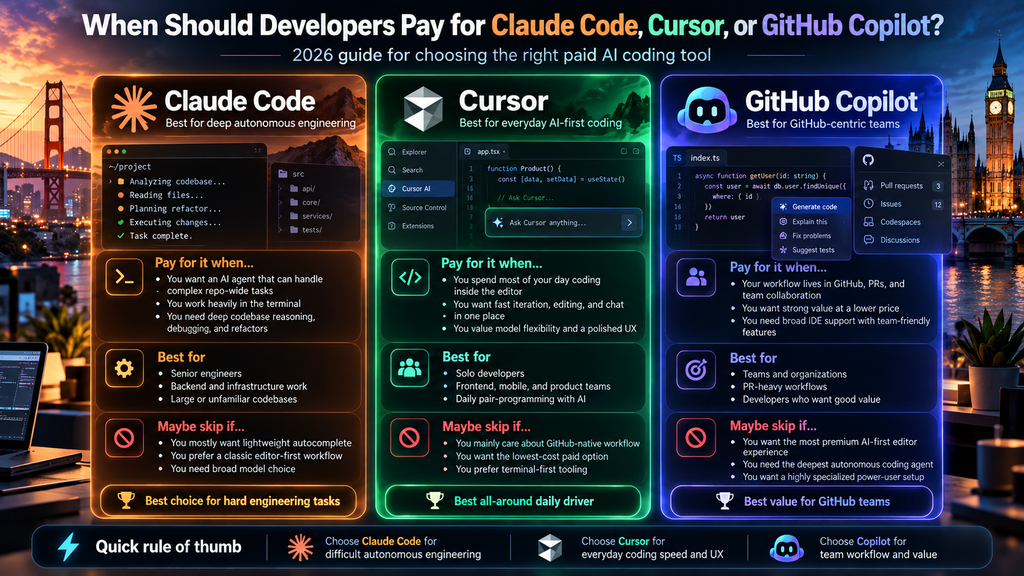
If you pay for one AI coding tool this year, make it Claude Code. Search demand in the US, UK, and Australia says so, and so does the Stack Overflow Developer Survey published on 6 October 2026. The useful part is the exceptions. Copilot is still the right bill when the company already runs on GitHub. Cursor is still the right bill when you want the editor itself to be the AI, and you are willing to leave VS Code or JetBrains for it.
Pay for Claude Code if the hard part of your week is a multi-file change in a repo you already have, and you are fine living in a terminal or a plugin. The Pro plan is $20 a month, or $17 a month if you pay $200 up front for the year. Claude Code is included on every paid Claude plan.
Pay for Cursor if you want Tab completions, a visual diff, and an agent inside one editor, and your team will actually switch editors. Pro is $20 a month. Cursor’s own help docs recommend Pro+ at $60 for daily agent use and Ultra at $200 for heavy agent use.
Pay for GitHub Copilot if people on the team use different editors, pull requests already live on GitHub, and finance wants a per-seat Microsoft bill. Pro is $10 a month. Business is $19 per user. Enterprise is $39 per user.
Do not buy the top tier of all three “to be safe.” That is how a solo developer ends up with a software bill that looks like a small team’s.
What 12,255 developers actually used
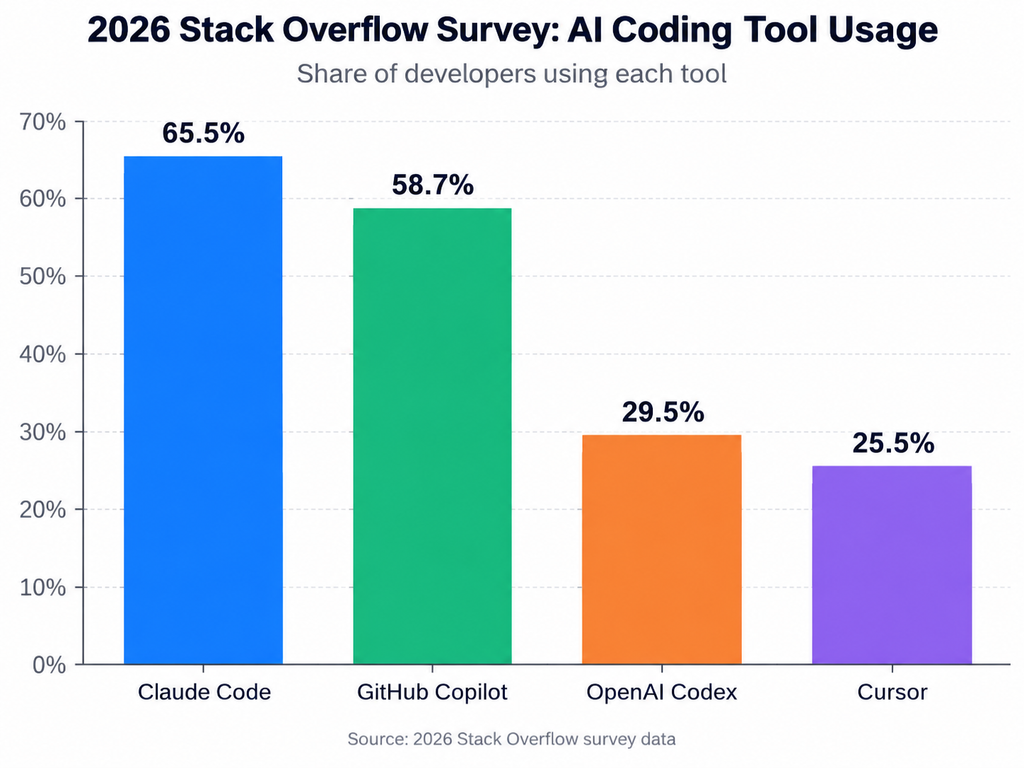
Stack Overflow asked people which coding agents or assistants they had used in the past year, and which they wanted in the next six months. The published “used” numbers, n = 12,255:
Claude Code, 8,030 people, 65.5%. GitHub Copilot, 7,196, 58.7%. OpenAI Codex, 3,620, 29.5%. Cursor, 3,127, 25.5%. Windsurf is much further down, at 6.5%.
Two readings matter more than the ranking.
People can tick more than one tool. Claude Code at 65.5% and Copilot at 58.7% means a lot of overlap, not a world where one product deleted the others. Treat this as “have used,” not “this is my only tool.”
Cursor’s 25.5% is still thousands of working developers. It is a normal professional product. It is not the tool most of this sample reached for first. If your timeline is full of Cursor screenshots, the survey is the correction.
The same survey says developers switch tools because the output got better (25.1%), or because the company told them to (10.6%). Only 6.4% switched to save money. Quality moves the subscription. Price mostly does not, until the invoice is embarrassing.
Google’s search data rhymes with that ranking. For the 90 days through early October 2026, “claude code” drew far more US, UK, and Australian web search interest than “github copilot” or “cursor ai.” Copilot held a steady second. Cursor tracked just under it. A related US query, “codex vs claude code,” showed up as a breakout, which is Google’s label for a search that grew from almost nothing.
These three are different shapes of tool
Claude Code is an agent. It reads the repo, edits files, and runs commands. Anthropic ships it in the terminal, in IDE plugins, on the desktop, and on the web. You do not have to throw away your editor. Your usage for Claude chat and Claude Code comes out of one pool, on a rolling five-hour window, with weekly caps on paid plans. There is no fixed “you get 80 messages” number. Long sessions on a big model simply spend the pool faster.
Cursor is the editor. It is its own app, built on a VS Code base, with agent, Tab, cloud agents, and MCP on the paid plans. The cost of choosing it is the switch. A JetBrains shop, or a Vim shop, feels that cost on day one. A VS Code shop often does not.
GitHub Copilot is the plugin and the GitHub layer. It runs in VS Code, Visual Studio, JetBrains, Neovim, Xcode, Eclipse, and on github.com. Paid plans keep code completions and next-edit suggestions outside the credit meter. Chat, agent mode, CLI, code review, and the cloud agent spend GitHub AI Credits. One credit is $0.01.
That last split is why a Copilot Pro subscription can feel cheap for a month and then feel tight the week you leave autocomplete and start assigning whole tickets to the agent.
What you actually pay in October 2026
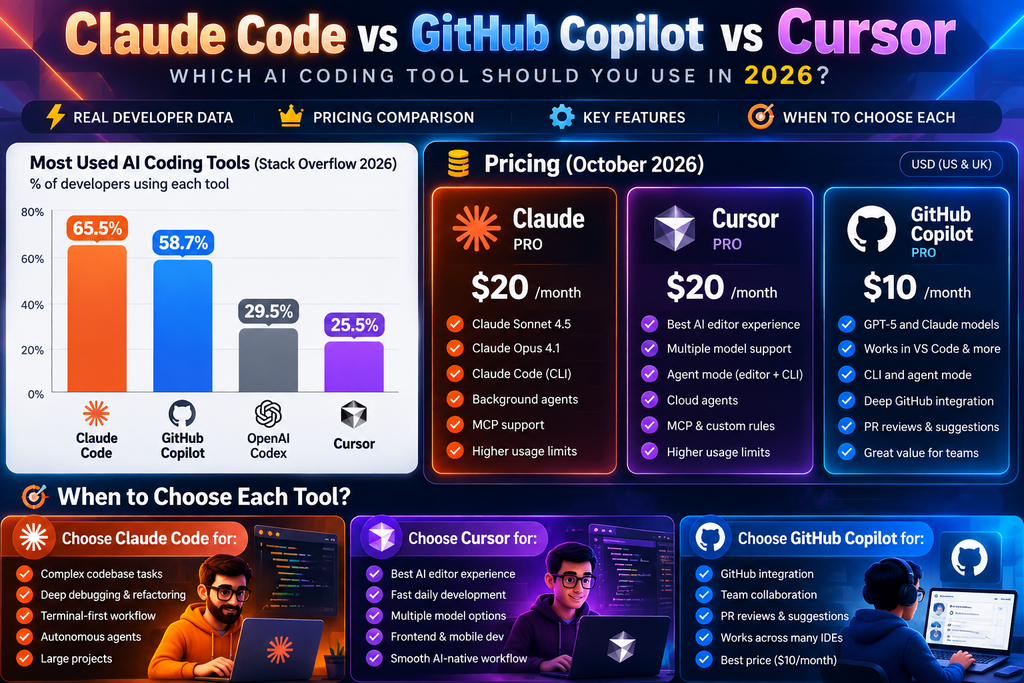
| Tool | Plan | Price | What you are buying |
| Claude | Pro | $20/mo, or $17/mo annual | Claude Code included. Shared limits with chat |
| Claude | Max | From $100/mo | 5x or 20x Pro usage. Higher output limits |
| Cursor | Hobby | $0 | Limited Agent, Composer access |
| Cursor | Pro | $20/mo | The normal individual plan |
| Cursor | Pro+ | $60/mo | Cursor’s recommendation for daily agent users |
| Cursor | Ultra | $200/mo | Cursor’s recommendation for agent power users |
| Cursor | Teams Standard | $40/user/mo | Shared billing, SSO, team privacy mode |
| Copilot | Free | $0 | 2,000 completions and 50 chats a month |
| Copilot | Pro | $10/mo | Base allowance of 1,000 AI credits, plus a flex amount GitHub can change |
| Copilot | Pro+ | $39/mo | Base 3,900 AI credits |
| Copilot | Max | $100/mo | Base 10,000 AI credits |
| Copilot | Business | $19/user/mo | 1,900 AI credits per user, admin controls |
| Copilot | Enterprise | $39/user/mo | 3,900 AI credits per user, earlier access to new models |
On paid Copilot plans, inline completions do not draw those credits down. Agent work does. Individual Copilot plans can also carry a flex allotment on top of the base, and GitHub says that flex number can change, so the docs’ base figure is the one to budget against.
Claude Max is the jump that surprises people. Pro is a fair trial. If Claude Code dies on you most afternoons, you are already a Max customer and have not admitted it. The way those limits reset is covered in why Claude Code stops.
Cursor’s tier choice is the same kind of problem. Pro is the right start. Pro+ and Ultra exist because daily frontier-model agent runs eat the included usage. The plan-by-plan version is in Cursor Pro vs Pro+ vs Ultra. A wider price map sits in what AI coding tools actually cost.
When Claude Code is the one to open
Use it for the task you would otherwise split across an afternoon: a migration, a bug that crosses six files, a test suite that fails in a way the diff does not explain. The agent can read, edit, run, and look at the failure. That loop is the product.
It is a poor fit if you want a suggestion every time you pause while typing, and you rarely hand over a whole task. Copilot’s completions are built for that rhythm. Claude Code will do small edits, then you will feel like you hired a carpenter to hang one picture.
Watch the session length. A thread that starts at 9 and is still going at 1 resends a huge history on every new instruction. You hit the cap sooner, and the answers get worse, because the thread is full of dead ends. Cut the thread when the task changes. That habit is the whole point of the workflow fix for long agent sessions.
Also notice what the survey says people trust. Only 6.6% will trust an AI on an important decision. About 48% trust it when they can check the answer easily. 78.7% say source attribution matters when they judge an AI answer. Claude Code fits that mood if you actually read the diff and run the tests. If you accept the edit because the summary sounded confident, the tool is no longer the thing that failed.
When Cursor is worth leaving your editor
Cursor earns the switch when the day’s work is a stream of medium changes and you want them as reviewable diffs, in the same window as the file tree. Cloud agents, MCP, and team privacy mode matter once more than one person is on the account. Teams Standard at $40 a user is the point where an admin can turn privacy mode on for everyone, which Cursor says means code is not used for training by Cursor or the model providers.
Skip the switch if half the team is on JetBrains and happy, or if your “AI problem” is really autocomplete inside a monorepo you already understand. Moving eight people to a new editor to get a sidebar is a bad trade. Copilot already sits in the IDE they have.
One more filter. If you are mostly generating app UI you do not plan to maintain, you are shopping in a different aisle than Cursor. Cursor assumes you can read what it wrote.
When GitHub Copilot is still the grown-up choice
Copilot wins in companies, and it wins for a dull reason. The repo host, the PR, the CI, and the assistant are the same vendor. Business at $19 and Enterprise at $39 are prices a procurement team already knows how to approve. Enterprise needs GitHub Enterprise Cloud. You get a credit pool, model choice across more than one lab, and policy controls.
It is also the cheapest honest start for a person. Ten dollars, completions that do not eat the meter, and enough credits to learn agent mode without pretending you will live there. Students and some open-source maintainers can get Pro free. Check that before you pay.
The limit shows up when you want one lab’s model and a long unattended run. Copilot will offer Claude and GPT models, then charge them as credits. A long frontier-model agent session is a different product from ghost text. If that is your whole job, Claude Code or Cursor will feel more direct, and Copilot becomes the thing you keep for PRs and for the days your other pool is empty.
In Australia, a fast-rising search is whether GitHub Copilot and Microsoft Copilot are the same thing. They are not. GitHub Copilot is the developer product in the editor and on GitHub. Microsoft Copilot is the assistant in Windows and Microsoft 365. Same family name. Different subscription. Buying one does not turn the other on.
Codex is the fourth name, and people are searching it
Codex at 29.5% beat Cursor in this survey. In the US, “codex vs claude code” is a breakout related query on Google Trends. If you already pay for ChatGPT, run Codex on one real ticket before you add a second $20 or $60 plan. If the ticket comes back in a shape you would merge, you may not need Cursor at all.
If you do not already pay OpenAI, do not collect Codex as a fourth subscription out of curiosity. The survey’s future-intent numbers lean Anthropic: 49% want to use Anthropic models over the coming year, against 32% for OpenAI. Agent intent splits the same way, 45% to 32%. Interest is not a coupon. It does say the traffic is not only habit.
The combination that wastes the least
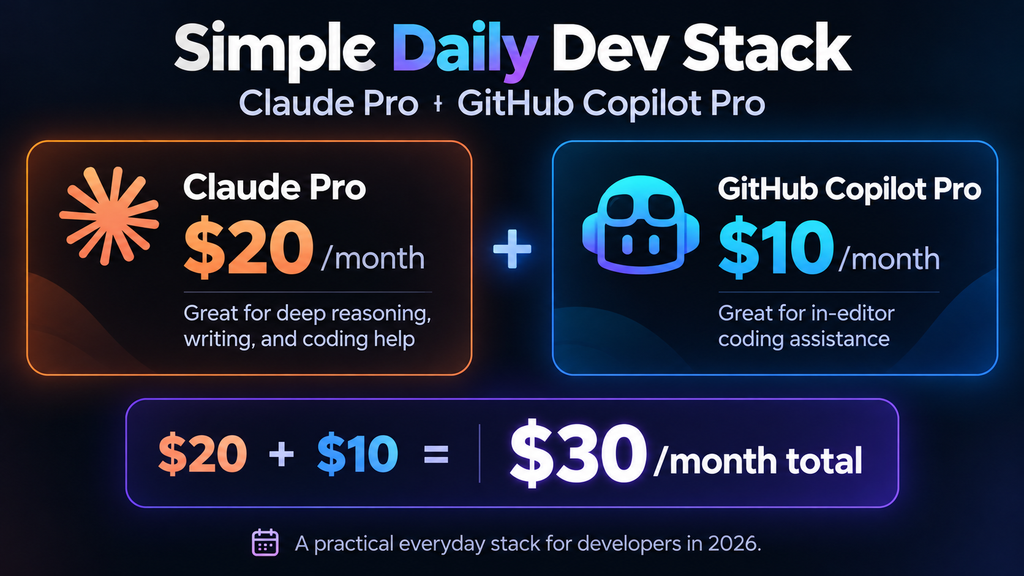
A practical pair, for someone shipping most days, is Claude Pro plus Copilot Pro. Thirty dollars. Claude Code for the long job. Copilot for completions and for the hours when Claude’s window is used up. The two meters are separate, so one outage or one cap does not end the day.
Add Cursor only after a week in which you missed the visual diff enough to say so out loud. Start on Pro, not Ultra.
For a company, standardize on Copilot Business unless the engineers have already voted with their keyboards. A mandated tool that 10.6% of switchers only use because the org required it will get installed and ignored. If the team’s real work has moved to Claude Code, pay for Claude’s Team or Enterprise plan and keep Copilot for the people who live in pull requests. Write the choice down. Only 24% of developers in this survey said their company publishes an approved-tool list or an AI policy. The other gap is skill. 17.1% avoid AI at work because they are afraid of losing the skill or training a replacement. That fear is reasonable, and it is also a way to stop learning the tools your teammates are already using. There is a separate piece on what skill atrophy looks like and how to stop it.
Questions people ask before they subscribe
Is Claude Code better than Cursor?
For a long task in a repo you already work in, Claude Code is the better default in 2026, and both the survey and search demand agree. Cursor is better when the editor session itself is the product you want, and your team will move to it. They solve different hours of the same day.
Is GitHub Copilot still worth paying for?
Yes, at $10 for an individual who wants completions in the editor they already use, and at $19 per user when the company is already on GitHub and needs admin controls. It is a weak buy if you are about to spend $100 on Copilot Max and you really wanted a terminal agent. That person should price Claude Max first.
Can you use Claude Code and Cursor together?
Yes. A lot of the survey overlap is exactly that. The waste is paying Ultra and Max in the same month before you know which one you open at 9am.
Which is the cheapest tool that can do real work?
Copilot Pro at $10, if completions and light chat are enough. Claude Pro at $20, if you want a real agent and you can live with the shared cap. Cursor Pro at $20, if you want the AI-native editor and your usage stays inside the included pool.
Does this survey mean Cursor is finished?
No. 3,127 respondents used it in the past year. It means Cursor is a choice, not the water supply. Buy it because the editor fits the way you review diffs. Do not buy it because a screenshot made it look like the only serious option.
If you have switched in the last six months, the useful comment is the ticket that made you switch, not the logo. Output quality is the reason a quarter of this sample moved. A specific before-and-after helps the next person more than another tier list.